View methods side by side.
Choose up to four methods. Add them using the search and share the comparison by copying its link.
| Criterion |  Decision Making Risk Matrix | 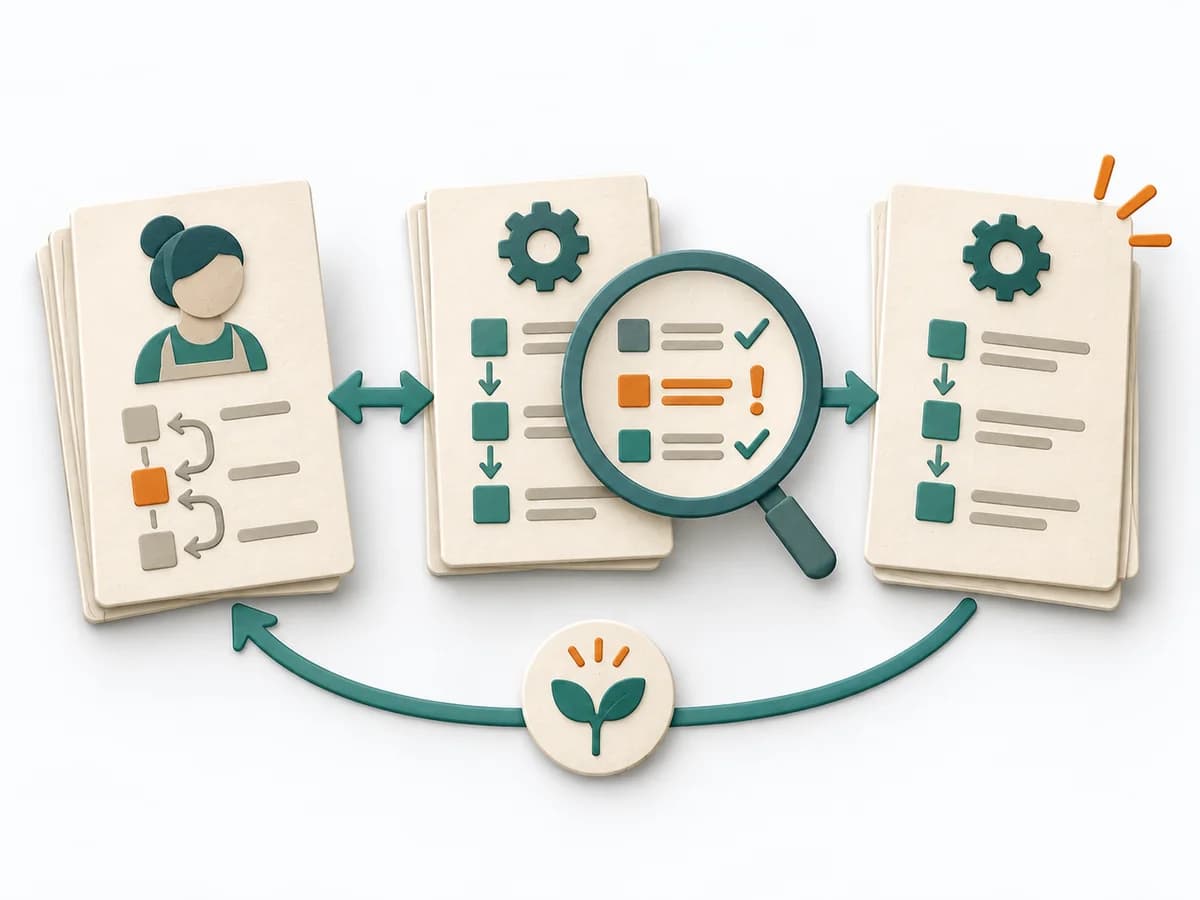 Operations Standard Work Analysis |  Agile WSJF |  Decision Making Assumption Surfacing |
|---|---|---|---|---|
Purposedifferent | When a project faces many possible disruptions, it quickly becomes unclear which risks deserve attention first. It separates options, evaluation criteria, and open risks. The result is captured as a Risk Matrix and a Top Risk List. | When the same task is done differently depending on the person, the method exposes the reliable core. It creates comparability without unnecessarily choking off needed latitude. | When many tasks compete for the same capacity, it orders work by economic impact. It makes time lost, benefit, and effort comparable together. | Plans often contain assumptions that were never openly stated and remain dangerous precisely because of that. Assumption Surfacing makes these silent premises visible and prioritizes which of them carry the initiative or could sink it. |
Complexitydifferent | Low | Medium | High | Low |
Timedifferent | 30-60 min | 1-3 h | 45-90 min | 45-90 min |
Participantsdifferent | 3-10 | 2-6 | 3-10 | 2-8 |
Formatdifferent | Workshop + async | Workshop | Workshop | Workshop + async |
Outputdifferent | Risk Matrix, Top Risk List | Standard Work Sheet, Deviation List, Improved Standard, Training Needs | Ranked Backlog, Cost-of-Delay Assumptions | Assumption List, Critical Assumptions, Learning Plan |
Tagsno overlap | RiskDecisionPrioritizationAssessment | LeanProcessQuality | LeanEconomicsSequencePrioritization | AssumptionsRiskDecisionDiscovery |