View methods side by side.
Choose up to four methods. Add them using the search and share the comparison by copying its link.
Selected:Request for CommentsSailboat RetrospectiveStarfish RetrospectiveArchitecture Decision Record
| Criterion |  Architecture Request for Comments | 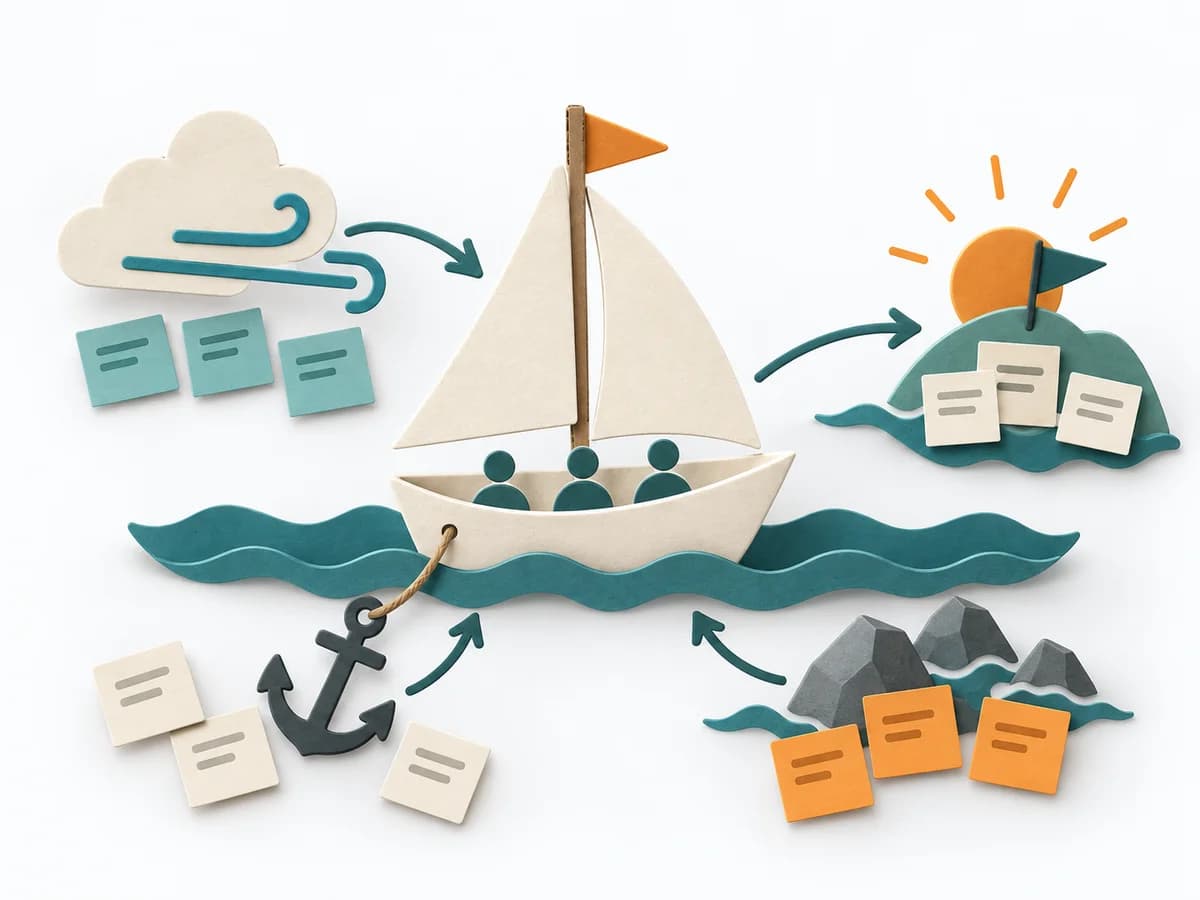 Agile Sailboat Retrospective |  Agile Starfish Retrospective |  Architecture Architecture Decision Record |
|---|---|---|---|---|
Purposedifferent | An RFC clarifies architecture context, options, and consequences. It structures technical context, alternatives, tradeoffs, open questions, and review feedback, and captures the result as an RFC document, reviewer comments, and a decision rationale. | When a team wants to read momentum, brakes, and risks together, it offers an easily understandable picture of the situation. It makes drive, obstacles, and headwind visible in the same picture. | When improvement options need to be sorted more finely than just start and stop, it brings observations into clear kinds of action. This makes visible what should be done more, less, newly, or continued. | An ADR permanently records an architecture decision with context, trade-offs, and consequence. It creates continuity for later changes because the decision path stays traceable. |
Complexitydifferent | Medium | Low | Low | Low |
Timedifferent | 1-3 Wochen vom Draft bis zur Entscheidung | 45-90 min | 45-90 min | 15-45 min |
Participantsdifferent | 3-20 Reviewer | 4-12 | 4-12 | 1-3 |
Formatdifferent | Async | Workshop | Workshop | Async |
Outputdifferent | RFC document, Reviewer comments, Decision rationale, Follow-up ADR or tickets | Sailboat Board, Risks, Improvement Actions | Starfish Board, Practice Changes, Experiments | ADR File, Decision Log, Rationale |
Tagsno overlap | ArchitectureDecisionAsyncGovernance | RetrospectiveTeamImprovement | RetrospectiveImprovementExperimentsTeam | ArchitectureRationaleDocumentationGovernance |