View methods side by side.
Choose up to four methods. Add them using the search and share the comparison by copying its link.
Selected:Request for CommentsDecision JamARID (Active Reviews for Intermediate Designs)Consensus Workshop
| Criterion | 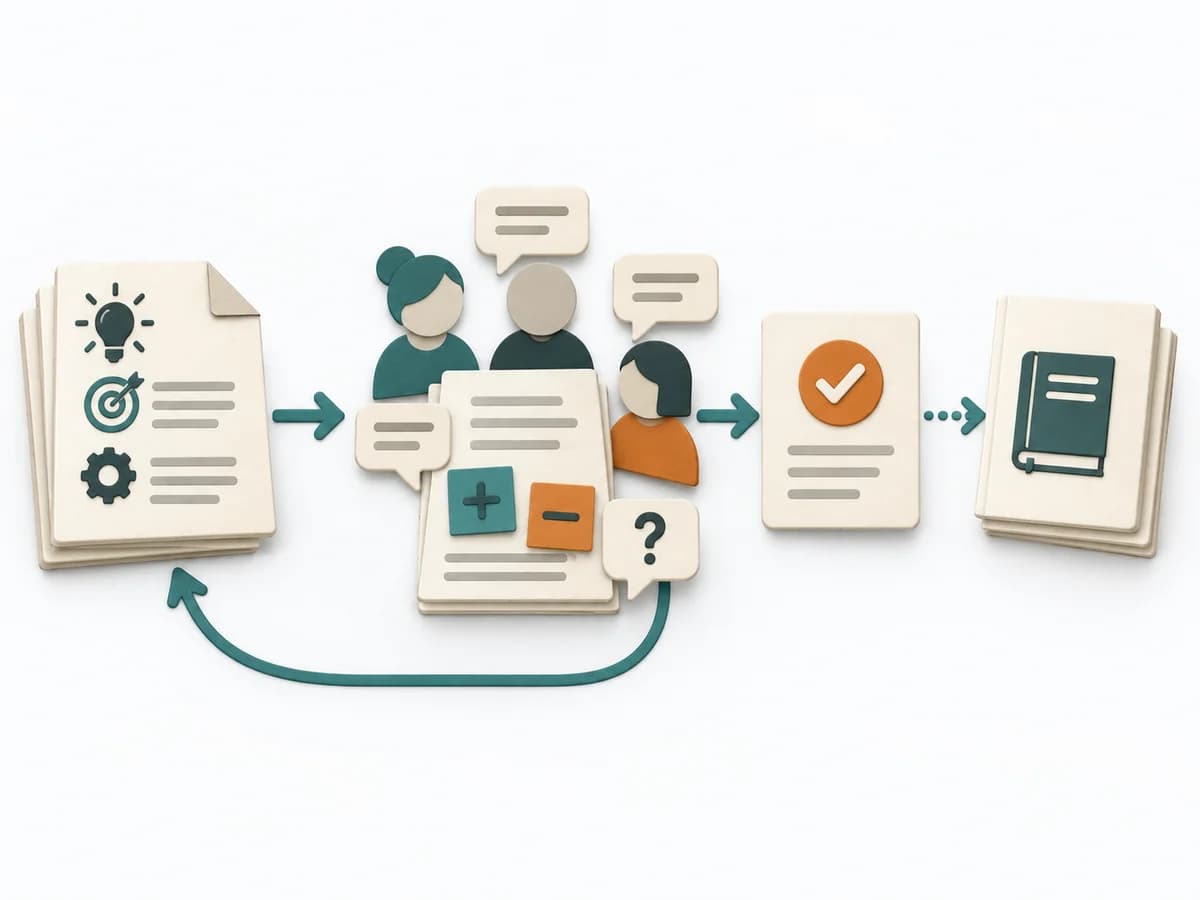 Architecture Request for Comments |  Facilitation Decision Jam |  Architecture ARID (Active Reviews for Intermediate Designs) |  Facilitation Consensus Workshop |
|---|---|---|---|---|
Purposedifferent | An RFC clarifies architecture context, options, and consequences. It structures technical context, alternatives, tradeoffs, open questions, and review feedback, and captures the result as an RFC document, reviewer comments, and a decision rationale. | When a decision is stuck, Decision Jam loosens the knot through structured separation of problem, idea, and selection. The format creates movement without jumping prematurely at the first seemingly elegant answer. | ARID examines how well developers can work with a technical design. It focuses on a part of the system that can still be revised, between the architecture overview and the detailed specification. | When a group needs a solid decision without outvoting individual factions, a Consensus Workshop creates a negotiable common ground. It makes agreement, reservations, and open tensions discussable at the same time. |
Complexitydifferent | Medium | Low | Medium | Medium |
Timedifferent | 1-3 Wochen vom Draft bis zur Entscheidung | 60-90 min | 2–4 h review as a planning range; preparation and evaluation additional | 1-3 h |
Participantsdifferent | 3-20 Reviewer | 4-10 | Designers, developers as users, and facilitation | 5-30 |
Formatdifferent | Async | Workshop | Workshop + async | Workshop |
Outputdifferent | RFC document, Reviewer comments, Decision rationale, Follow-up ADR or tickets | Problem Cluster, Prioritized Challenge, Experiment | Prioritized development tasks, Jointly produced code or pseudocode, Observed difficulties and open design questions, Proposed design revisions | Consensus Clusters, Theme Titles, Priority Areas |
Tagsno overlap | ArchitectureDecisionAsyncGovernance | FacilitationDecisionProblem solvingWorkshop | ArchitectureEngineeringFeedbackValidationTasks | FacilitationConsensusWorkshopAlignment |