View methods side by side.
Choose up to four methods. Add them using the search and share the comparison by copying its link.
| Criterion |  Product Strategy Product Canvas |  Business Strategy GAP Analysis | 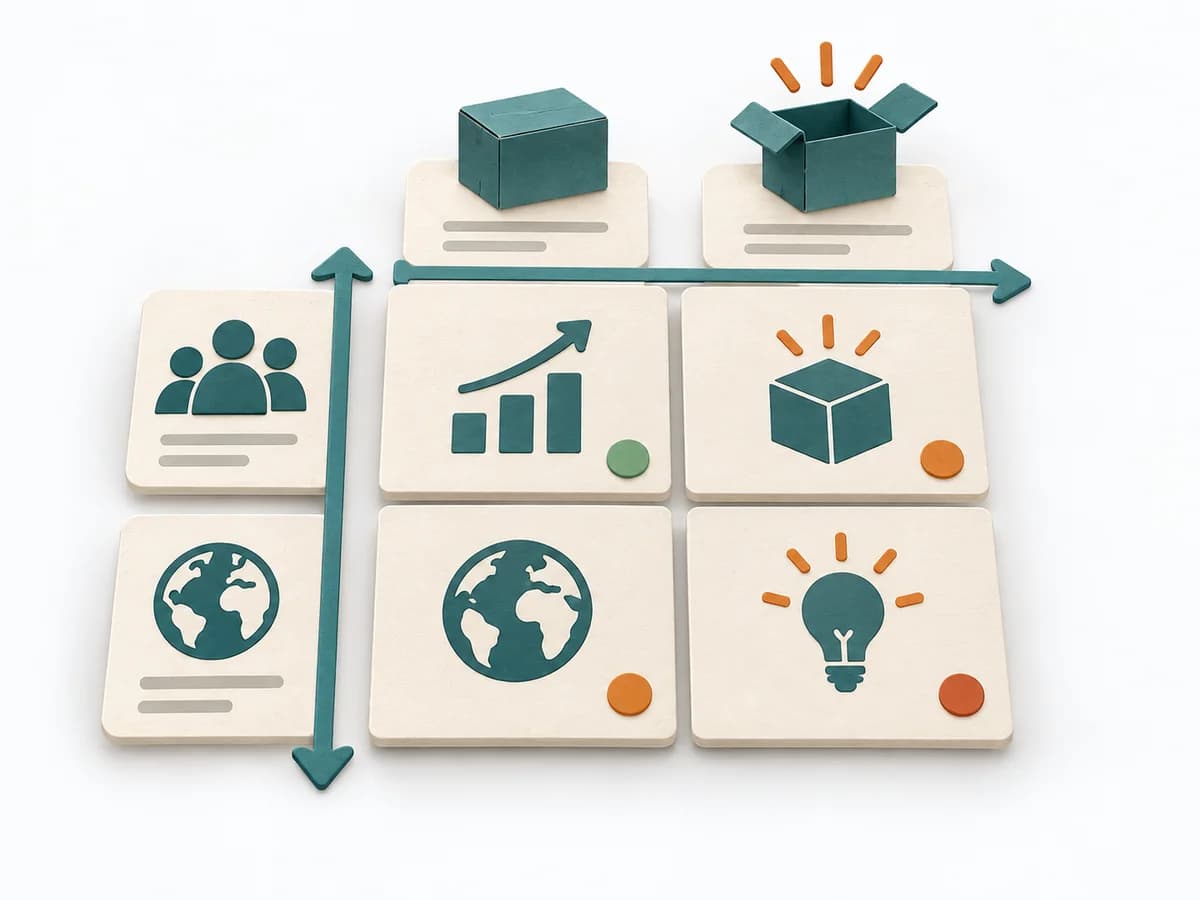 Business Strategy Ansoff Matrix |  UX Design Lean UX Canvas |
|---|---|---|---|---|
Purposedifferent | When product goal and feature scope don't yet fit cleanly together, it creates a shared working picture. It connects need, core features, and assumptions into a solid starting point. | GAP Analysis compares the current state with a target picture and makes the distance manageable. It becomes useful when, ahead of new initiatives, it must become clear which capabilities, processes, or resources are missing. | The Ansoff Matrix organizes growth options by market and product relation. It helps weigh expansion, diversification, and adaptation cleanly against each other. | The Lean UX Canvas helps clarify user behavior, touchpoints, and concept decisions. It makes assumptions and desired outcomes visible and captures the result as a completed canvas, hypothesis list, and first experiment. |
Complexitydifferent | Medium | Medium | Low | Medium |
Timedifferent | 1-2 h | 1-3 h | 45-90 min | 2-3 h |
Participantsdifferent | 2-8 | 2-8 | 2-8 | 3-8 |
Formatsame | Workshop + async | Workshop + async | Workshop + async | Workshop + async |
Outputdifferent | Product Canvas, Product Assumptions, Scope Notes | Gap Matrix, Action Plan, Risk Notes | Ansoff Matrix, Growth Options, Risk Notes | Completed Lean UX Canvas, Hypothesis list, First experiment |
Tagsno overlap | CanvasDiscoveryScope | StrategyAnalysisPlanning | GrowthStrategyMarketPortfolio | CanvasHypothesisOutcomesDiscovery |