View methods side by side.
Choose up to four methods. Add them using the search and share the comparison by copying its link.
| Criterion |  Decision Making Pre-Mortem |  UX Research Card Sorting | 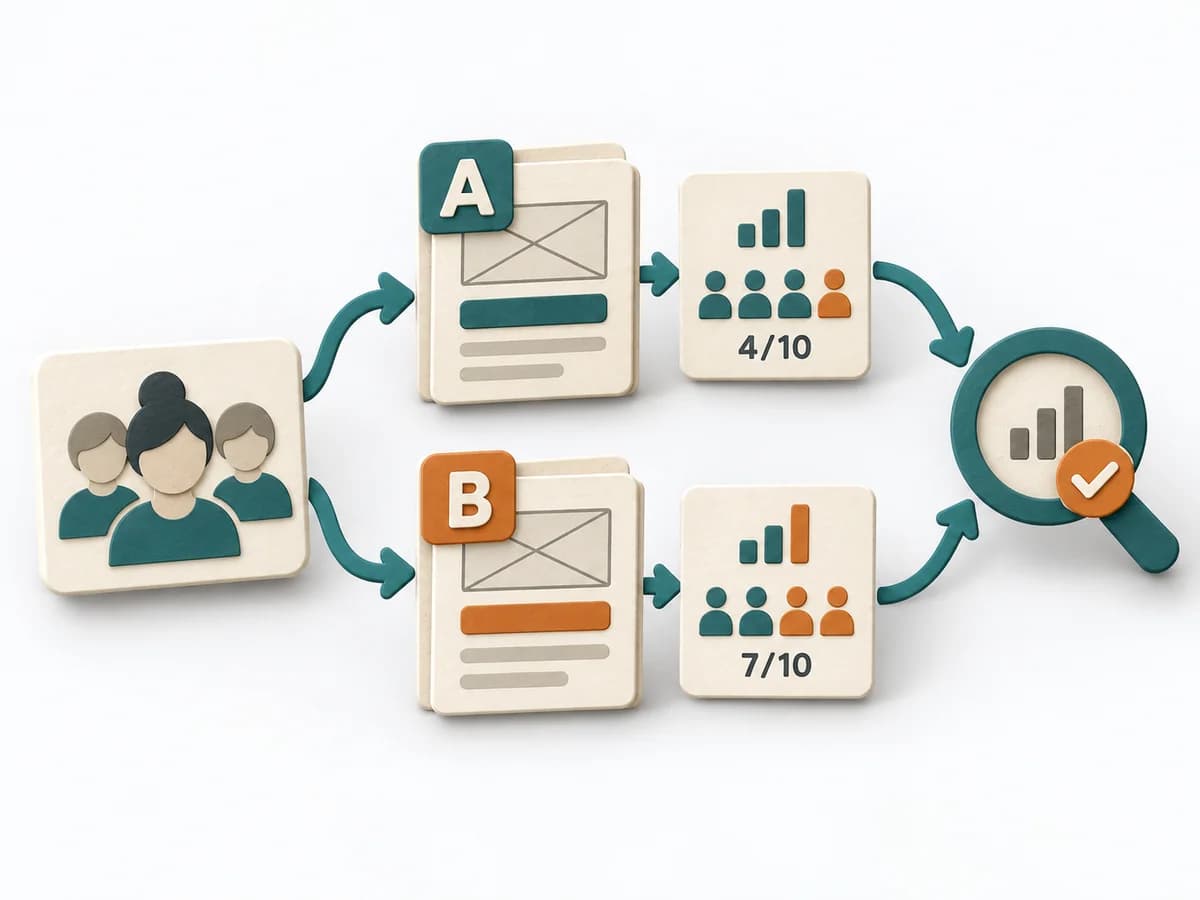 Growth A/B Testing |  Decision Making Constraint Analysis |
|---|---|---|---|---|
Purposedifferent | In early initiatives with many uncertainties, planning quickly turns too optimistic. A pre-mortem makes the expected failure visible in advance and sharpens the view of causes, gaps, and countermeasures. | When content only makes sense internally and users can't find the structure again, card sorting exposes their mental order. Terms, groups, and naming are then aligned with the target group's expectations. | When two variants compete, discussions quickly decide by taste rather than effect. A/B Testing checks behavior under controlled conditions and separates real improvement from chance or expectation effects. | When an initiative stalls, the limit often lies not in the idea but in hard or soft boundary conditions. Constraint Analysis separates these limits and shows which of them can actually be shaped. |
Complexitydifferent | Low | Low | High | Low |
Timedifferent | 20–45 min | 20-45 min | 1-4 Wochen | 30-90 min |
Participantsdifferent | Small cross-functional group | Based on research question | 1-6 | 2-8 |
Formatdifferent | Workshop | Workshop + async | Async | Workshop + async |
Outputdifferent | Risk list, Mitigation plan, Assumption log | Content groups, Label set, IA hypotheses | Experiment results, Decision log, Learning summary | Constraint List, Hard/Soft Classification, Option Impact Notes, Decision Boundaries |
Tagsno overlap | RiskDecisionFailurePlanning | Information architectureNavigationStructure | ExperimentsGrowthAnalyticsValidation | ConstraintsDecisionPlanningOptions |