View methods side by side.
Choose up to four methods. Add them using the search and share the comparison by copying its link.
| Criterion | 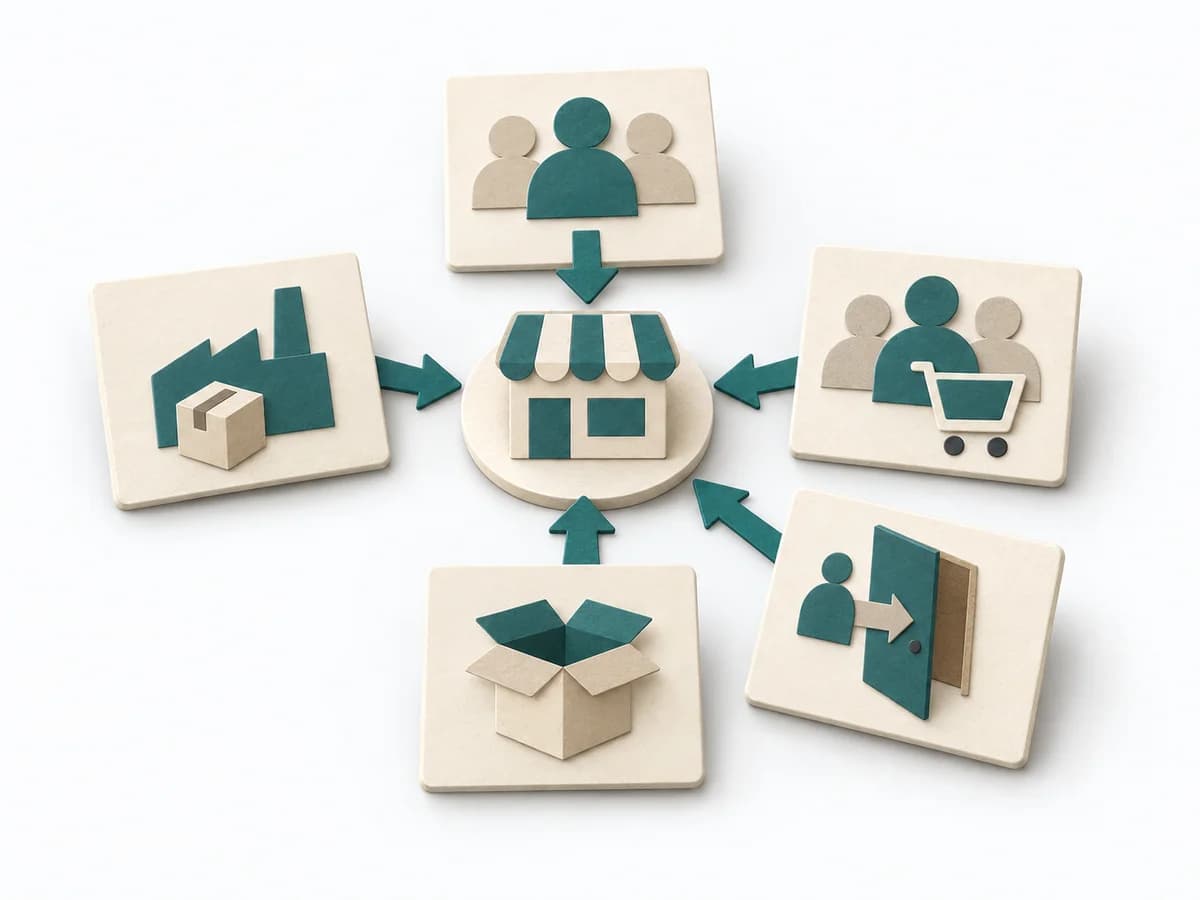 Business Strategy Porter Five Forces |  UX Design Lean UX Canvas |  Decision Making Delphi Method |  Product Discovery Experiment Canvas |
|---|---|---|---|---|
Purposedifferent | Porter Five Forces analyzes the forces that shape competitive pressure and profitability in a market. The view of market structure goes beyond individual competitors and reveals systemic pressure points. | The Lean UX Canvas helps clarify user behavior, touchpoints, and concept decisions. It makes assumptions and desired outcomes visible and captures the result as a completed canvas, hypothesis list, and first experiment. | When knowledge is distributed and direct dominance should be avoided, groups quickly fall under the sway of their opinion leaders. The Delphi Method gathers assessments iteratively and gradually brings expert judgments closer together. | When experiments become unreadable after the fact, it arranges hypothesis, signal, and learning goal on a single canvas. It separates problem, assumption, solution, and evidence. The result is captured as a Completed Experiment Canvas and a Success Metric. |
Complexitydifferent | Medium | Medium | High | Low |
Timedifferent | 1-3 h | 2-3 h | 1-4 Wochen | 30-60 min |
Participantsdifferent | 2-8 | 3-8 | 6-30 Experten | 1-5 |
Formatdifferent | Workshop + async | Workshop + async | Async | Workshop + async |
Outputdifferent | Five Forces Analysis, Competitive Risks, Strategic Options | Completed Lean UX Canvas, Hypothesis list, First experiment | Expert Forecast, Consensus Range, Assumption Notes | Completed Experiment Canvas, Success Metric |
Tagsno overlap | StrategyCompetitionMarket | CanvasHypothesisOutcomesDiscovery | ForecastingExpertsDecisionStrategy | ExperimentsValidationDiscoveryHypothesis |