View methods side by side.
Choose up to four methods. Add them using the search and share the comparison by copying its link.
| Criterion |  Business Strategy Porter Five Forces |  Product Strategy Lean Canvas |  Business Strategy PESTLE Analysis | 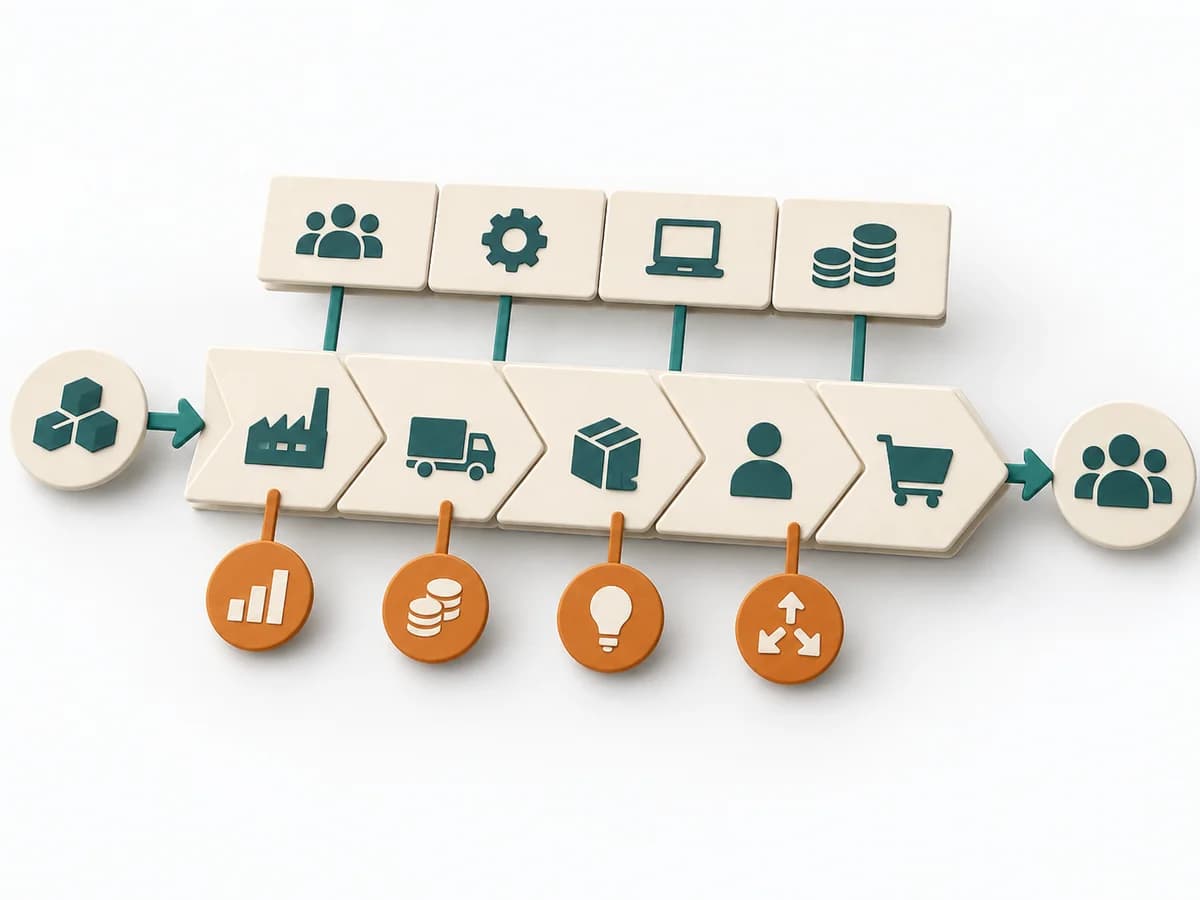 Business Strategy Value Chain Analysis |
|---|---|---|---|---|
Purposedifferent | Porter Five Forces analyzes the forces that shape competitive pressure and profitability in a market. The view of market structure goes beyond individual competitors and reveals systemic pressure points. | When an early product bet still has too many open points, it brings target group, problem, and assumptions into a single view. It condenses the idea so core risks become nameable. | PESTLE Analysis makes political, economic, social, technological, legal, and environmental influences visible. The environment of an initiative is thereby read systematically instead of through isolated trends. | Value Chain Analysis shows where value is created, costs accrue, and differentiation becomes possible along the process. It compares strengths, risks, market logic, and courses of action. The result is captured as a value-chain map and lever list. |
Complexitydifferent | Medium | Medium | Medium | High |
Timedifferent | 1-3 h | 45-90 min | 1-3 h | Half day |
Participantsdifferent | 2-8 | 1-6 | 2-10 | 3-8 |
Formatdifferent | Workshop + async | Workshop + async | Workshop + async | Workshop |
Outputdifferent | Five Forces Analysis, Competitive Risks, Strategic Options | Lean Canvas, Core Assumptions, Experiment Backlog | PESTLE Map, External Risks, Strategic Questions | Value Chain Map, Lever List |
Tagsno overlap | StrategyCompetitionMarket | StartupLeanAssumptionsBusiness model | StrategyMarketAnalysis | StrategyBusiness modelDiagnosisAnalysis |