View methods side by side.
Choose up to four methods. Add them using the search and share the comparison by copying its link.
| Criterion | 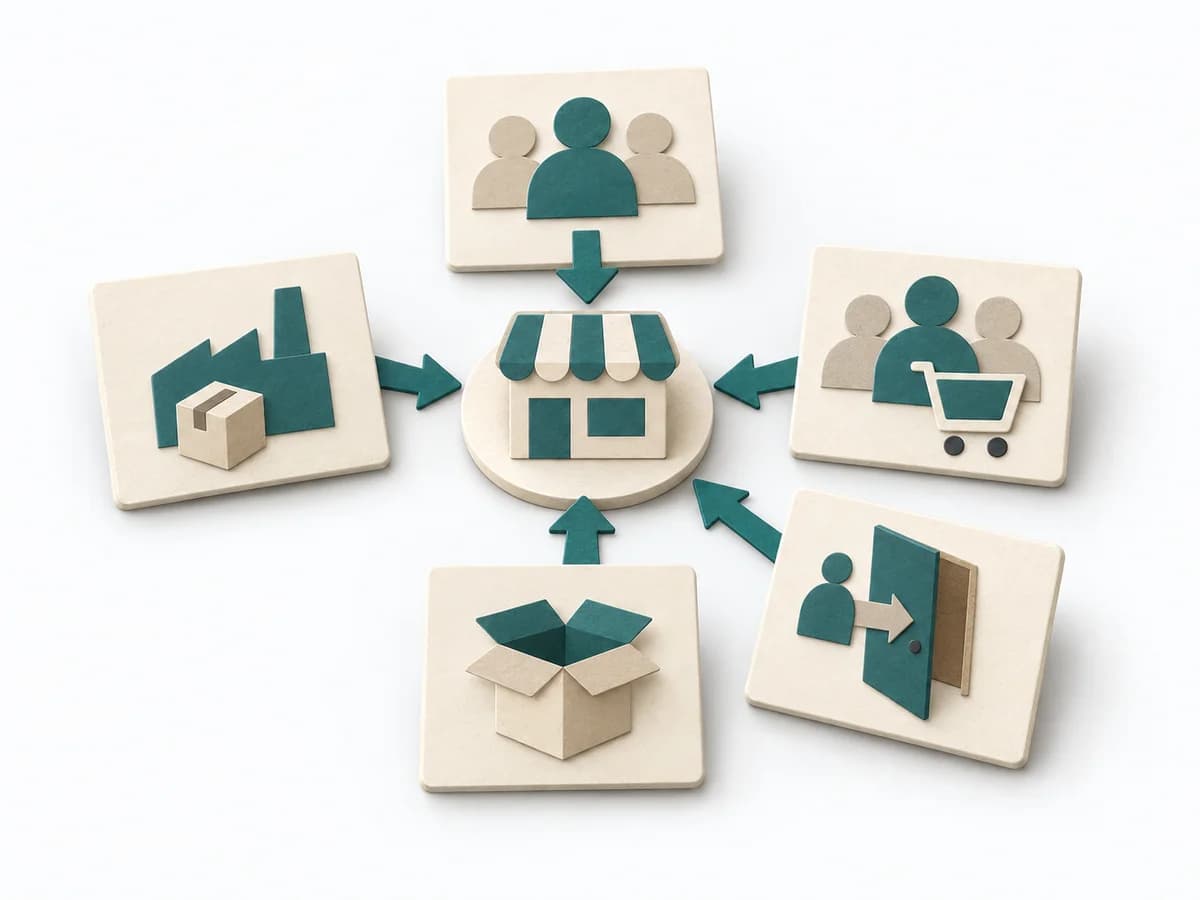 Business Strategy Porter Five Forces |  Product Strategy Impact Mapping |  Growth Funnel Analysis |  Growth Flywheel |
|---|---|---|---|---|
Purposedifferent | Porter Five Forces analyzes the forces that shape competitive pressure and profitability in a market. The view of market structure goes beyond individual competitors and reveals systemic pressure points. | When a goal needs to be connected to several possible paths, it shows chains of impact instead of feature lists. It connects business goal, behavior change, and measures. | When many visitors or users drop off along the way, the reason behind the number often stays hidden. Funnel Analysis exposes these transitions and makes visible exactly where the path collapses. | Growth often breaks down where a reinforcing mechanism builds up too much friction. A Flywheel shows the cycle of value, repetition, and reinforcement meant to sustain growth. |
Complexitysame | Medium | Medium | Medium | Medium |
Timedifferent | 1-3 h | 45-90 min | 1-3 h | 60-120 min |
Participantsdifferent | 2-8 | 3-8 | 1-5 | 3-8 |
Formatdifferent | Workshop + async | Workshop | Async | Workshop |
Outputdifferent | Five Forces Analysis, Competitive Risks, Strategic Options | Impact Map, Outcome Hypotheses, Delivery Options | Funnel report, Drop-off analysis, Optimization hypotheses | Flywheel Map, Friction Points, Growth Levers, Experiment Backlog |
Tagsno overlap | StrategyCompetitionMarket | OutcomesStrategyBehaviorPlanning | AnalyticsConversionGrowth | GrowthRetentionConversion |