View methods side by side.
Choose up to four methods. Add them using the search and share the comparison by copying its link.
| Criterion |  Systems Thinking Polarity Mapping |  Agile ROAM Board | 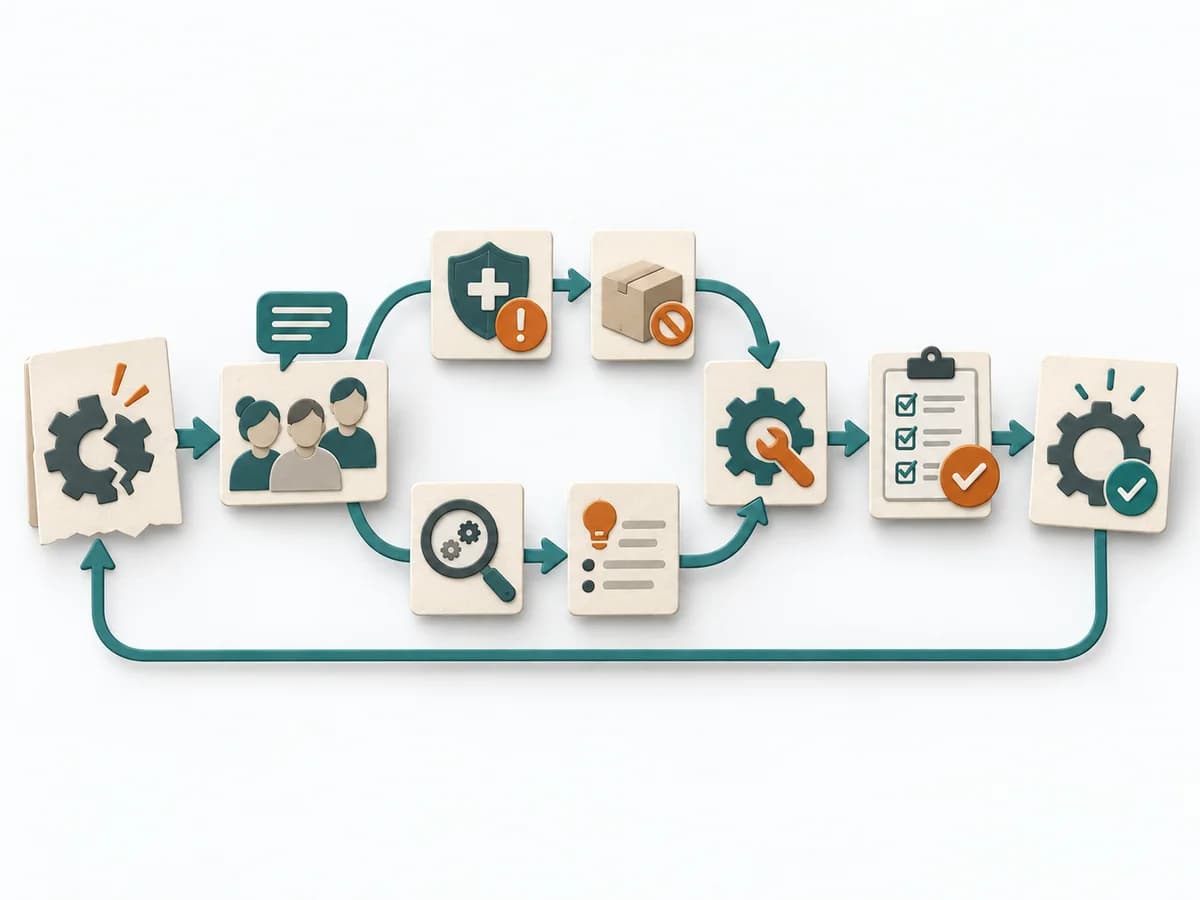 Operations 8D Problem Solving |  Operations Failure Mode and Effects Analysis |
|---|---|---|---|---|
Purposedifferent | Polarity Mapping makes tensions between two opposing poles tangible, such as standardization and adaptation or control and autonomy. The method guards against making apparent either-or decisions prematurely. | When work needs to move between different states or columns, it makes that movement and its handoffs legible. It sorts work by value, risk, and delivery ability. The result is captured as a ROAM Board and an Owner List. | For an acute quality or delivery problem, the method structures immediate protection and root cause work together. It keeps the situation stable while the actual cause is investigated cleanly. | For a process, product, or service with noticeable failure risks, the method assesses possible failure modes in advance. It directs attention to combinations of occurrence, effect, and detectability. |
Complexitydifferent | Medium | Low | High | High |
Timedifferent | 1-2 h | 20-40 min initial, dann laufend | 1-6 Wochen | 2-6 h |
Participantsdifferent | 3-12 | 3-15 | 4-10 | 3-10 |
Formatdifferent | Workshop | Workshop + async | Workshop + async | Workshop |
Outputdifferent | Polarity Map, Warning Signs, Balance Actions | ROAM Board, Owner List | 8D Report, Containment Plan, Root Cause Evidence, Corrective Action Plan | FMEA Table, Risk Priority, Mitigation Actions |
Tagsno overlap | Systems thinkingTradeoffsLeadership | RiskAgileTrackingAlignment | QualityProblem solvingRoot cause | RiskQualityOperationsRoot cause |