View methods side by side.
Choose up to four methods. Add them using the search and share the comparison by copying its link.
| Criterion |  Systems Thinking Polarity Mapping |  Knowledge Modeling Peer Instruction |  Product Discovery Product Kata | 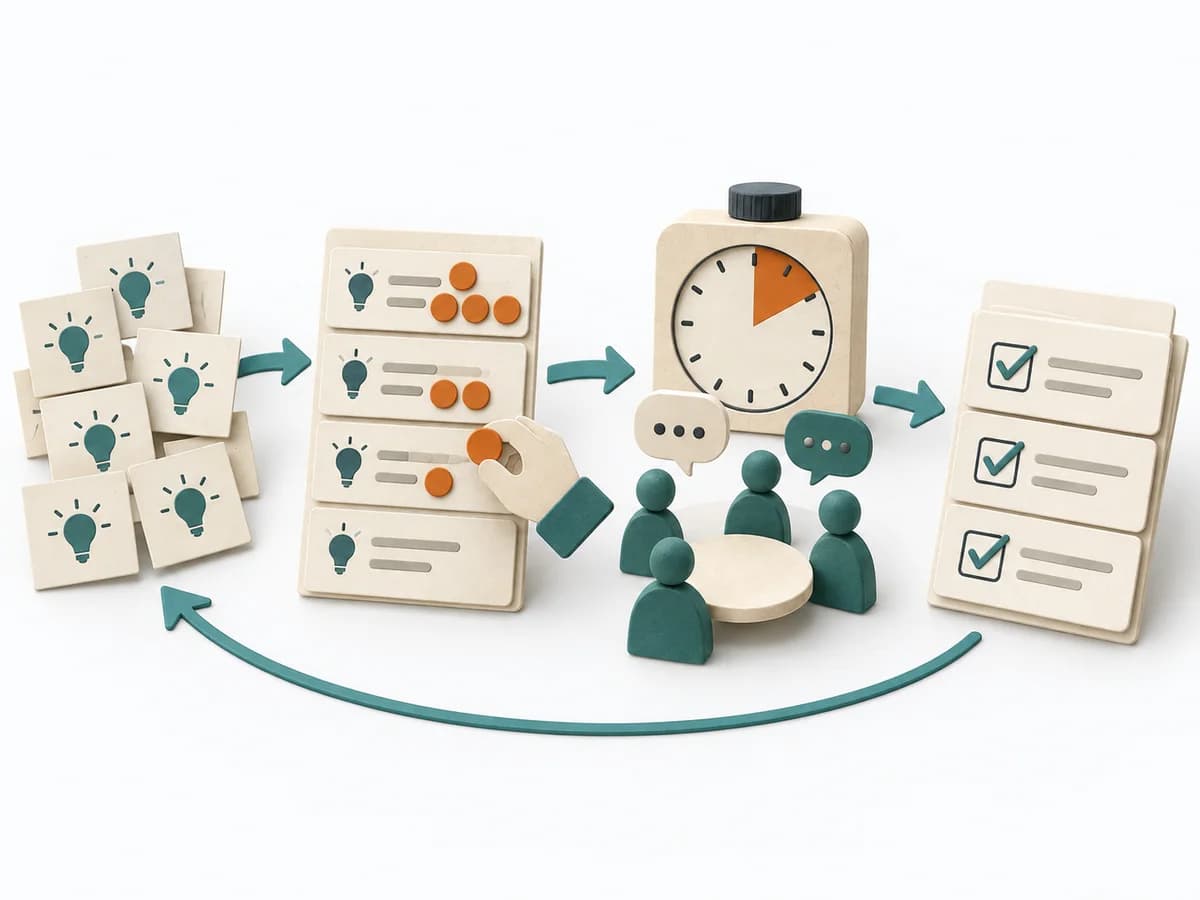 Facilitation Lean Coffee |
|---|---|---|---|---|
Purposedifferent | Polarity Mapping makes tensions between two opposing poles tangible, such as standardization and adaptation or control and autonomy. The method guards against making apparent either-or decisions prematurely. | Peer Instruction uses group thinking to clarify difficult terms or concepts faster. The method combines individual reflection with social correction and shared precision. | Product Kata helps clarify customer problems, solution ideas, and evidence through a repeatable improvement routine. It captures direction, current metric, target metric, experiment notes, and learning. | When a group without a fixed agenda needs to get into useful conversations quickly, Lean Coffee structures the start around interests rather than a presentation. The group itself negotiates which topics get time first and which wait. |
Complexitydifferent | Medium | Medium | Medium | Low |
Timedifferent | 1-2 h | 10-20 min je Frage | 1-2 Wochen je Loop | 30-90 min |
Participantsdifferent | 3-12 | 6-50 | 3-10 | 3-20 |
Formatdifferent | Workshop | Workshop | Workshop + async | Workshop |
Outputdifferent | Polarity Map, Warning Signs, Balance Actions | Concept Questions, Vote Results, Learning Notes | Direction, Current metric, Target metric, Experiment note, Learning report | Prioritized Topics, Discussion Notes, Action Items |
Tagsno overlap | Systems thinkingTradeoffsLeadership | LearningDialogueFacilitation | OutcomesDiscoveryLearningIterationCoaching | FacilitationAutonomyDialogue |