View methods side by side.
Choose up to four methods. Add them using the search and share the comparison by copying its link.
| Criterion |  Systems Thinking Polarity Mapping |  Facilitation Mind Mapping | 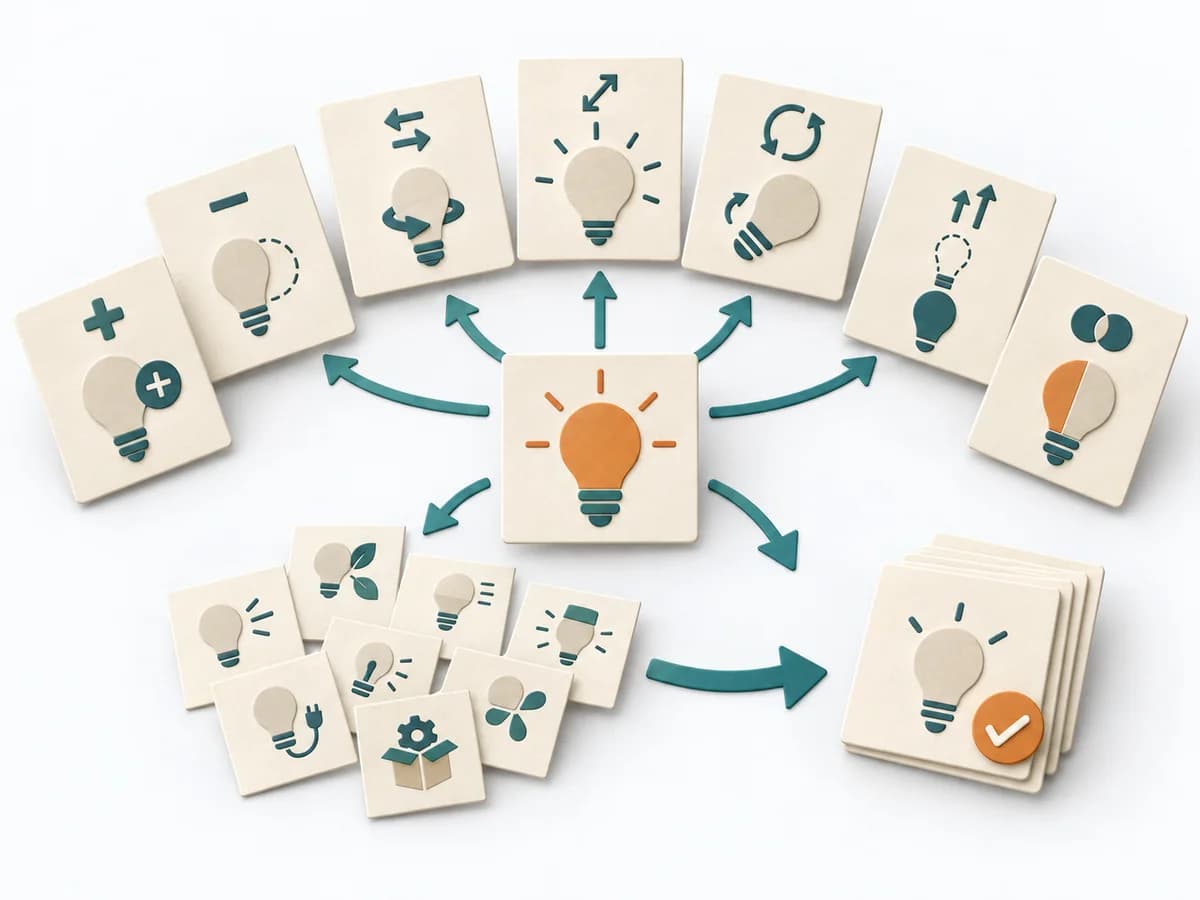 Innovation SCAMPER |  Innovation Lotus Blossom |
|---|---|---|---|---|
Purposedifferent | Polarity Mapping makes tensions between two opposing poles tangible, such as standardization and adaptation or control and autonomy. The method guards against making apparent either-or decisions prematurely. | When a topic is still unclear and too many thoughts surface at once, Mind Mapping creates an open surface for ordering them. It makes connections, subtopics, and starting points visible without fixing them too early. | For an existing solution under pressure to change, the method deliberately opens space for systematic variants. It directs attention to rebuilding, combining, and repurposing rather than only new basic ideas. This produces concrete evolution paths for products, offerings, or workflows. | When a central question feels too large, the method breaks it into neighboring topic fields with their own depth of ideation. It holds structure and openness at the same time, so adjacent perspectives don't get lost. This grows an idea space out of a core problem. |
Complexitydifferent | Medium | Low | Low | Low |
Timedifferent | 1-2 h | 15-45 min | 30-60 min | 45-90 min |
Participantsdifferent | 3-12 | 1-10 | 2-10 | 3-10 |
Formatdifferent | Workshop | Workshop + async | Workshop | Workshop |
Outputdifferent | Polarity Map, Warning Signs, Balance Actions | Mind Map, Topic Clusters, Open Questions | SCAMPER Idea List, Concept Shortlist, Variation Notes | Lotus Diagram, Idea Themes, Shortlist |
Tagsno overlap | Systems thinkingTradeoffsLeadership | BrainstormingIdeasMappingStructureFacilitation | BrainstormingIdeationCreativityReframingInnovation | BrainstormingIdeationCreativityDivergenceWorkshop |