View methods side by side.
Choose up to four methods. Add them using the search and share the comparison by copying its link.
| Criterion |  Growth Pirate Metrics AARRR |  Product Discovery Learning Card |  Product Discovery Fake Door Test | 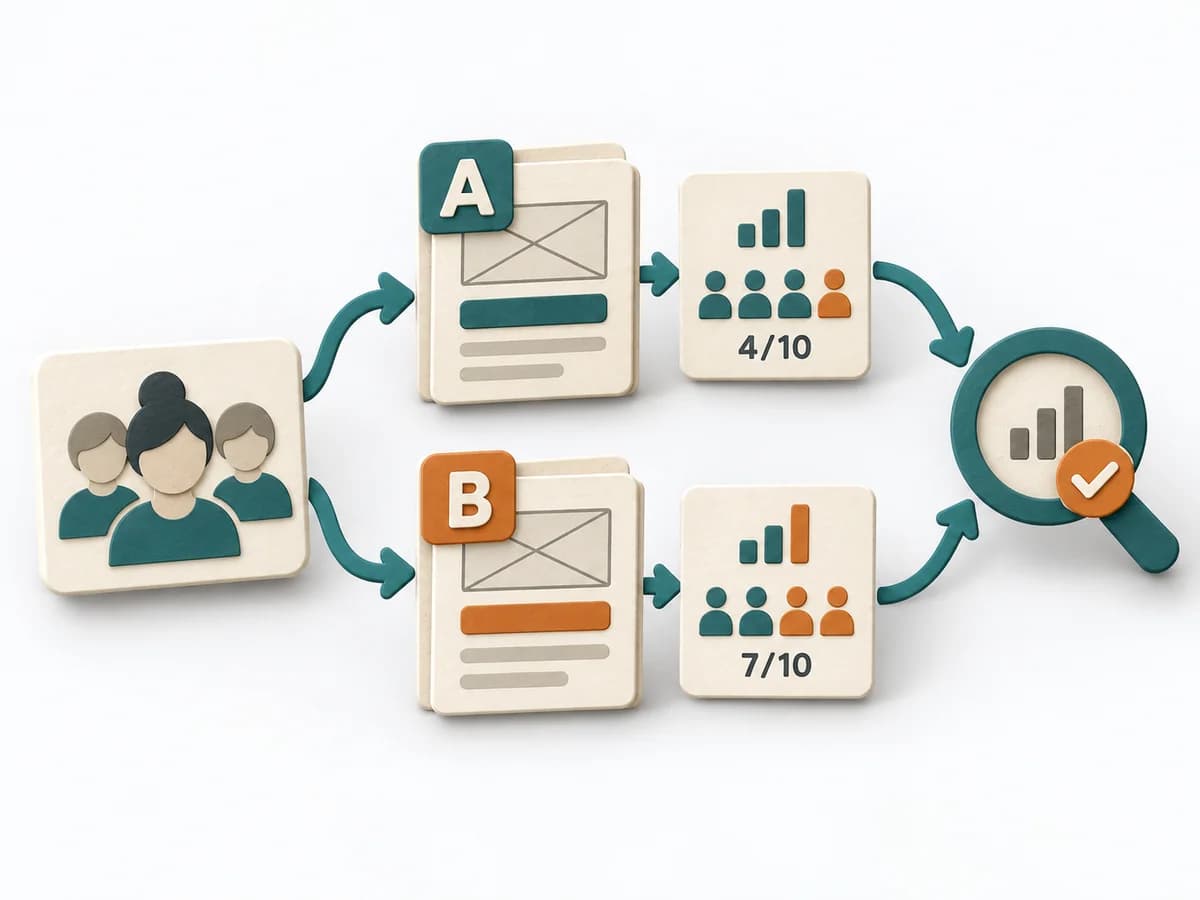 Growth A/B Testing |
|---|---|---|---|---|
Purposedifferent | For products with complex usage paths, overall growth alone is too coarse to reveal bottlenecks. Pirate Metrics breaks the relationship with the product into consecutive stages and shows where the funnel actually leaks. | The Learning Card connects traceable test results to a reasoned next action while keeping the limits of the insight visible. | When demand is still unclear, it measures interest in a feature before it is built. It separates real behavior from polite agreement and deliberately keeps build effort small. | When two variants compete, discussions quickly decide by taste rather than effect. A/B Testing checks behavior under controlled conditions and separates real improvement from chance or expectation effects. |
Complexitydifferent | Medium | Low | Medium | High |
Timedifferent | 1-2 h Setup, laufend | 25-40 min | 1-5 Tage | 1-4 Wochen |
Participantsdifferent | 2-8 | 1-5 | Nutzertraffic | 1-6 |
Formatdifferent | Workshop + async | Workshop + async | Async | Async |
Outputdifferent | AARRR funnel, Metric baseline, Experiment backlog | Learning Card with evidence and next action | Click Data, Interest Signal, Learning Decision | Experiment results, Decision log, Learning summary |
Tags1 shared | GrowthMetricsExperiments | ExperimentsValidationDiscoveryLearning | ValidationExperimentsDemandDiscovery | ExperimentsGrowthAnalyticsValidation |