View methods side by side.
Choose up to four methods. Add them using the search and share the comparison by copying its link.
| Criterion |  Operations PDCA Cycle | 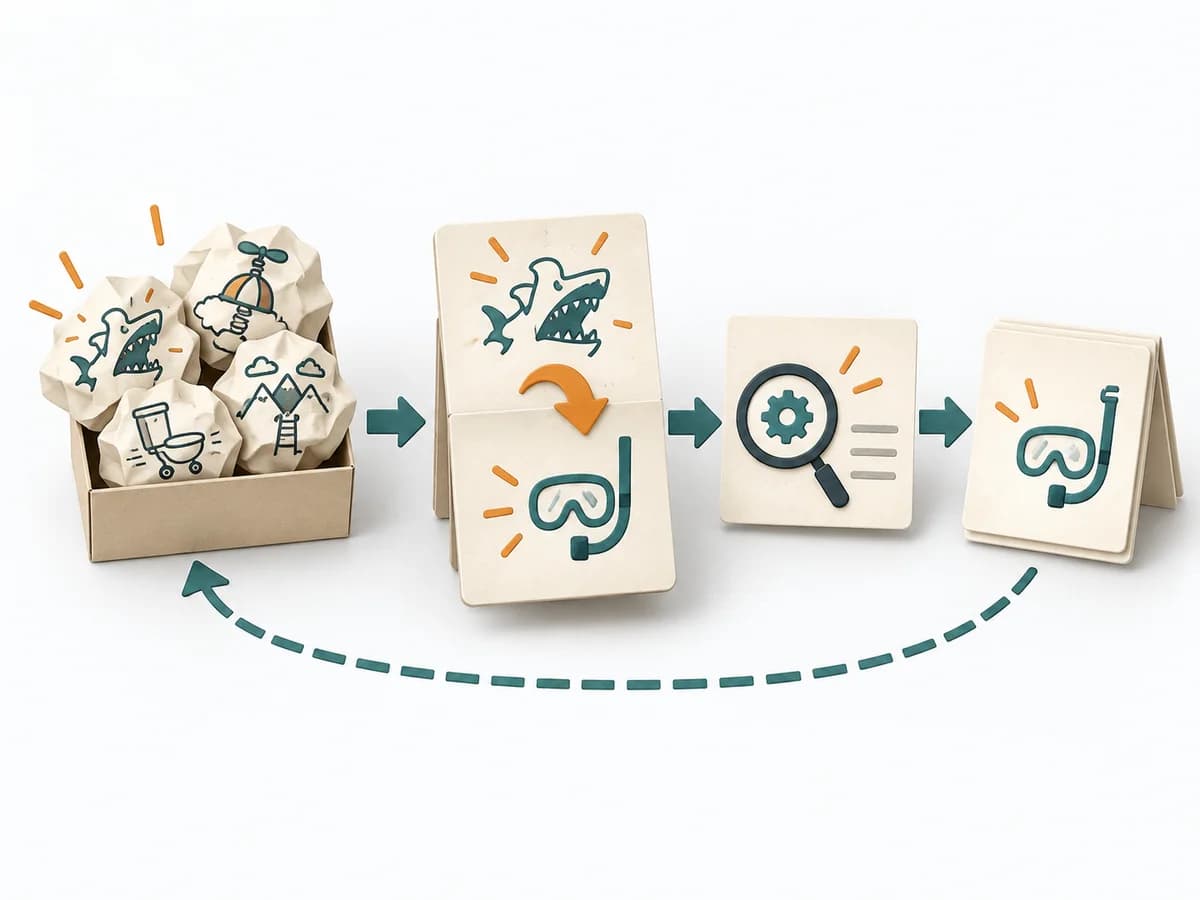 Innovation Worst Possible Idea |  Innovation SCAMPER |  Innovation Morphological Analysis |
|---|---|---|---|---|
Purposedifferent | For an improvement that still has to prove itself in everyday work, the method runs it through small learning loops. It connects planning, checking, and standardization into a repeatable learning mode. | For a seemingly familiar problem with paralyzing seriousness, the method dissolves pressure and fear of judgment. It deliberately makes failure pictures extreme, so hidden assumptions become visible faster. This clarifies what a workable path should avoid. | For an existing solution under pressure to change, the method deliberately opens space for systematic variants. It directs attention to rebuilding, combining, and repurposing rather than only new basic ideas. This produces concrete evolution paths for products, offerings, or workflows. | For a search for solutions with many degrees of freedom, a grid emerges for systematic combinations. The method separates features, variants, and exclusion criteria, so the space gets explored deliberately. |
Complexitydifferent | Low | Low | Low | Medium |
Timedifferent | 1 h bis mehrere Wochen | 20-45 min | 30-60 min | 1-3 h |
Participantsdifferent | 1-8 | 3-12 | 2-10 | 2-8 |
Formatdifferent | Workshop + async | Workshop | Workshop | Workshop + async |
Outputdifferent | PDCA Log, Experiment Plan, Learning Outcome, Standard Change | Bad Idea List, Reframed Concepts, Idea Shortlist | SCAMPER Idea List, Concept Shortlist, Variation Notes | Morphological Box, Concept Combinations, Idea Shortlist |
Tagsno overlap | Continuous improvementLeanExperiments | IdeationCreativityDivergence | BrainstormingIdeationCreativityReframingInnovation | IdeationInnovationCreativity |