View methods side by side.
Choose up to four methods. Add them using the search and share the comparison by copying its link.
| Criterion |  Operations PDCA Cycle | 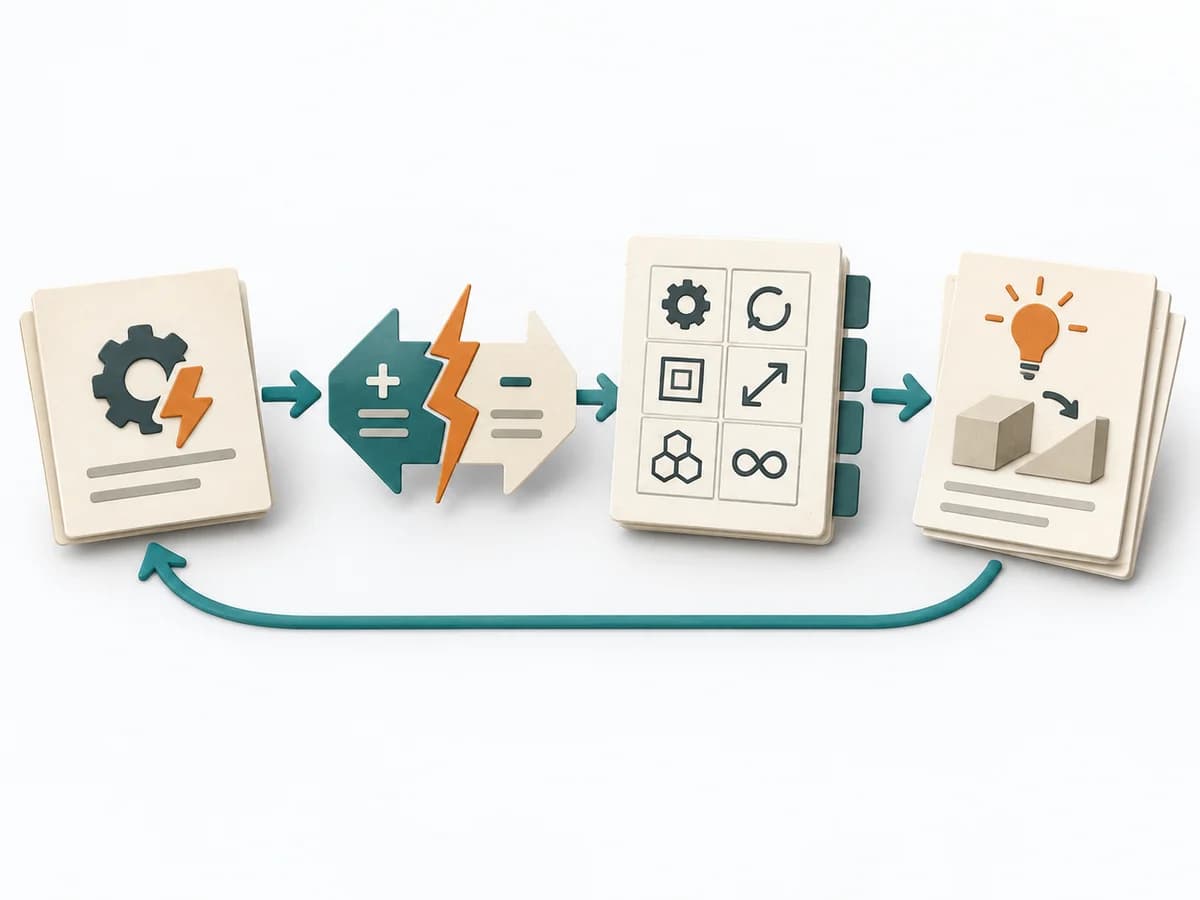 Innovation TRIZ |  Operations Gemba Walk |  Operations 5 Whys |
|---|---|---|---|---|
Purposedifferent | For an improvement that still has to prove itself in everyday work, the method runs it through small learning loops. It connects planning, checking, and standardization into a repeatable learning mode. | For technical contradictions or trade-offs, the method looks for solutions that resolve opposing requirements at the same time. It translates limits into an explicit picture of conflict that becomes workable. This produces not just compromises but more elegant principles. | When there is uncertainty about the real course of a process, the method brings observation to the place where work happens. It combines perception, follow-up questions, and process knowledge so decisions rest on actual workflows instead of assumptions. | For a single, hard-to-explain deviation, the method exposes the causal chain behind the visible symptom. It keeps the cause open until a controllable condition emerges instead of a mere description. |
Complexitydifferent | Low | High | Low | Low |
Timedifferent | 1 h bis mehrere Wochen | 1-4 h | 30-120 min | 15-30 min |
Participantsdifferent | 1-8 | 2-8 | 2-6 | 2-6 |
Formatdifferent | Workshop + async | Workshop + async | Workshop | Workshop |
Outputdifferent | PDCA Log, Experiment Plan, Learning Outcome, Standard Change | Contradiction Statement, Inventive Principles, Solution Concepts | Observation Notes, Improvement Ideas | Root cause notes, Countermeasures |
Tagsno overlap | Continuous improvementLeanExperiments | InnovationProblem solvingContradictionsCreativity | LeanObservationProcessOperations | Root causeIncidentLeanProblem solving |