View methods side by side.
Choose up to four methods. Add them using the search and share the comparison by copying its link.
| Criterion |  Knowledge Modeling PARA Method |  Facilitation Six Thinking Hats | 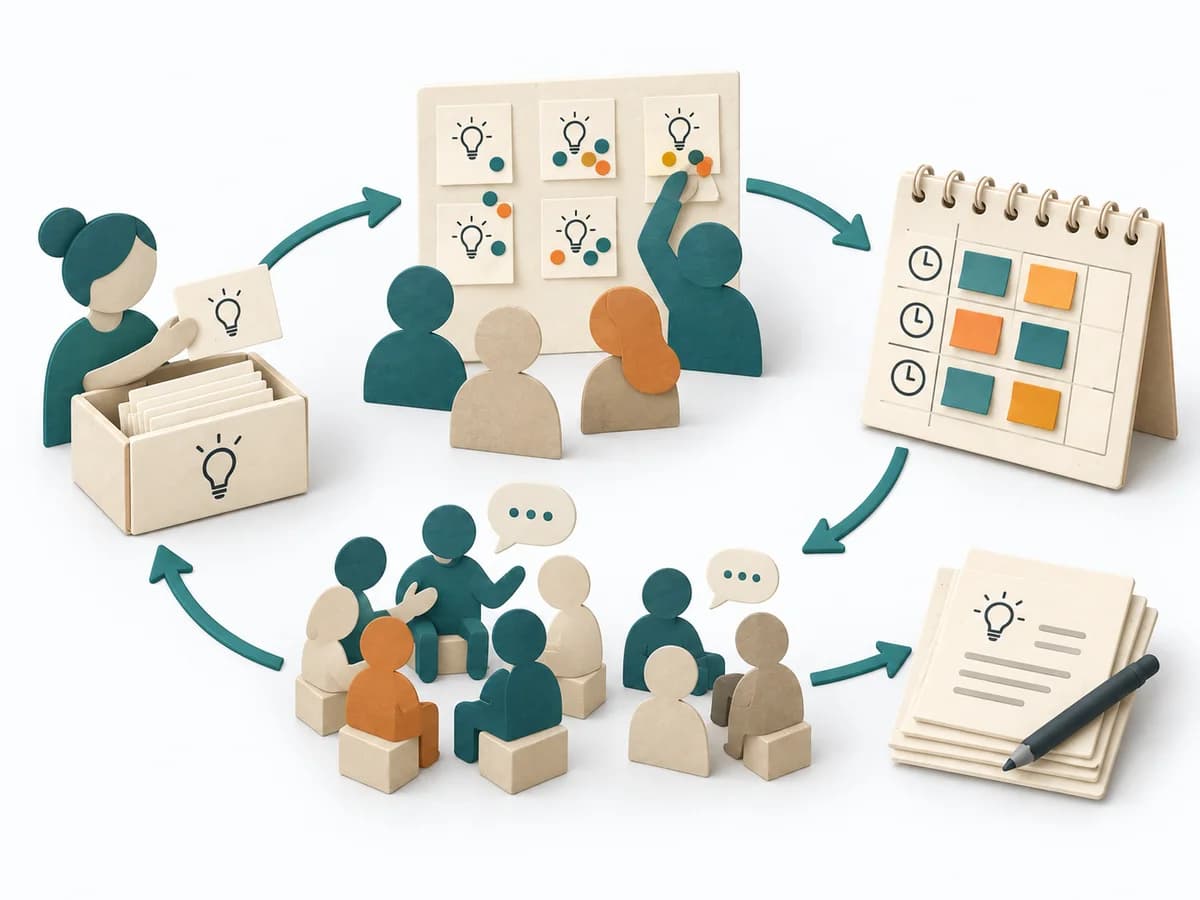 Facilitation Barcamp |  Decision Making Decision Tree |
|---|---|---|---|---|
Purposedifferent | The PARA Method organizes knowledge into Projects, Areas, Resources, and Archives. It creates order when digital notes, files, and tasks no longer cleanly fit current work. | When a topic gets stuck too quickly in the same thinking mode, Six Thinking Hats deliberately separates the perspectives. This means facts, risks, creativity, and emotional signals get worked through one after another instead of mixed together. | When many people can contribute knowledge and the flow should stay open, Barcamp provides a framework for self-organized sessions. The format channels energy without defining the content too narrowly in advance. | For decisions with follow-on paths and dependencies, a linear comparison is often not enough. A Decision Tree shows how options branch under conditions and which consequences hang on each branch. |
Complexitysame | Medium | Medium | Medium | Medium |
Timedifferent | 1-3 h Setup, laufend | 45-90 min | Halber Tag bis 2 Tage | 30-90 min |
Participantsdifferent | 1 | 4-12 | 15-200 | 1-6 |
Formatdifferent | Async | Workshop | Workshop | Workshop + async |
Outputdifferent | PARA Structure, Project Notes, Knowledge Archive | Perspective Notes, Decision Inputs, Action Items | Session Board, Session Notes, Community Learnings | Decision Tree, Option Map, Assumption List |
Tagsno overlap | KnowledgeProductivityOrganization | FacilitationOptionsDecision | FacilitationLarge groupLearning | DecisionTreeOptions |