View methods side by side.
Choose up to four methods. Add them using the search and share the comparison by copying its link.
| Criterion |  Knowledge Modeling PARA Method |  Operations Pomodoro Technique | 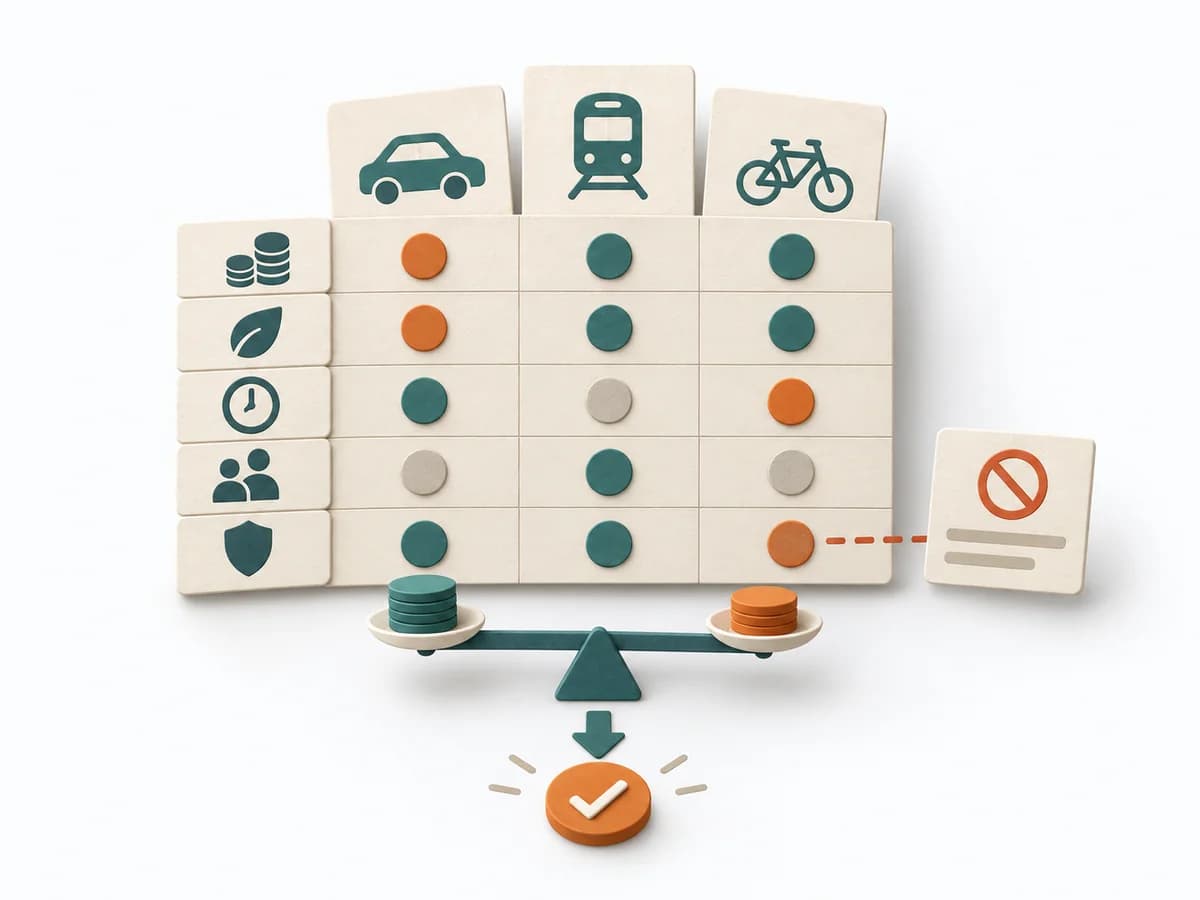 Decision Making Trade-off Analysis |  Decision Making Constraint Analysis |
|---|---|---|---|---|
Purposedifferent | The PARA Method organizes knowledge into Projects, Areas, Resources, and Archives. It creates order when digital notes, files, and tasks no longer cleanly fit current work. | For easily distracted solo work, the method sets clear time boundaries for concentrated work. It protects attention when large tasks would otherwise fall apart into small avoidance moves. | With limited resources, quality, speed, cost, and risk almost always compete with each other. Trade-off Analysis makes these tensions explicit and prevents decisions from producing hidden side effects. | When an initiative stalls, the limit often lies not in the idea but in hard or soft boundary conditions. Constraint Analysis separates these limits and shows which of them can actually be shaped. |
Complexitydifferent | Medium | Low | Medium | Low |
Timedifferent | 1-3 h Setup, laufend | 25 min Zyklen | 45-120 min | 30-90 min |
Participantsdifferent | 1 | 1 | 2-8 | 2-8 |
Formatdifferent | Async | Async | Workshop + async | Workshop + async |
Outputdifferent | PARA Structure, Project Notes, Knowledge Archive | Focus Sessions, Task Progress, Interruption Notes | Trade-off Matrix, Criteria List, Decision Rationale, Accepted Downsides | Constraint List, Hard/Soft Classification, Option Impact Notes, Decision Boundaries |
Tagsno overlap | KnowledgeProductivityOrganization | FocusTime managementProductivityExecution | TradeoffsDecisionCriteriaOptions | ConstraintsDecisionPlanningOptions |