View methods side by side.
Choose up to four methods. Add them using the search and share the comparison by copying its link.
| Criterion |  Knowledge Modeling PARA Method |  Knowledge Modeling Concept Mapping | 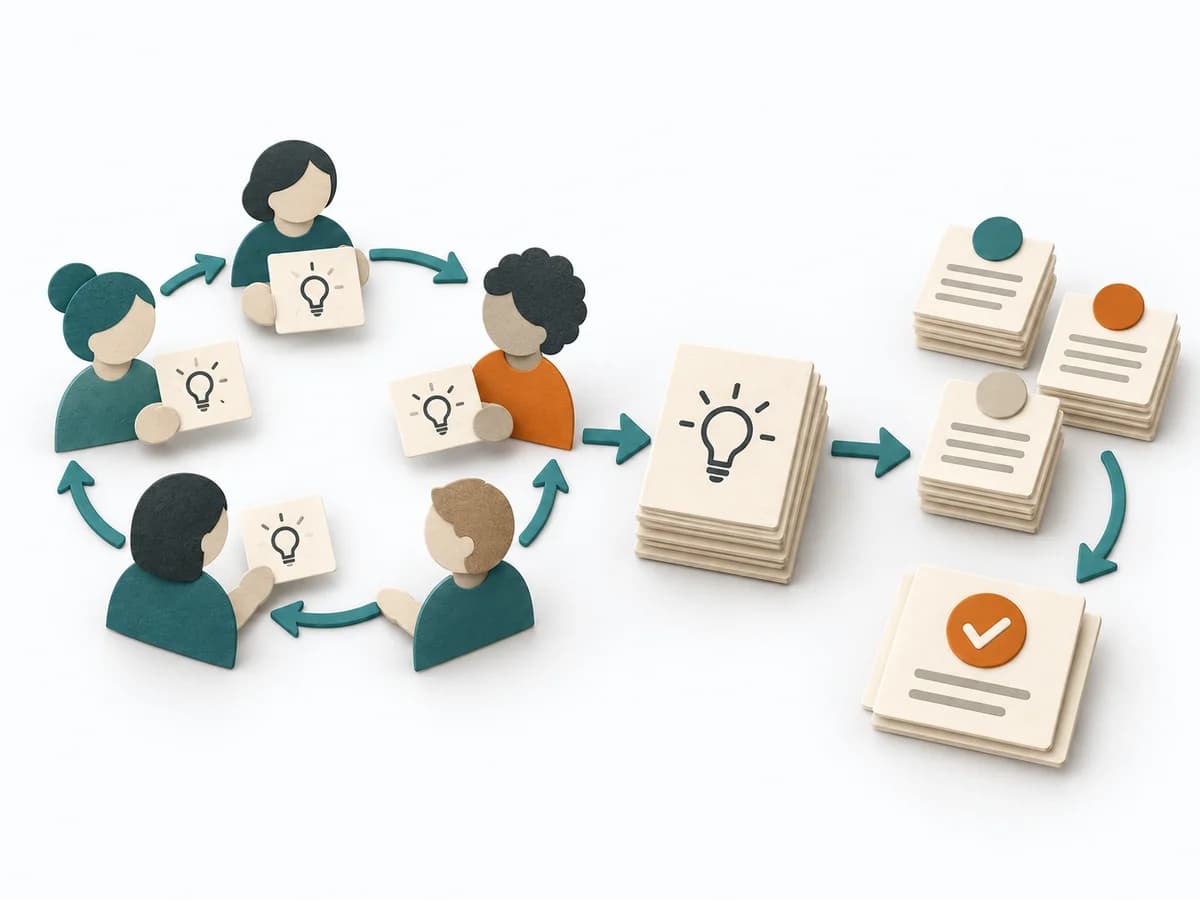 Innovation Round Robin Brainstorming |  Innovation Lotus Blossom |
|---|---|---|---|---|
Purposedifferent | The PARA Method organizes knowledge into Projects, Areas, Resources, and Archives. It creates order when digital notes, files, and tasks no longer cleanly fit current work. | Concept Mapping arranges terms and relationships in a network that makes subject-matter connections tangible. It fits when a topic needs to be understood structurally rather than linearly. | With unevenly distributed speaking time, the method brings every person into the contribution one after another. It prevents early voices from setting the direction while still producing a shared idea space. This makes participation plannable and the team's diversity visible. | When a central question feels too large, the method breaks it into neighboring topic fields with their own depth of ideation. It holds structure and openness at the same time, so adjacent perspectives don't get lost. This grows an idea space out of a core problem. |
Complexitydifferent | Medium | Medium | Low | Low |
Timedifferent | 1-3 h Setup, laufend | 1-2 h | 20-45 min | 45-90 min |
Participantsdifferent | 1 | 1-8 | 4-10 | 3-10 |
Formatdifferent | Async | Workshop + async | Workshop | Workshop |
Outputdifferent | PARA Structure, Project Notes, Knowledge Archive | Concept Map, Relationship Labels, Knowledge Gaps | Idea List, Cluster, Shortlist | Lotus Diagram, Idea Themes, Shortlist |
Tagsno overlap | KnowledgeProductivityOrganization | KnowledgeConceptsMappingSensemaking | BrainstormingIdeationFacilitationInclusionCreativity | BrainstormingIdeationCreativityDivergenceWorkshop |