View methods side by side.
Choose up to four methods. Add them using the search and share the comparison by copying its link.
| Criterion |  Knowledge Modeling PARA Method | 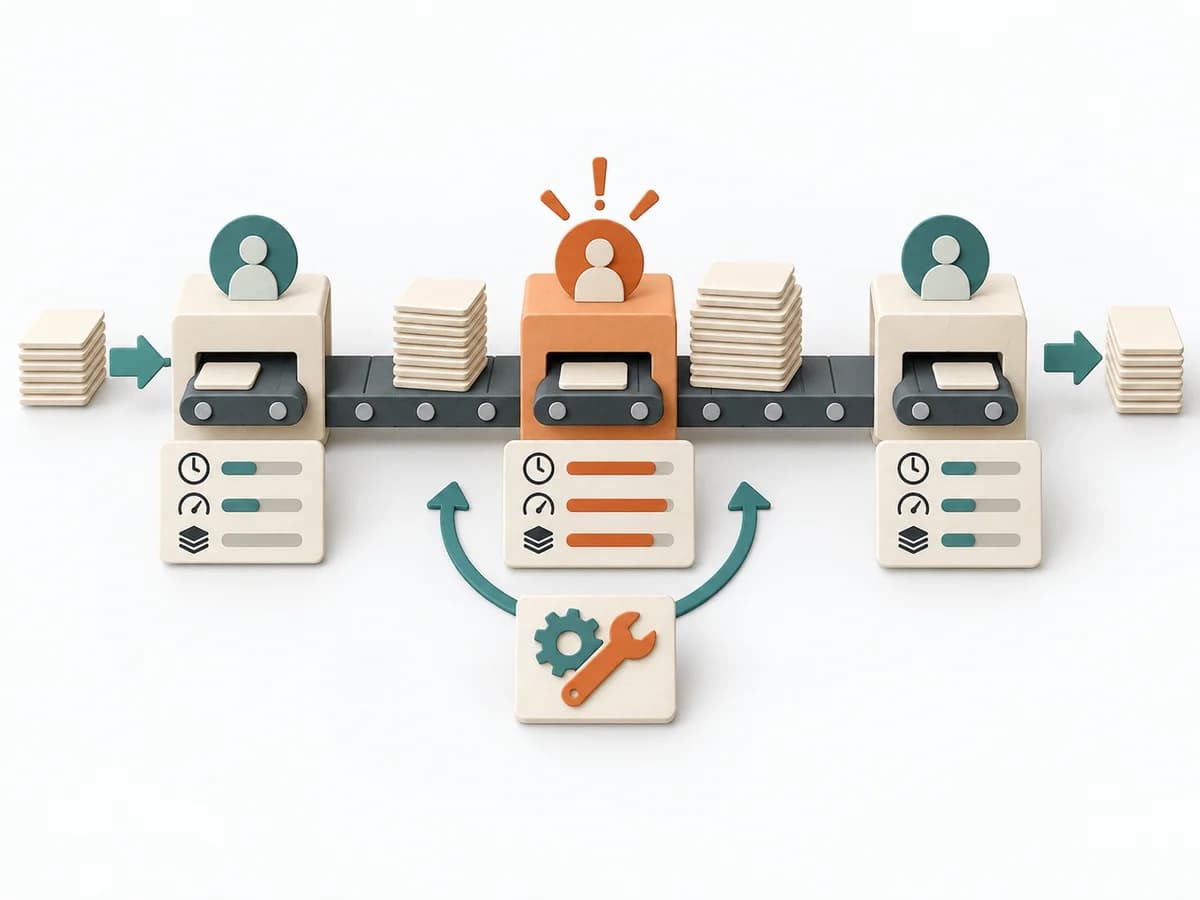 Operations Bottleneck Analysis |  Decision Making Decision Rights Mapping |  Decision Making Constraint Analysis |
|---|---|---|---|---|
Purposedifferent | The PARA Method organizes knowledge into Projects, Areas, Resources, and Archives. It creates order when digital notes, files, and tasks no longer cleanly fit current work. | For a flow that backs up at one point, the method looks for the capacity limit with the greatest leverage. It explains why extra effort elsewhere barely improves throughput. | In organizations with many stakeholders, it often blurs who actually decides and who is merely consulted. It separates options, evaluation criteria, and open risks. The result is captured as a Decision Rights matrix and an agreement. | When an initiative stalls, the limit often lies not in the idea but in hard or soft boundary conditions. Constraint Analysis separates these limits and shows which of them can actually be shaped. |
Complexitydifferent | Medium | Medium | Medium | Low |
Timedifferent | 1-3 h Setup, laufend | 1-3 h | 90-180 min | 30-90 min |
Participantsdifferent | 1 | 3-8 | 4-12 | 2-8 |
Formatdifferent | Async | Workshop + async | Workshop | Workshop + async |
Outputdifferent | PARA Structure, Project Notes, Knowledge Archive | Bottleneck Map, Flow Metrics, Improvement Options, Follow-up Measures | Decision Rights Matrix, Agreement | Constraint List, Hard/Soft Classification, Option Impact Notes, Decision Boundaries |
Tagsno overlap | KnowledgeProductivityOrganization | FlowMeasurementConstraints | DecisionGovernanceAlignmentResponsibility | ConstraintsDecisionPlanningOptions |