View methods side by side.
Choose up to four methods. Add them using the search and share the comparison by copying its link.
| Criterion |  Knowledge Modeling PARA Method |  Facilitation Barcamp |  Facilitation 1-2-4-All | 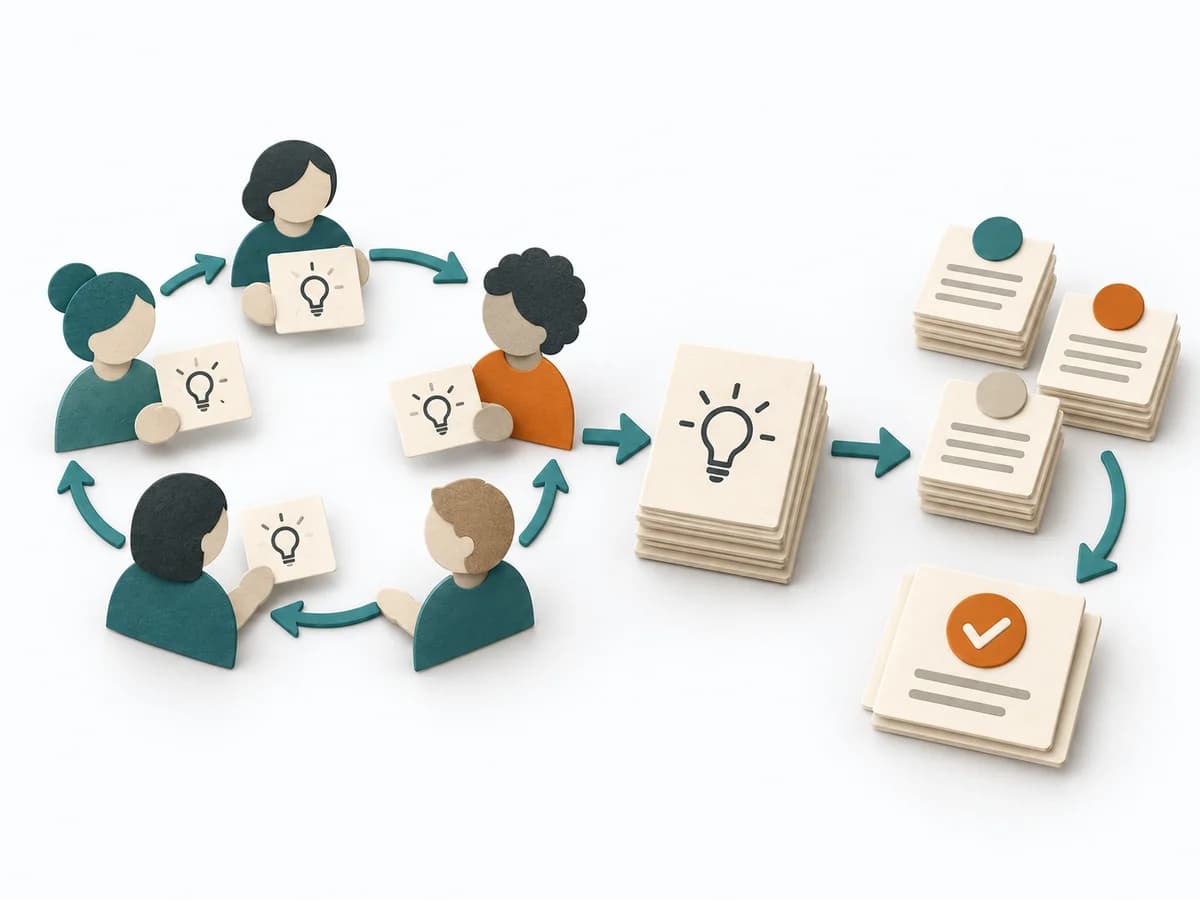 Innovation Round Robin Brainstorming |
|---|---|---|---|---|
Purposedifferent | The PARA Method organizes knowledge into Projects, Areas, Resources, and Archives. It creates order when digital notes, files, and tasks no longer cleanly fit current work. | When many people can contribute knowledge and the flow should stay open, Barcamp provides a framework for self-organized sessions. The format channels energy without defining the content too narrowly in advance. | When many people in a group too rarely get to speak, 1-2-4-All distributes thinking time more fairly. The format builds participation step by step and makes quiet or still-unformed thoughts usable faster. | With unevenly distributed speaking time, the method brings every person into the contribution one after another. It prevents early voices from setting the direction while still producing a shared idea space. This makes participation plannable and the team's diversity visible. |
Complexitydifferent | Medium | Medium | Low | Low |
Timedifferent | 1-3 h Setup, laufend | Halber Tag bis 2 Tage | 10-20 min | 20-45 min |
Participantsdifferent | 1 | 15-200 | 4-100+ | 4-10 |
Formatdifferent | Async | Workshop | Workshop | Workshop |
Outputdifferent | PARA Structure, Project Notes, Knowledge Archive | Session Board, Session Notes, Community Learnings | Idea List, Shared Insights, Emergent Themes | Idea List, Cluster, Shortlist |
Tagsno overlap | KnowledgeProductivityOrganization | FacilitationLarge groupLearning | FacilitationInclusionIdeation | BrainstormingIdeationFacilitationInclusionCreativity |