View methods side by side.
Choose up to four methods. Add them using the search and share the comparison by copying its link.
| Criterion |  Product Discovery Opportunity Scoring |  Product Discovery Jobs to Be Done |  Innovation SCAMPER | 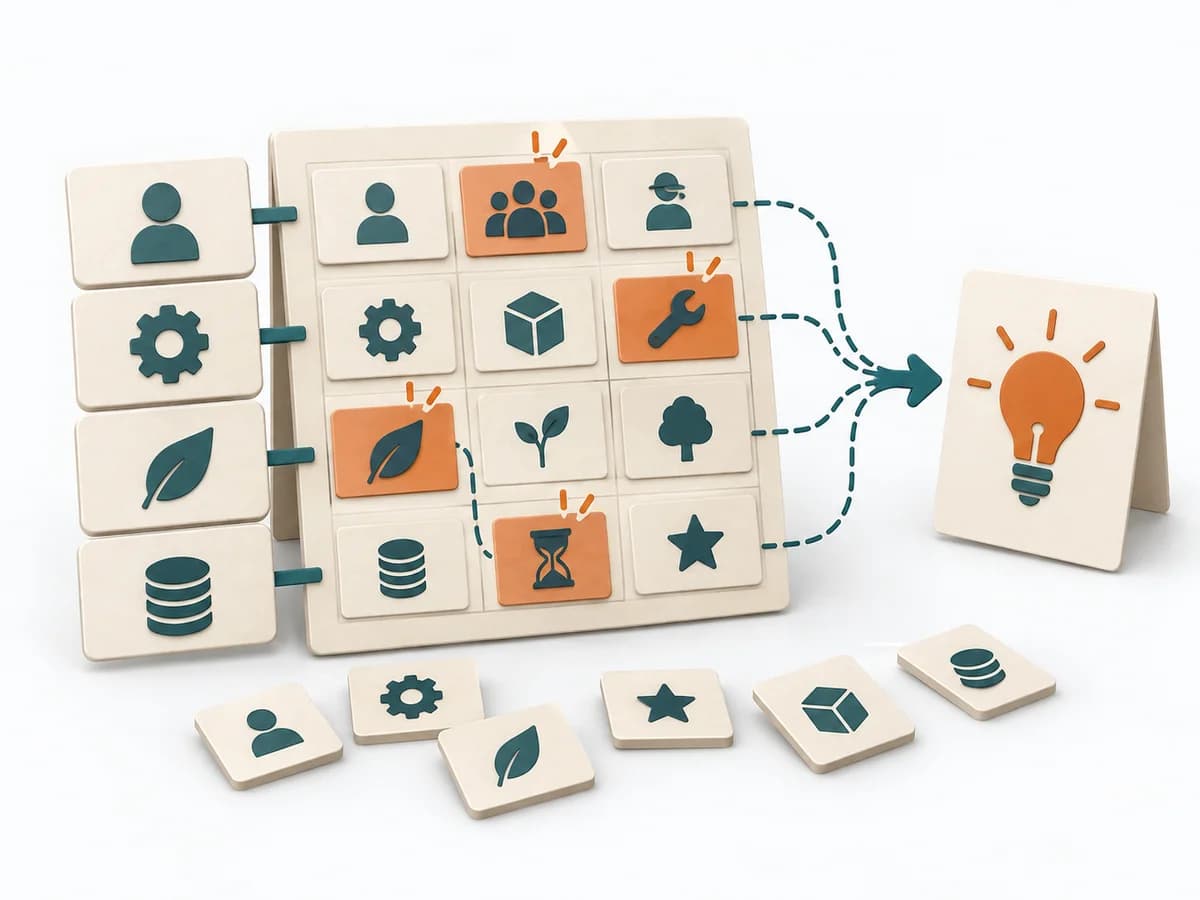 Innovation Morphological Analysis |
|---|---|---|---|---|
Purposedifferent | When opportunities need ranking by their effect, it makes importance and satisfaction directly comparable. It separates problem, assumption, solution, and evidence. The result is captured as an opportunity-score table and top outcomes. | When switching motives and progress are unclear, it reconstructs the situation from real customer circumstances. It shows why a switch happens and what kind of progress is being sought. | For an existing solution under pressure to change, the method deliberately opens space for systematic variants. It directs attention to rebuilding, combining, and repurposing rather than only new basic ideas. This produces concrete evolution paths for products, offerings, or workflows. | For a search for solutions with many degrees of freedom, a grid emerges for systematic combinations. The method separates features, variants, and exclusion criteria, so the space gets explored deliberately. |
Complexitydifferent | Medium | Medium | Low | Medium |
Timedifferent | 60-120 min | 1-3 Wochen | 30-60 min | 1-3 h |
Participantsdifferent | 3-6 | 5-12 Interviews | 2-10 | 2-8 |
Formatdifferent | Workshop + async | Workshop + async | Workshop | Workshop + async |
Outputdifferent | Opportunity Score Table, Top Outcomes | Job Stories, Outcome Statements, Opportunity List | SCAMPER Idea List, Concept Shortlist, Variation Notes | Morphological Box, Concept Combinations, Idea Shortlist |
Tagsno overlap | PrioritizationDiscoveryOutcomesNeeds | CustomerOutcomesNeeds | BrainstormingIdeationCreativityReframingInnovation | IdeationInnovationCreativity |