View methods side by side.
Choose up to four methods. Add them using the search and share the comparison by copying its link.
| Criterion |  Product Discovery Outcome-Driven Innovation | 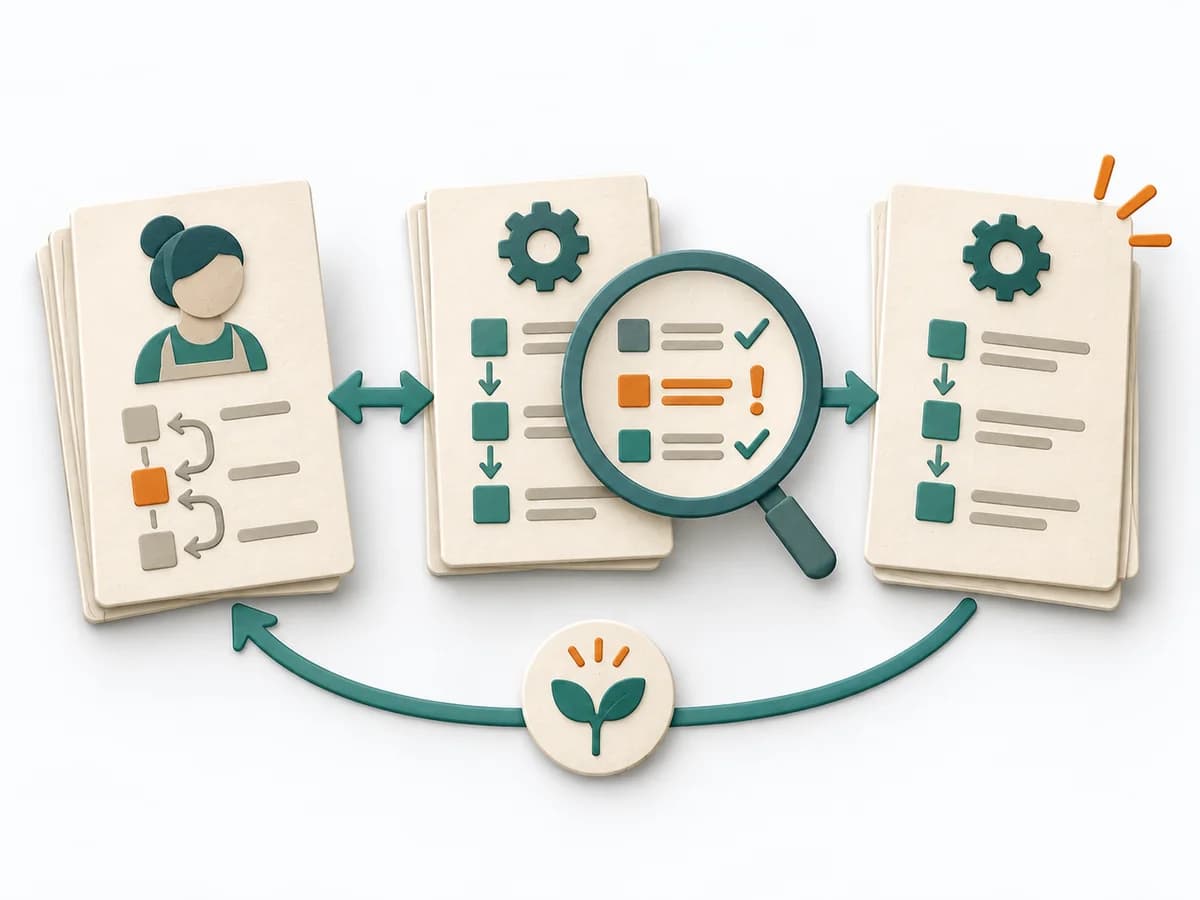 Operations Standard Work Analysis |  Operations Failure Mode and Effects Analysis |  Operations Gemba Walk |
|---|---|---|---|---|
Purposedifferent | Outcome-Driven Innovation clarifies customer problems, solution opportunities, and evidence. It separates jobs, desired outcomes, importance, satisfaction, and opportunity, and captures results as desired outcome statements, an opportunity landscape, and segments by underserved needs. | When the same task is done differently depending on the person, the method exposes the reliable core. It creates comparability without unnecessarily choking off needed latitude. | For a process, product, or service with noticeable failure risks, the method assesses possible failure modes in advance. It directs attention to combinations of occurrence, effect, and detectability. | When there is uncertainty about the real course of a process, the method brings observation to the place where work happens. It combines perception, follow-up questions, and process knowledge so decisions rest on actual workflows instead of assumptions. |
Complexitydifferent | High | Medium | High | Low |
Timedifferent | Mehrere Wochen | 1-3 h | 2-6 h | 30-120 min |
Participantsdifferent | 2-6 researchers plus sample | 2-6 | 3-10 | 2-6 |
Formatdifferent | Workshop + async | Workshop | Workshop | Workshop |
Outputdifferent | Desired outcome statements, Opportunity landscape, Segmentation by underserved needs, Innovation hypotheses | Standard Work Sheet, Deviation List, Improved Standard, Training Needs | FMEA Table, Risk Priority, Mitigation Actions | Observation Notes, Improvement Ideas |
Tagsno overlap | OutcomesInnovationResearchQuantitative | LeanProcessQuality | RiskQualityOperationsRoot cause | LeanObservationProcessOperations |