View methods side by side.
Choose up to four methods. Add them using the search and share the comparison by copying its link.
| Criterion |  Product Discovery Outcome-Driven Innovation |  Operations Kepner-Tregoe | 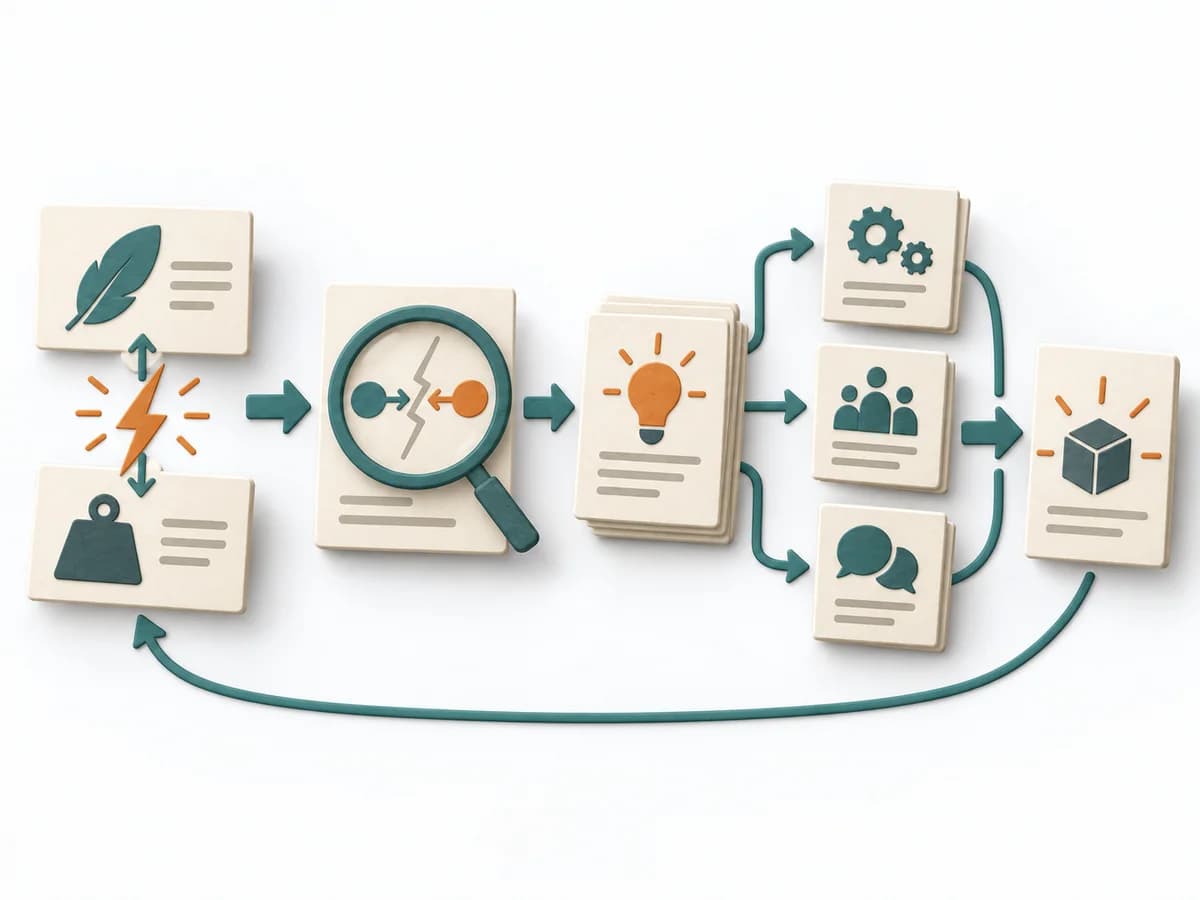 Innovation Contradiction Analysis |  Operations 5 Whys |
|---|---|---|---|---|
Purposedifferent | Outcome-Driven Innovation clarifies customer problems, solution opportunities, and evidence. It separates jobs, desired outcomes, importance, satisfaction, and opportunity, and captures results as desired outcome statements, an opportunity landscape, and segments by underserved needs. | For a disturbance that's hard to pin down, the method cleanly separates problem, cause, and decision. It reduces mixing when symptoms allow several interpretations. | When a system should improve while another measure suffers as a result, the method makes the underlying conflict precisely formulable. It separates the desired effect from its side effect. This makes solutions possible that address the contradiction deliberately instead of half-heartedly. | For a single, hard-to-explain deviation, the method exposes the causal chain behind the visible symptom. It keeps the cause open until a controllable condition emerges instead of a mere description. |
Complexitydifferent | High | High | Medium | Low |
Timedifferent | Mehrere Wochen | 2-8 h | 60-120 min | 15-30 min |
Participantsdifferent | 2-6 researchers plus sample | 2-8 | 2-8 | 2-6 |
Formatdifferent | Workshop + async | Workshop + async | Workshop | Workshop |
Outputdifferent | Desired outcome statements, Opportunity landscape, Segmentation by underserved needs, Innovation hypotheses | Problem Analysis, Decision Analysis, Risk Plan | Contradiction Statement, Abstraction Notes, Solution Principles, Concept Ideas | Root cause notes, Countermeasures |
Tagsno overlap | OutcomesInnovationResearchQuantitative | Problem solvingRoot causeDecisionOperations | ContradictionsInnovationProblem solving | Root causeIncidentLeanProblem solving |