View methods side by side.
Choose up to four methods. Add them using the search and share the comparison by copying its link.
| Criterion |  Product Discovery Outcome-Driven Innovation |  Operations Fault Tree Analysis | 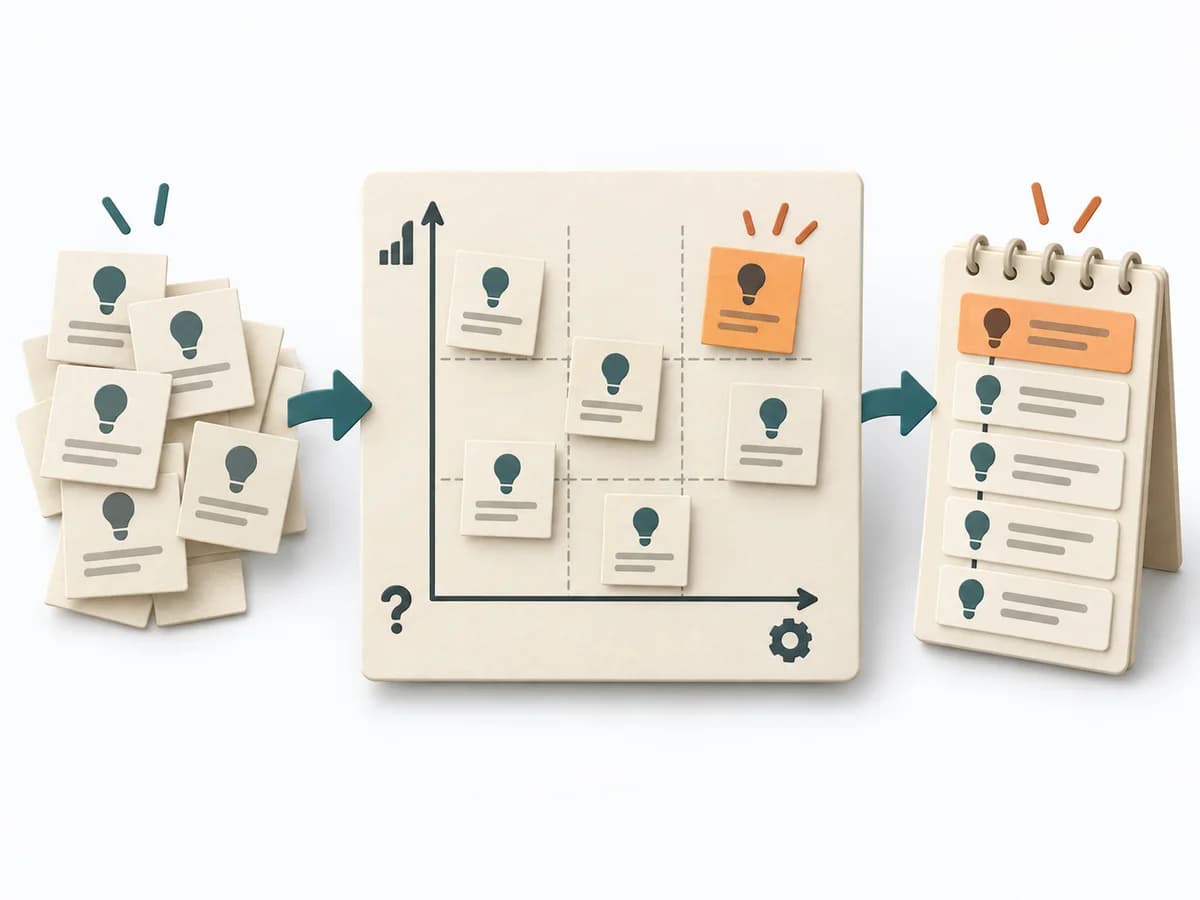 Product Discovery Hypothesis Prioritization Canvas |  UX Design Lean UX Canvas |
|---|---|---|---|---|
Purposedifferent | Outcome-Driven Innovation clarifies customer problems, solution opportunities, and evidence. It separates jobs, desired outcomes, importance, satisfaction, and opportunity, and captures results as desired outcome statements, an opportunity landscape, and segments by underserved needs. | For a critical top event with several possible triggers, the method logically models failure paths. It makes visible which combinations of conditions can lead to damage. | When many hypotheses compete for attention, it brings order to their learning sequence and importance. It separates problem, assumption, solution, and evidence. The result is captured as a prioritization canvas and a hypothesis backlog. | The Lean UX Canvas helps clarify user behavior, touchpoints, and concept decisions. It makes assumptions and desired outcomes visible and captures the result as a completed canvas, hypothesis list, and first experiment. |
Complexitydifferent | High | High | Medium | Medium |
Timedifferent | Mehrere Wochen | 2-6 h | 60-90 min | 2-3 h |
Participantsdifferent | 2-6 researchers plus sample | 3-8 | 3-8 | 3-8 |
Formatdifferent | Workshop + async | Workshop + async | Workshop | Workshop + async |
Outputdifferent | Desired outcome statements, Opportunity landscape, Segmentation by underserved needs, Innovation hypotheses | Fault Tree, Critical Paths, Cause Hypotheses, Control Actions | Prioritization Canvas, Hypothesis Backlog | Completed Lean UX Canvas, Hypothesis list, First experiment |
Tagsno overlap | OutcomesInnovationResearchQuantitative | RiskRoot causeSafety | ExperimentsPrioritizationDiscoveryHypothesis | CanvasHypothesisOutcomesDiscovery |