View methods side by side.
Choose up to four methods. Add them using the search and share the comparison by copying its link.
| Criterion |  Product Discovery Outcome-Driven Innovation |  Operations Change Analysis | 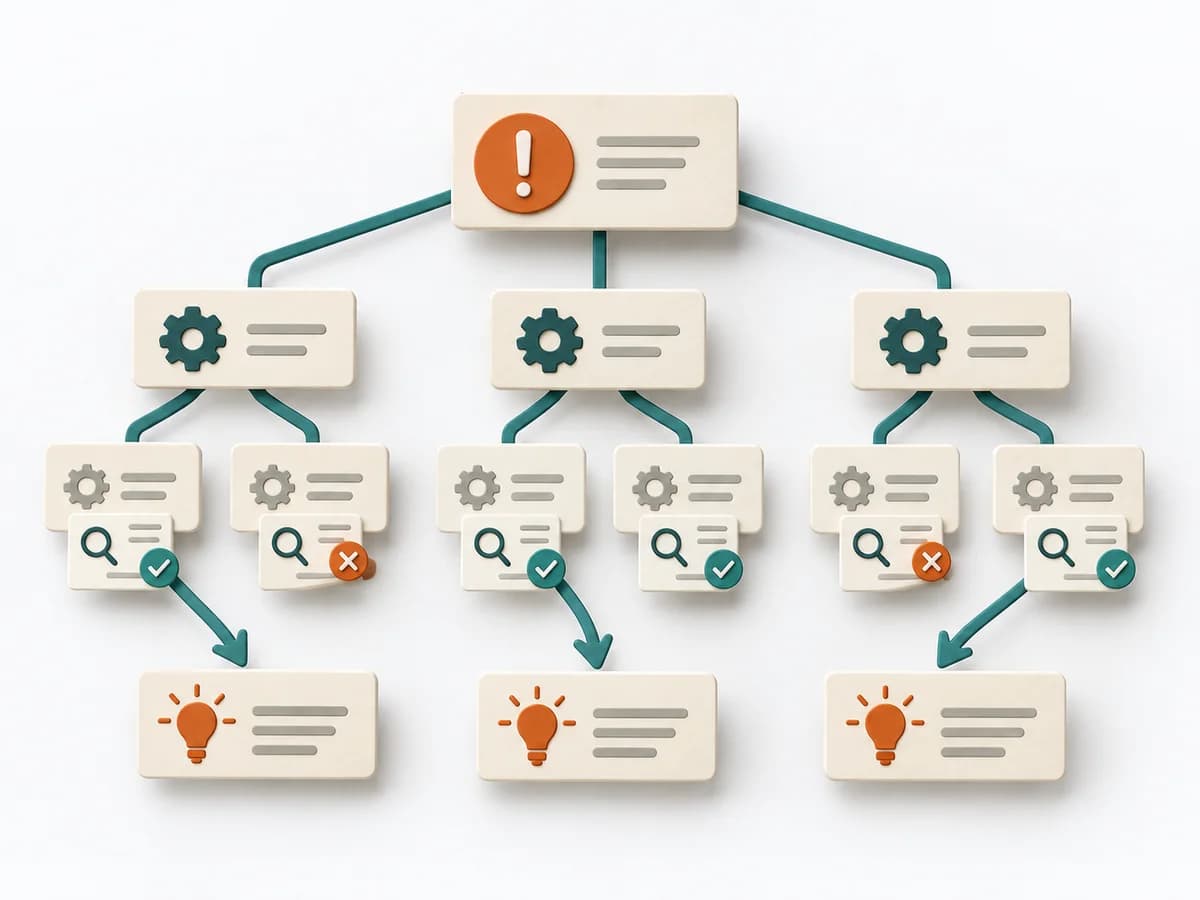 Operations Root Cause Tree Analysis |  Operations 5 Whys |
|---|---|---|---|---|
Purposedifferent | Outcome-Driven Innovation clarifies customer problems, solution opportunities, and evidence. It separates jobs, desired outcomes, importance, satisfaction, and opportunity, and captures results as desired outcome statements, an opportunity landscape, and segments by underserved needs. | For a deviation after a change, the method isolates the influence of the altered condition. It narrows down which differences are relevant and which are just accompanying noise. | For a problem with several suspected causes, the method builds a causal structure instead of a mere list. It makes visible how causes connect and where the strongest points of leverage lie. | For a single, hard-to-explain deviation, the method exposes the causal chain behind the visible symptom. It keeps the cause open until a controllable condition emerges instead of a mere description. |
Complexitydifferent | High | Medium | Medium | Low |
Timedifferent | Mehrere Wochen | 45-120 min | 1-3 h | 15-30 min |
Participantsdifferent | 2-6 researchers plus sample | 2-6 | 2-8 | 2-6 |
Formatdifferent | Workshop + async | Workshop + async | Workshop | Workshop |
Outputdifferent | Desired outcome statements, Opportunity landscape, Segmentation by underserved needs, Innovation hypotheses | Change Matrix, Cause Hypotheses, Validation Questions, Action List | Cause Tree, Evidence Notes, Countermeasures | Root cause notes, Countermeasures |
Tagsno overlap | OutcomesInnovationResearchQuantitative | ChangeRoot causeTroubleshootingComparison | Root causeTreeIncidentQuality | Root causeIncidentLeanProblem solving |