View methods side by side.
Choose up to four methods. Add them using the search and share the comparison by copying its link.
| Criterion |  Product Discovery Outcome-Driven Innovation |  Architecture Architecture Decision Record |  Decision Making Decision Rights Mapping | 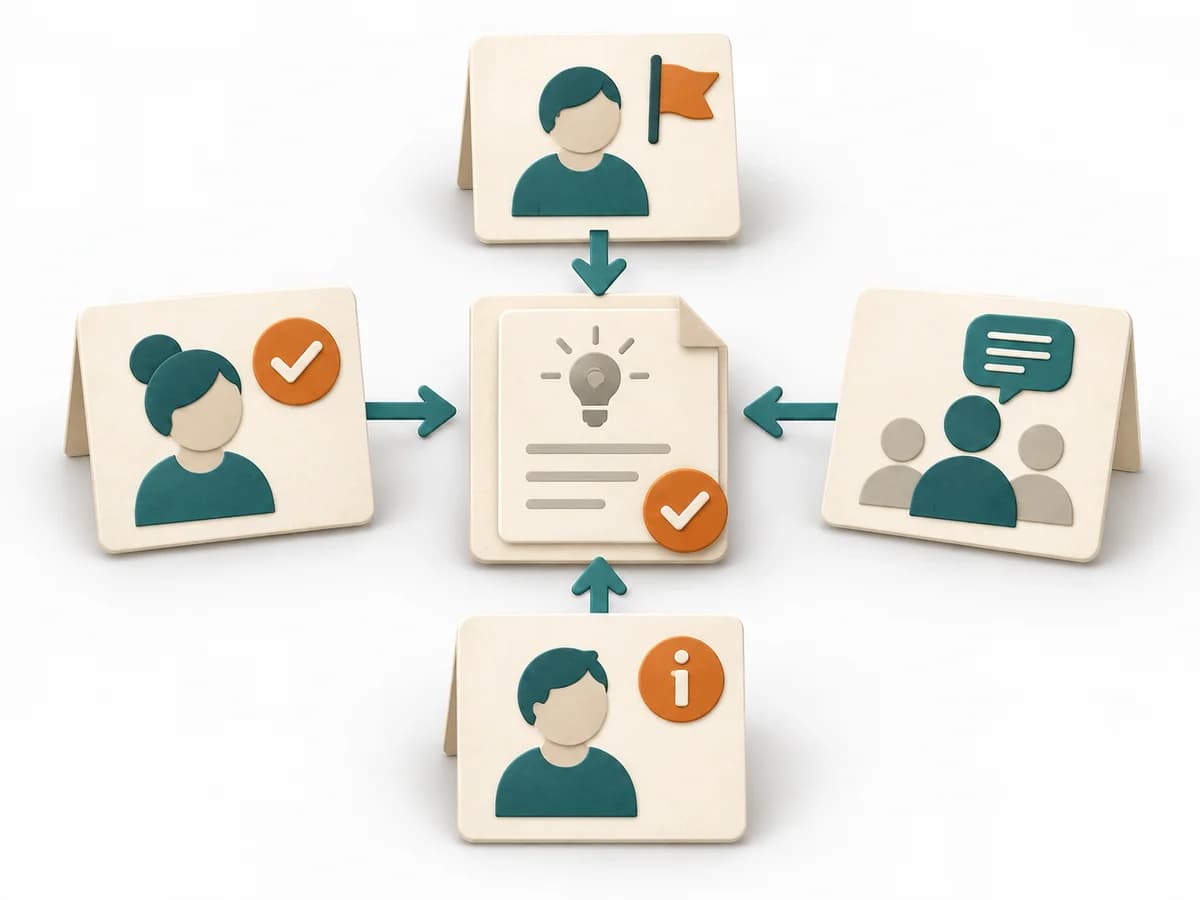 Decision Making DACI |
|---|---|---|---|---|
Purposedifferent | Outcome-Driven Innovation clarifies customer problems, solution opportunities, and evidence. It separates jobs, desired outcomes, importance, satisfaction, and opportunity, and captures results as desired outcome statements, an opportunity landscape, and segments by underserved needs. | An ADR permanently records an architecture decision with context, trade-offs, and consequence. It creates continuity for later changes because the decision path stays traceable. | In organizations with many stakeholders, it often blurs who actually decides and who is merely consulted. It separates options, evaluation criteria, and open risks. The result is captured as a Decision Rights matrix and an agreement. | In cross-functional decisions, responsibilities quickly blur between approval, influence, and execution. DACI arranges these roles so decision pressure, contribution, and information stay cleanly separated. |
Complexitydifferent | High | Low | Medium | Low |
Timedifferent | Mehrere Wochen | 15-45 min | 90-180 min | 30-60 min |
Participantsdifferent | 2-6 researchers plus sample | 1-3 | 4-12 | 2-10 |
Formatdifferent | Workshop + async | Async | Workshop | Workshop + async |
Outputdifferent | Desired outcome statements, Opportunity landscape, Segmentation by underserved needs, Innovation hypotheses | ADR File, Decision Log, Rationale | Decision Rights Matrix, Agreement | DACI Matrix, Decision Owner, Decision Log |
Tagsno overlap | OutcomesInnovationResearchQuantitative | ArchitectureRationaleDocumentationGovernance | DecisionGovernanceAlignmentResponsibility | DecisionRolesGovernanceAlignment |