View methods side by side.
Choose up to four methods. Add them using the search and share the comparison by copying its link.
| Criterion |  Delivery MoSCoW | 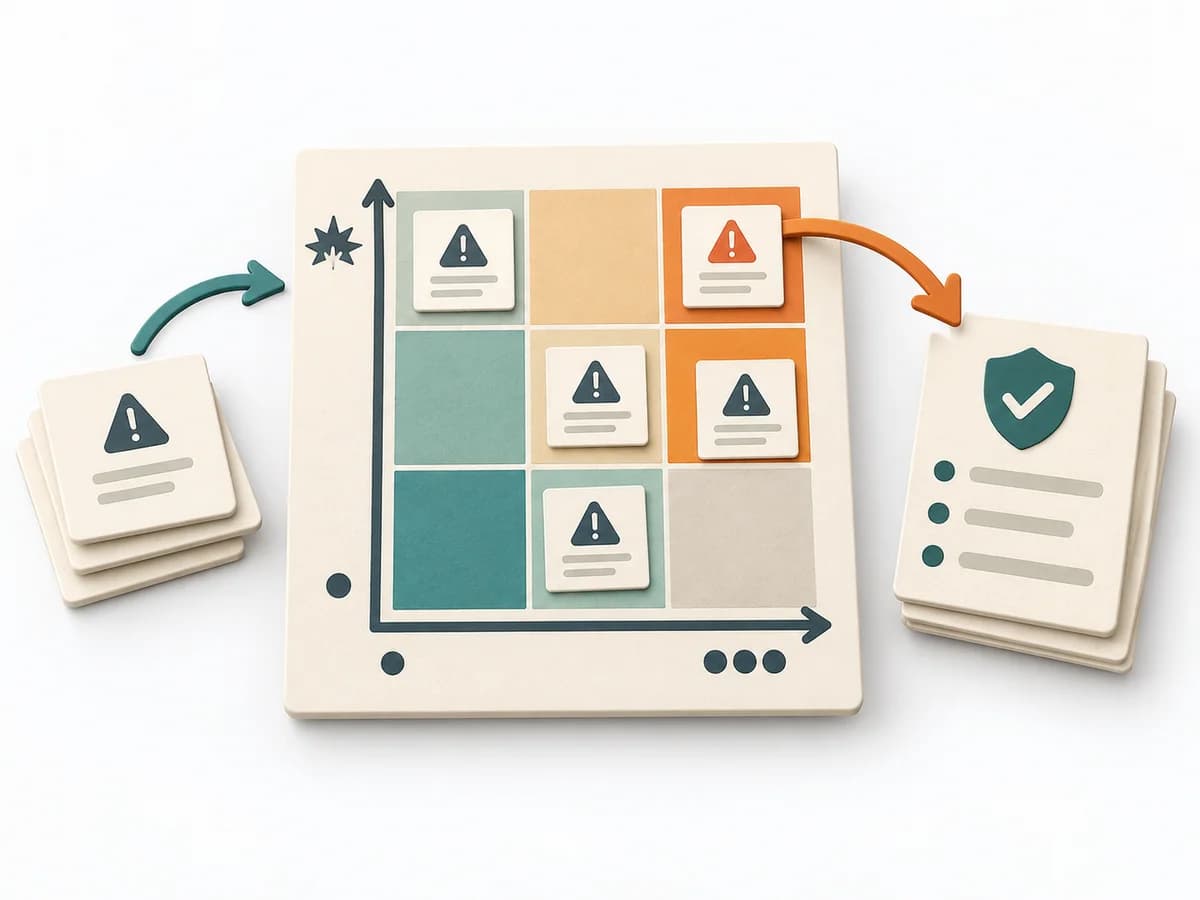 Decision Making Risk Matrix |  Agile Affinity Estimation |  Facilitation Dot Estimation |
|---|---|---|---|---|
Purposedifferent | When a release carries too many demands and priorities are only ever negotiated, MoSCoW creates clear boundaries for the next cut. Must, Should, Could, and Won't make commitment, room for maneuver, and trade-off logic visible to everyone involved. | When a project faces many possible disruptions, it quickly becomes unclear which risks deserve attention first. It separates options, evaluation criteria, and open risks. The result is captured as a Risk Matrix and a Top Risk List. | When many tasks need to be classified quickly, it sorts them by perceived effort and similarity. It reduces the effort of fine-grained estimation for large volumes. | When size or effort can only be estimated roughly, Dot Estimation condenses the group's experience into a quick range. It turns individual contributions into a visible selection. The result is captured as an Effort Heatmap, Risk Signals, and Discussion Targets. |
Complexitydifferent | Low | Low | Medium | Low |
Timedifferent | 30-90 min | 30-60 min | 30-90 min | 5-20 min |
Participantsdifferent | 3-12 | 3-10 | 3-12 | 3-20 |
Formatdifferent | Workshop + async | Workshop + async | Workshop | Workshop |
Outputdifferent | Prioritized Backlog, Release Scope, Tradeoff Notes | Risk Matrix, Top Risk List | Affinity Size Map, Grouped Estimates, Unclear Items | Effort Heatmap, Risk Signals, Discussion Targets |
Tagsno overlap | PrioritizationScopeDecision | RiskDecisionPrioritizationAssessment | EstimationBacklogRelative sizing | EstimationEffortRisk |