View methods side by side.
Choose up to four methods. Add them using the search and share the comparison by copying its link.
| Criterion |  Innovation Morphological Analysis |  Knowledge Modeling Concept Mapping |  Decision Making Argument Mapping | 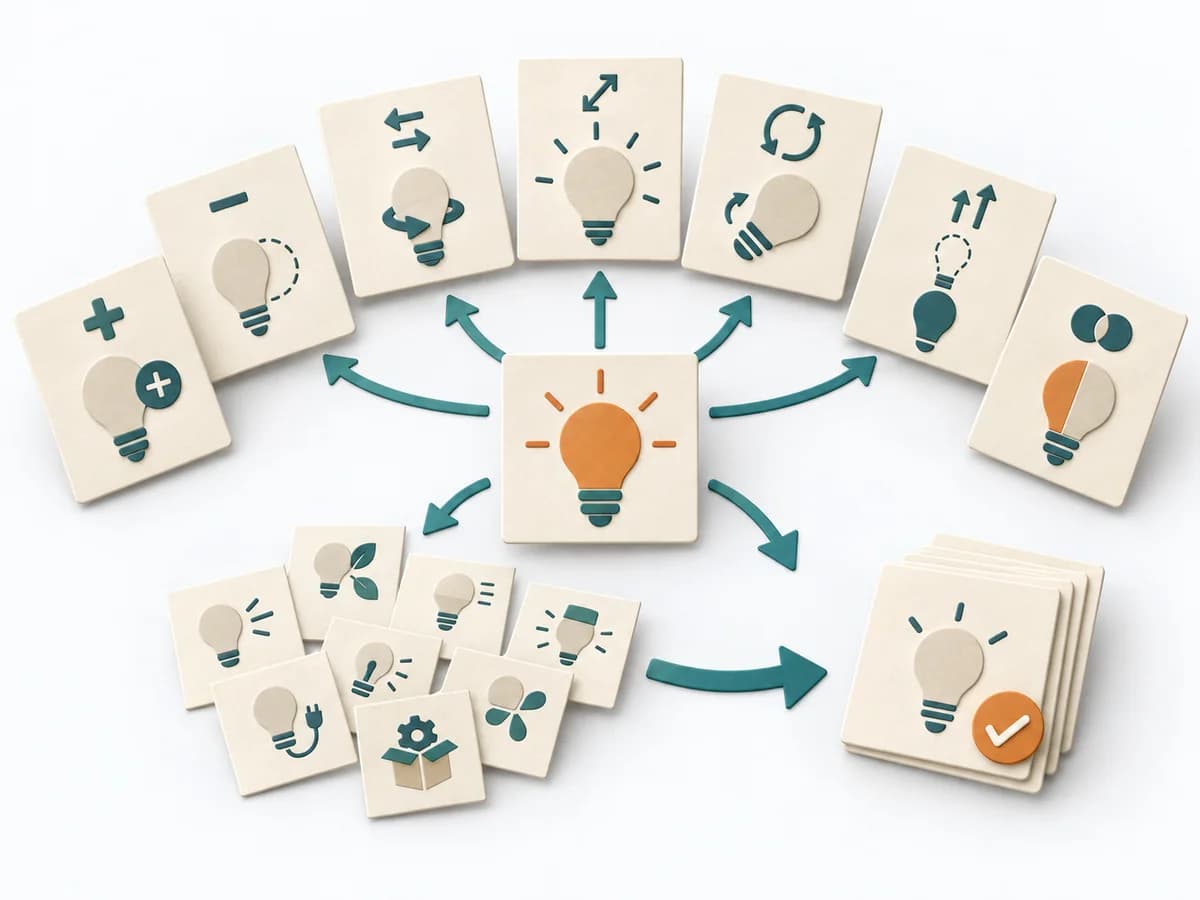 Innovation SCAMPER |
|---|---|---|---|---|
Purposedifferent | For a search for solutions with many degrees of freedom, a grid emerges for systematic combinations. The method separates features, variants, and exclusion criteria, so the space gets explored deliberately. | Concept Mapping arranges terms and relationships in a network that makes subject-matter connections tangible. It fits when a topic needs to be understood structurally rather than linearly. | When statements, evidence, and counterarguments get mixed up, a debate quickly loses its structure. Argument Mapping breaks a thesis down into its reasoning and makes visible what it really rests on. | For an existing solution under pressure to change, the method deliberately opens space for systematic variants. It directs attention to rebuilding, combining, and repurposing rather than only new basic ideas. This produces concrete evolution paths for products, offerings, or workflows. |
Complexitydifferent | Medium | Medium | Medium | Low |
Timedifferent | 1-3 h | 1-2 h | 1-3 h | 30-60 min |
Participantsdifferent | 2-8 | 1-8 | 1-8 | 2-10 |
Formatdifferent | Workshop + async | Workshop + async | Workshop + async | Workshop |
Outputdifferent | Morphological Box, Concept Combinations, Idea Shortlist | Concept Map, Relationship Labels, Knowledge Gaps | Argument Map, Evidence Gaps, Decision Rationale | SCAMPER Idea List, Concept Shortlist, Variation Notes |
Tagsno overlap | IdeationInnovationCreativity | KnowledgeConceptsMappingSensemaking | SensemakingDecisionRationale | BrainstormingIdeationCreativityReframingInnovation |