View methods side by side.
Choose up to four methods. Add them using the search and share the comparison by copying its link.
| Criterion |  Systems Thinking Leverage Points |  Innovation Morphological Analysis | 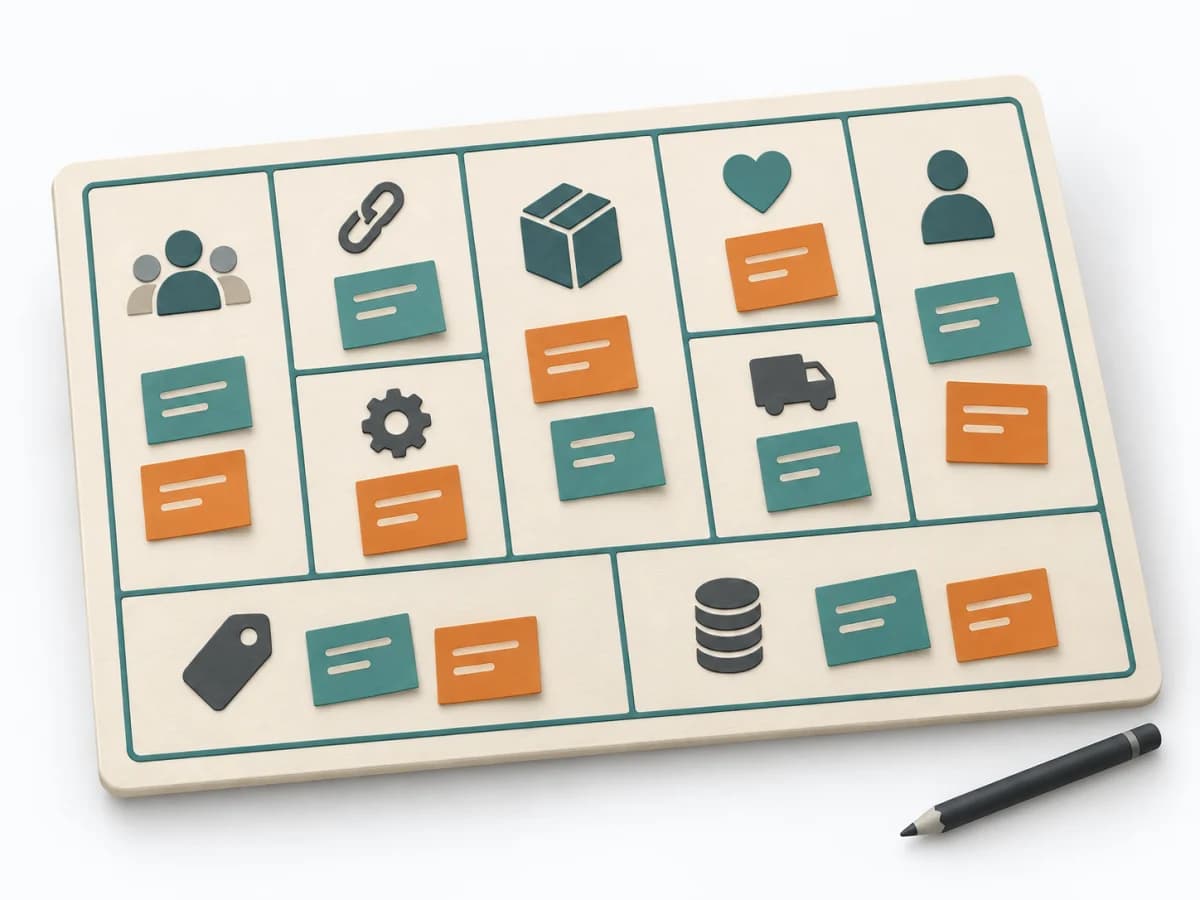 Business Strategy Business Model Canvas |  Innovation SCAMPER |
|---|---|---|---|---|
Purposedifferent | Leverage Points show exactly where interventions in a system produce a disproportionate effect. It draws relationships, patterns, and feedback loops. The result is captured as a leverage map and action strategy. | For a search for solutions with many degrees of freedom, a grid emerges for systematic combinations. The method separates features, variants, and exclusion criteria, so the space gets explored deliberately. | The Business Model Canvas condenses a business model to its key building blocks and assumptions. It makes variants quickly comparable and reveals gaps before validation or implementation begins. | For an existing solution under pressure to change, the method deliberately opens space for systematic variants. It directs attention to rebuilding, combining, and repurposing rather than only new basic ideas. This produces concrete evolution paths for products, offerings, or workflows. |
Complexitydifferent | High | Medium | Medium | Low |
Timedifferent | Half day | 1-3 h | 1-2 h | 30-60 min |
Participantsdifferent | 3-12 | 2-8 | 2-8 | 2-10 |
Formatdifferent | Workshop | Workshop + async | Workshop + async | Workshop |
Outputdifferent | Leverage Map, Action Strategy | Morphological Box, Concept Combinations, Idea Shortlist | Business Model Canvas, Assumption List, Business Hypotheses | SCAMPER Idea List, Concept Shortlist, Variation Notes |
Tagsno overlap | Systems thinkingChangeStrategy | IdeationInnovationCreativity | Business modelStrategyValueInnovation | BrainstormingIdeationCreativityReframingInnovation |