View methods side by side.
Choose up to four methods. Add them using the search and share the comparison by copying its link.
| Criterion |  UX Design Lean UX Canvas |  Product Discovery Outcome-Driven Innovation |  Facilitation Alignment Mapping | 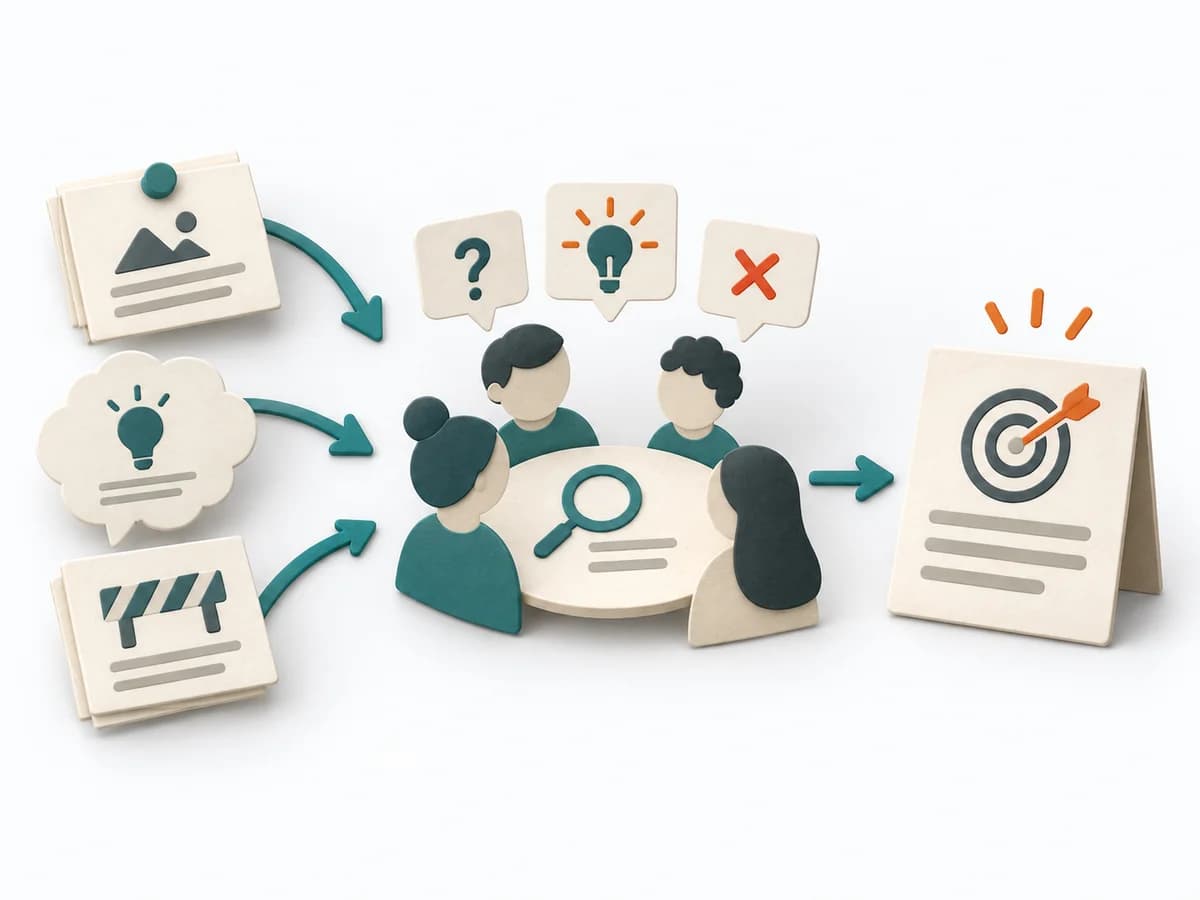 Facilitation Problem Framing Workshop |
|---|---|---|---|---|
Purposedifferent | The Lean UX Canvas helps clarify user behavior, touchpoints, and concept decisions. It makes assumptions and desired outcomes visible and captures the result as a completed canvas, hypothesis list, and first experiment. | Outcome-Driven Innovation clarifies customer problems, solution opportunities, and evidence. It separates jobs, desired outcomes, importance, satisfaction, and opportunity, and captures results as desired outcome statements, an opportunity landscape, and segments by underserved needs. | When several people work toward one goal but hold different mental maps, Alignment Mapping makes the discrepancies visible. It arranges goals, assumptions, and priorities so shared direction becomes verifiable. | When a team works on symptoms but the real question stays fuzzy, a Problem Framing Workshop sharpens the view of the right problem. It separates observation, interpretation, and target picture from each other. |
Complexitydifferent | Medium | High | Medium | Low |
Timedifferent | 2-3 h | Mehrere Wochen | 1-2 h | 60-120 min |
Participantsdifferent | 3-8 | 2-6 researchers plus sample | 4-12 | 4-10 |
Formatdifferent | Workshop + async | Workshop + async | Workshop | Workshop |
Outputdifferent | Completed Lean UX Canvas, Hypothesis list, First experiment | Desired outcome statements, Opportunity landscape, Segmentation by underserved needs, Innovation hypotheses | Alignment Map, Open Issues, Decision Questions | Problem Statement, Scope Boundaries, Assumption List, Next Analysis Questions |
Tagsno overlap | CanvasHypothesisOutcomesDiscovery | OutcomesInnovationResearchQuantitative | AlignmentStakeholdersStrategyFacilitation | FacilitationAlignmentDiscovery |