View methods side by side.
Choose up to four methods. Add them using the search and share the comparison by copying its link.
| Criterion |  UX Research Customer Journey Mapping |  Innovation Reverse Brainstorming | 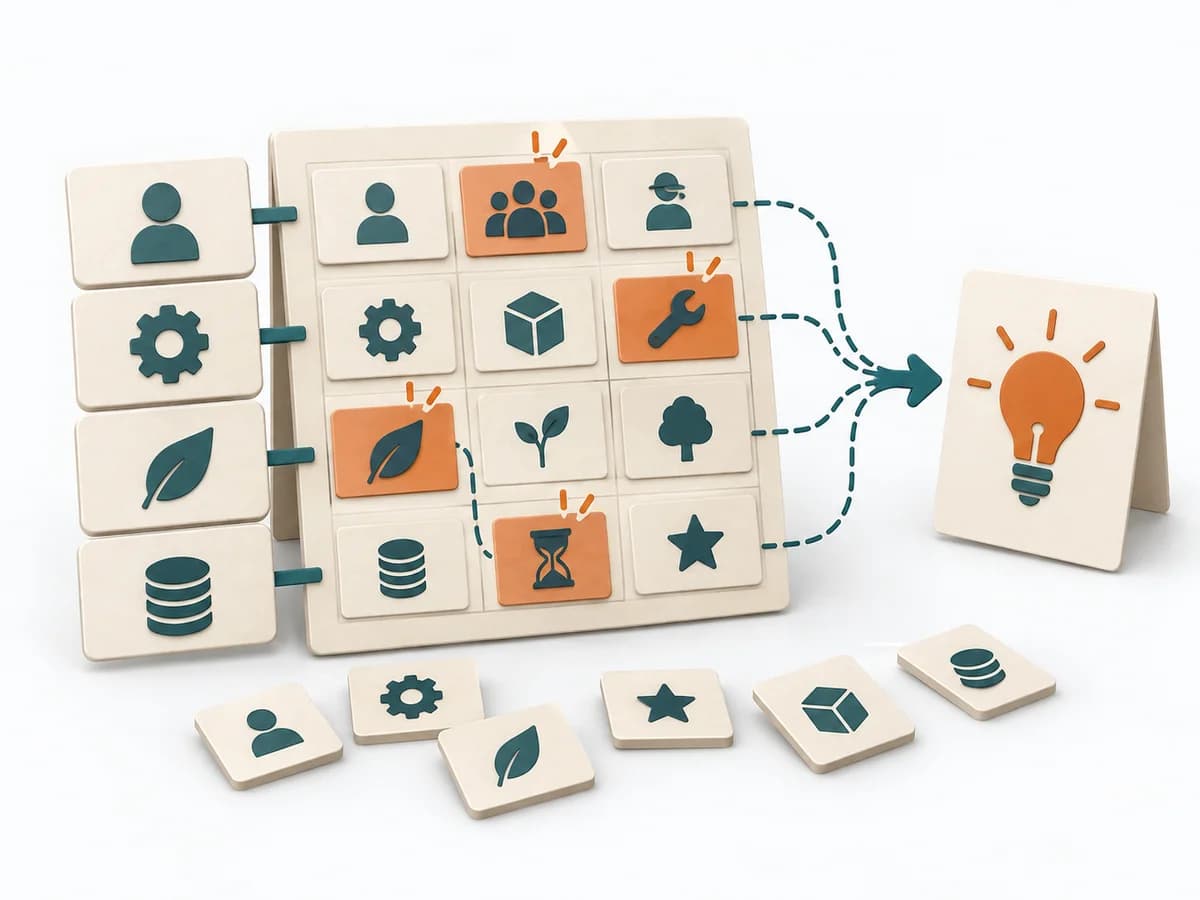 Innovation Morphological Analysis |  Innovation Brainstorming |
|---|---|---|---|---|
Purposedifferent | When a user journey falls apart across many touchpoints, customer journey mapping makes the experience visible as a coherent arc. Phases, emotions, and breaks become legible enough to prioritize critical moments deliberately. | For persistent errors or blockages, the method shifts the view to the opposite of the desired effect. It exposes the mechanics of failure and makes hidden causes easier to grasp. This makes improvement more concrete and the problem clearer. | For a search for solutions with many degrees of freedom, a grid emerges for systematic combinations. The method separates features, variants, and exclusion criteria, so the space gets explored deliberately. | When a team faces an open question with many obvious directions, the method first creates breadth instead of premature commitment. It separates idea flow from evaluation and makes lines of thought visible, creating a pool for selection and further development. |
Complexitydifferent | Medium | Low | Medium | Low |
Timedifferent | 2-4 h | 30-60 min | 1-3 h | 30-60 min |
Participantsdifferent | 4-10 | 3-12 | 2-8 | 4-12 |
Formatdifferent | Workshop | Workshop | Workshop + async | Workshop |
Outputdifferent | Journey Map, Pain-point List, Opportunity Backlog | Reverse Ideas, Risk Themes, Solution Ideas | Morphological Box, Concept Combinations, Idea Shortlist | Idea pool, Theme clusters, Shortlist |
Tagsno overlap | JourneyServiceService design | BrainstormingIdeationCreativityRisk | IdeationInnovationCreativity | BrainstormingIdeationCreativityWorkshopDivergence |