View methods side by side.
Choose up to four methods. Add them using the search and share the comparison by copying its link.
| Criterion |  Knowledge Modeling IBIS |  Product Discovery Outcome-Driven Innovation | 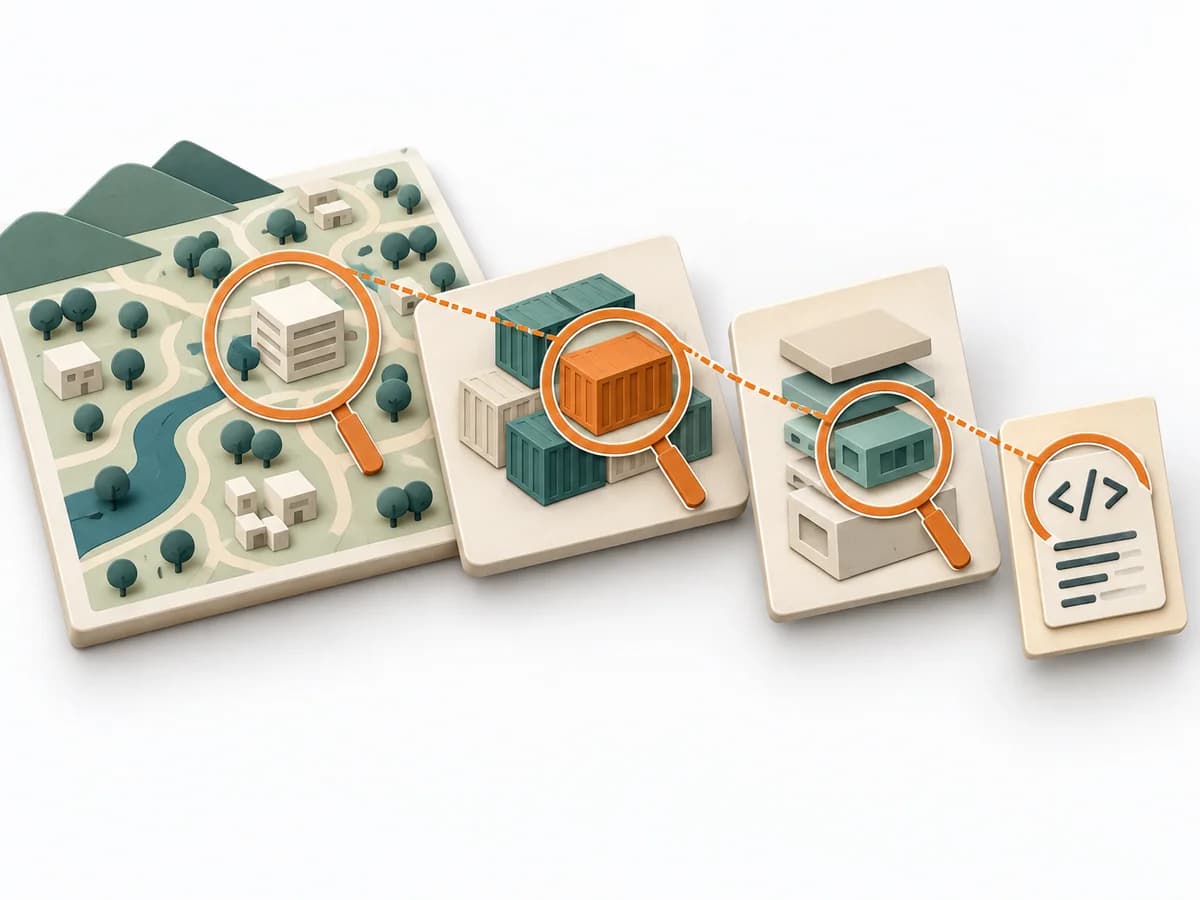 Architecture C4 Model |  Architecture Architecture Communication Canvas |
|---|---|---|---|---|
Purposedifferent | IBIS structures thinking about complex questions as a sequence of issues, ideas, and arguments. The method keeps discussions open without forcing them into premature consensus. | Outcome-Driven Innovation clarifies customer problems, solution opportunities, and evidence. It separates jobs, desired outcomes, importance, satisfaction, and opportunity, and captures results as desired outcome statements, an opportunity landscape, and segments by underserved needs. | The C4 Model makes a system legible across several resolution levels, from context down to code. It suits situations where different audiences need to understand the same architecture from different altitudes. | The Architecture Communication Canvas plans architecture communication so the right people receive the right message. The method turns technical complexity into deliberate communication design. |
Complexitydifferent | Medium | High | Low | Medium |
Timedifferent | 1-3 h | Mehrere Wochen | 1-4 h | 60-120 min |
Participantsdifferent | 2-8 | 2-6 researchers plus sample | 1-5 | 2-8 |
Formatsame | Workshop + async | Workshop + async | Workshop + async | Workshop + async |
Outputdifferent | Issue Map, Positions, Argument Notes | Desired outcome statements, Opportunity landscape, Segmentation by underserved needs, Innovation hypotheses | Context Diagram, Container Diagram, Component Diagram | Communication Canvas, Stakeholder Messages, Architecture Communication Plan |
Tagsno overlap | RationaleKnowledgeDecision | OutcomesInnovationResearchQuantitative | ArchitectureCommunicationVisualization | ArchitectureCommunicationStakeholdersCanvas |