View methods side by side.
Choose up to four methods. Add them using the search and share the comparison by copying its link.
| Criterion |  Knowledge Modeling IBIS |  Knowledge Modeling Feynman Technique | 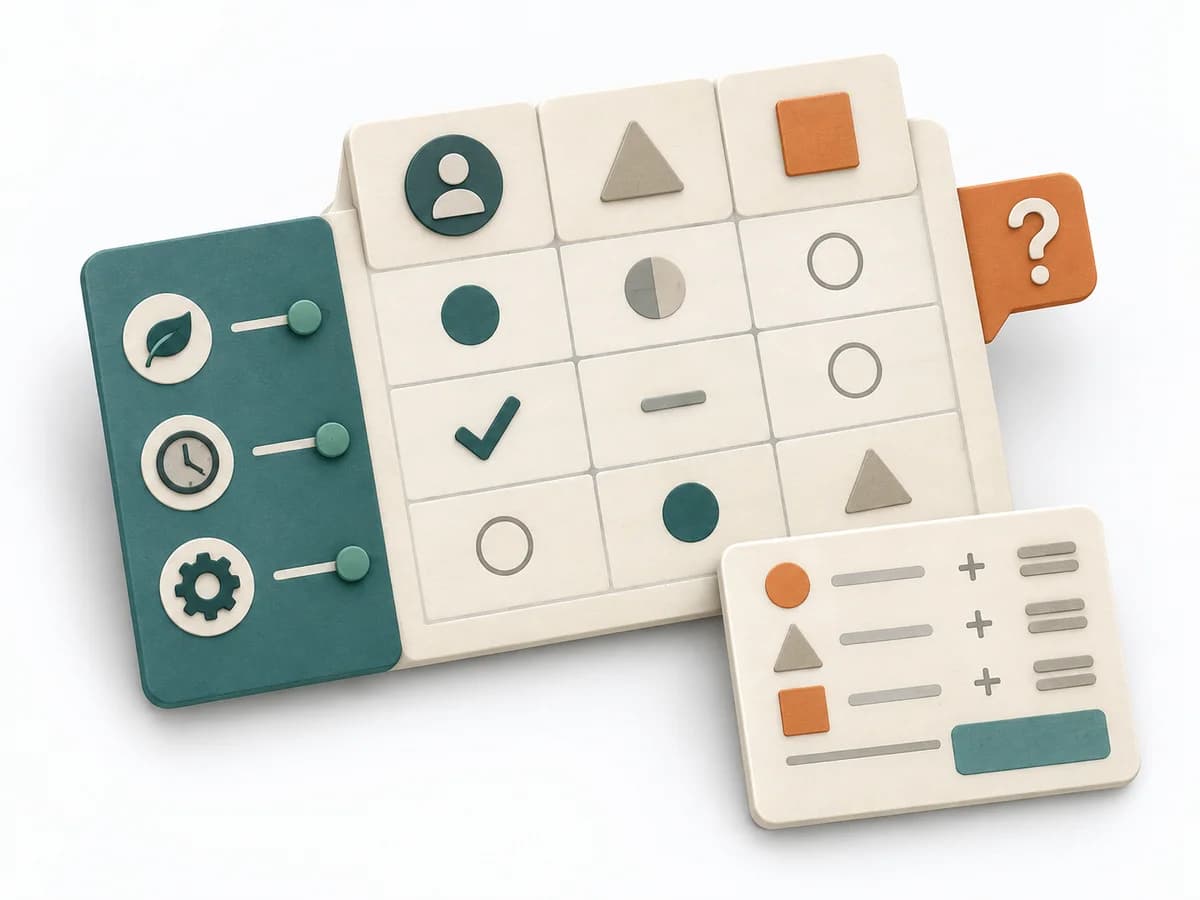 Decision Making Decision Matrix |  Product Strategy ICE Scoring |
|---|---|---|---|---|
Purposedifferent | IBIS structures thinking about complex questions as a sequence of issues, ideas, and arguments. The method keeps discussions open without forcing them into premature consensus. | The Feynman Technique checks understanding by explaining a topic so that it stays easy for others to understand. It makes knowledge gaps visible before they become costly in everyday work. | When several options collide with several criteria, comparison quickly becomes subjective. A Decision Matrix makes the trade-off visible and brings weighting, criteria, and options into a shared logic. | When ideas need sorting quickly, it condenses impact, confidence, and effort into one compact score. It connects customer value, product logic, and decision priorities. The result is captured as an ICE table and top-ideas list. |
Complexitydifferent | Medium | Low | Medium | Low |
Timedifferent | 1-3 h | 20-60 min | 45-90 min | 30-60 min |
Participantsdifferent | 2-8 | 1 | 2-8 | 2-8 |
Formatdifferent | Workshop + async | Async | Workshop + async | Workshop + async |
Outputdifferent | Issue Map, Positions, Argument Notes | Plain-language Explanation, Knowledge Gaps, Study Notes | Decision Matrix, Scoring Rationale, Selected Option | ICE Table, Top Idea List |
Tagsno overlap | RationaleKnowledgeDecision | LearningKnowledgeUnderstanding | DecisionCriteriaScoringTradeoffs | PrioritizationScoringGrowthDecision |