View methods side by side.
Choose up to four methods. Add them using the search and share the comparison by copying its link.
| Criterion |  Knowledge Modeling IBIS |  Facilitation Alignment Mapping | 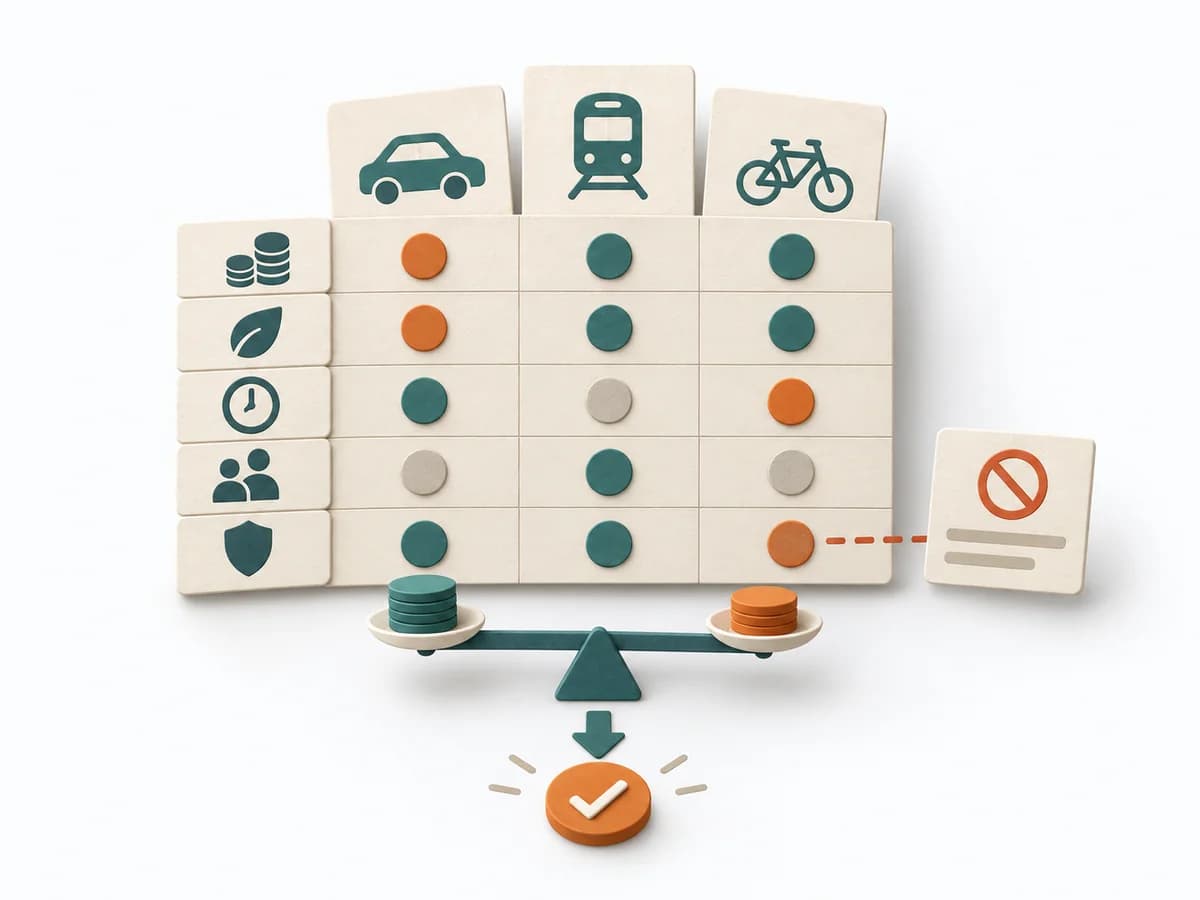 Decision Making Trade-off Analysis |  Facilitation Six Thinking Hats |
|---|---|---|---|---|
Purposedifferent | IBIS structures thinking about complex questions as a sequence of issues, ideas, and arguments. The method keeps discussions open without forcing them into premature consensus. | When several people work toward one goal but hold different mental maps, Alignment Mapping makes the discrepancies visible. It arranges goals, assumptions, and priorities so shared direction becomes verifiable. | With limited resources, quality, speed, cost, and risk almost always compete with each other. Trade-off Analysis makes these tensions explicit and prevents decisions from producing hidden side effects. | When a topic gets stuck too quickly in the same thinking mode, Six Thinking Hats deliberately separates the perspectives. This means facts, risks, creativity, and emotional signals get worked through one after another instead of mixed together. |
Complexitysame | Medium | Medium | Medium | Medium |
Timedifferent | 1-3 h | 1-2 h | 45-120 min | 45-90 min |
Participantsdifferent | 2-8 | 4-12 | 2-8 | 4-12 |
Formatdifferent | Workshop + async | Workshop | Workshop + async | Workshop |
Outputdifferent | Issue Map, Positions, Argument Notes | Alignment Map, Open Issues, Decision Questions | Trade-off Matrix, Criteria List, Decision Rationale, Accepted Downsides | Perspective Notes, Decision Inputs, Action Items |
Tagsno overlap | RationaleKnowledgeDecision | AlignmentStakeholdersStrategyFacilitation | TradeoffsDecisionCriteriaOptions | FacilitationOptionsDecision |