View methods side by side.
Choose up to four methods. Add them using the search and share the comparison by copying its link.
| Criterion |  Knowledge Modeling IBIS | 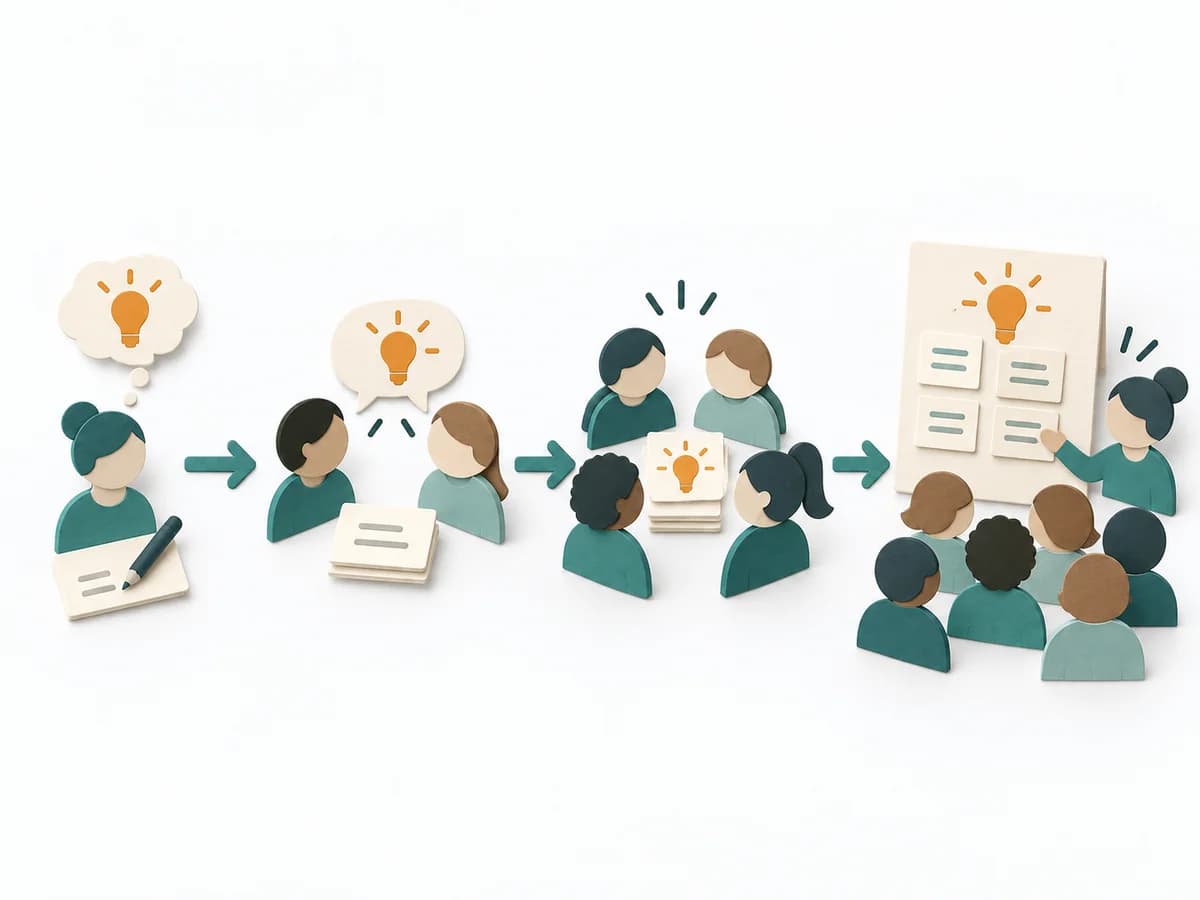 Facilitation 1-2-4-All |  Facilitation Decision Jam |  Innovation Brainstorming |
|---|---|---|---|---|
Purposedifferent | IBIS structures thinking about complex questions as a sequence of issues, ideas, and arguments. The method keeps discussions open without forcing them into premature consensus. | When many people in a group too rarely get to speak, 1-2-4-All distributes thinking time more fairly. The format builds participation step by step and makes quiet or still-unformed thoughts usable faster. | When a decision is stuck, Decision Jam loosens the knot through structured separation of problem, idea, and selection. The format creates movement without jumping prematurely at the first seemingly elegant answer. | When a team faces an open question with many obvious directions, the method first creates breadth instead of premature commitment. It separates idea flow from evaluation and makes lines of thought visible, creating a pool for selection and further development. |
Complexitydifferent | Medium | Low | Low | Low |
Timedifferent | 1-3 h | 10-20 min | 60-90 min | 30-60 min |
Participantsdifferent | 2-8 | 4-100+ | 4-10 | 4-12 |
Formatdifferent | Workshop + async | Workshop | Workshop | Workshop |
Outputdifferent | Issue Map, Positions, Argument Notes | Idea List, Shared Insights, Emergent Themes | Problem Cluster, Prioritized Challenge, Experiment | Idea pool, Theme clusters, Shortlist |
Tagsno overlap | RationaleKnowledgeDecision | FacilitationInclusionIdeation | FacilitationDecisionProblem solvingWorkshop | BrainstormingIdeationCreativityWorkshopDivergence |