View methods side by side.
Choose up to four methods. Add them using the search and share the comparison by copying its link.
| Criterion |  Engineering Hypothesis-Driven Troubleshooting |  Growth Growth Experiment | 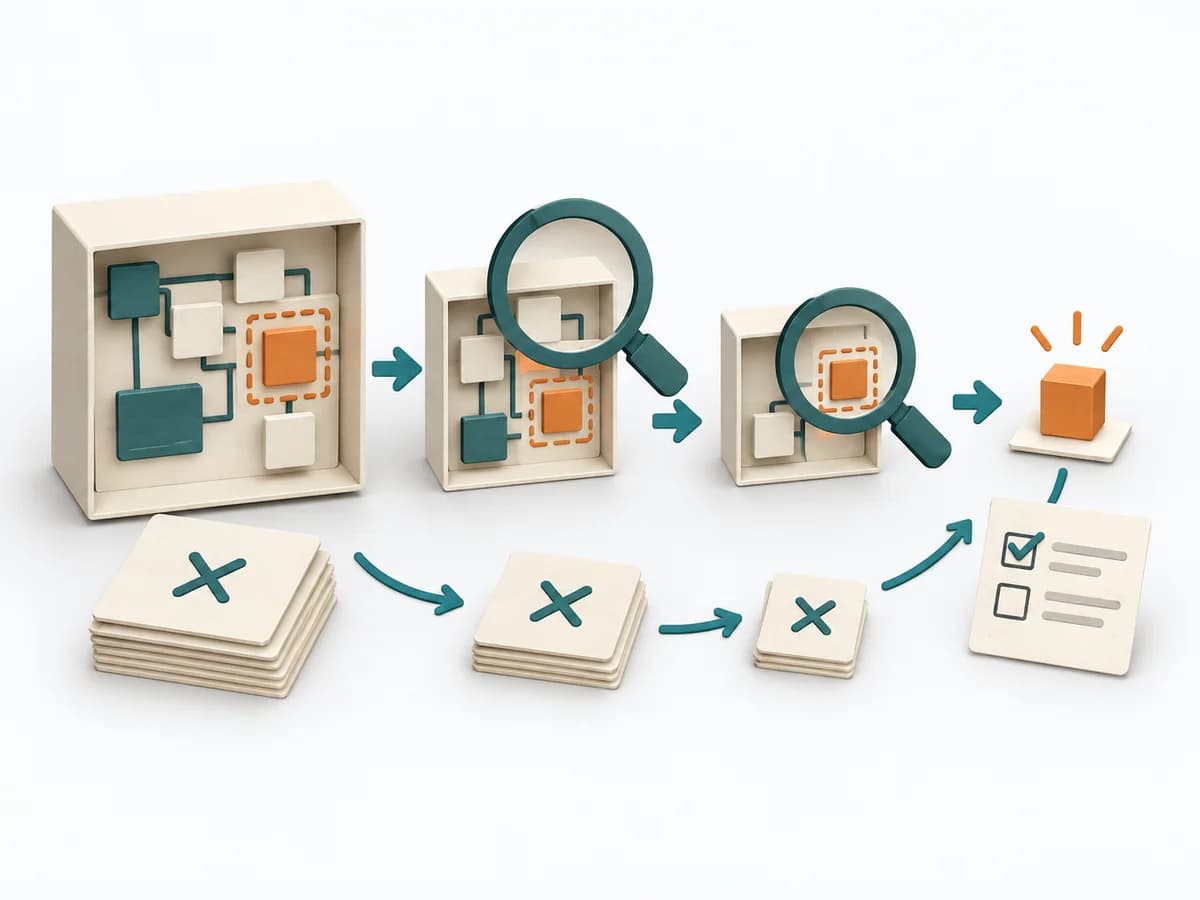 Engineering Fault Isolation |  Growth Pirate Metrics AARRR |
|---|---|---|---|---|
Purposedifferent | When systems fail unexpectedly, spontaneous attempts often produce more noise than insight. Hypothesis-driven Troubleshooting translates symptoms into testable assumptions and makes troubleshooting learnable. | When growth ideas surface quickly, the temptation to build immediately instead of learning is high. A Growth Experiment frames an assumption so target group, lever, and measurement are clear before the first deployment. | In technical failures, the visible symptom often gets mixed up with the actual cause. Fault Isolation narrows the fault space and progressively reduces which part of the system is truly affected. | For products with complex usage paths, overall growth alone is too coarse to reveal bottlenecks. Pirate Metrics breaks the relationship with the product into consecutive stages and shows where the funnel actually leaks. |
Complexitysame | Medium | Medium | Medium | Medium |
Timedifferent | 30-240 min | 1-2 Wochen | 30-180 min | 1-2 h Setup, laufend |
Participantsdifferent | 1-6 | 1-6 | 1-6 | 2-8 |
Formatsame | Workshop + async | Workshop + async | Workshop + async | Workshop + async |
Outputdifferent | Hypothesis Log, Test Plan, Evidence Notes, Diagnosis Summary | Experiment card, Result summary, Next bet | Fault Isolation Map, Test Log, Excluded Hypotheses, Narrowed Fault Area | AARRR funnel, Metric baseline, Experiment backlog |
Tagsno overlap | TroubleshootingProblem solvingDiagnosis | MarketingGrowthExperimentsLearning | TroubleshootingDiagnosisEngineering | GrowthMetricsExperiments |