View methods side by side.
Choose up to four methods. Add them using the search and share the comparison by copying its link.
Selected:Hypothesis-Driven Troubleshooting5-Minuten VC-CheckFailure Mode and Effects AnalysisFishbone Diagram
| Criterion |  Engineering Hypothesis-Driven Troubleshooting | 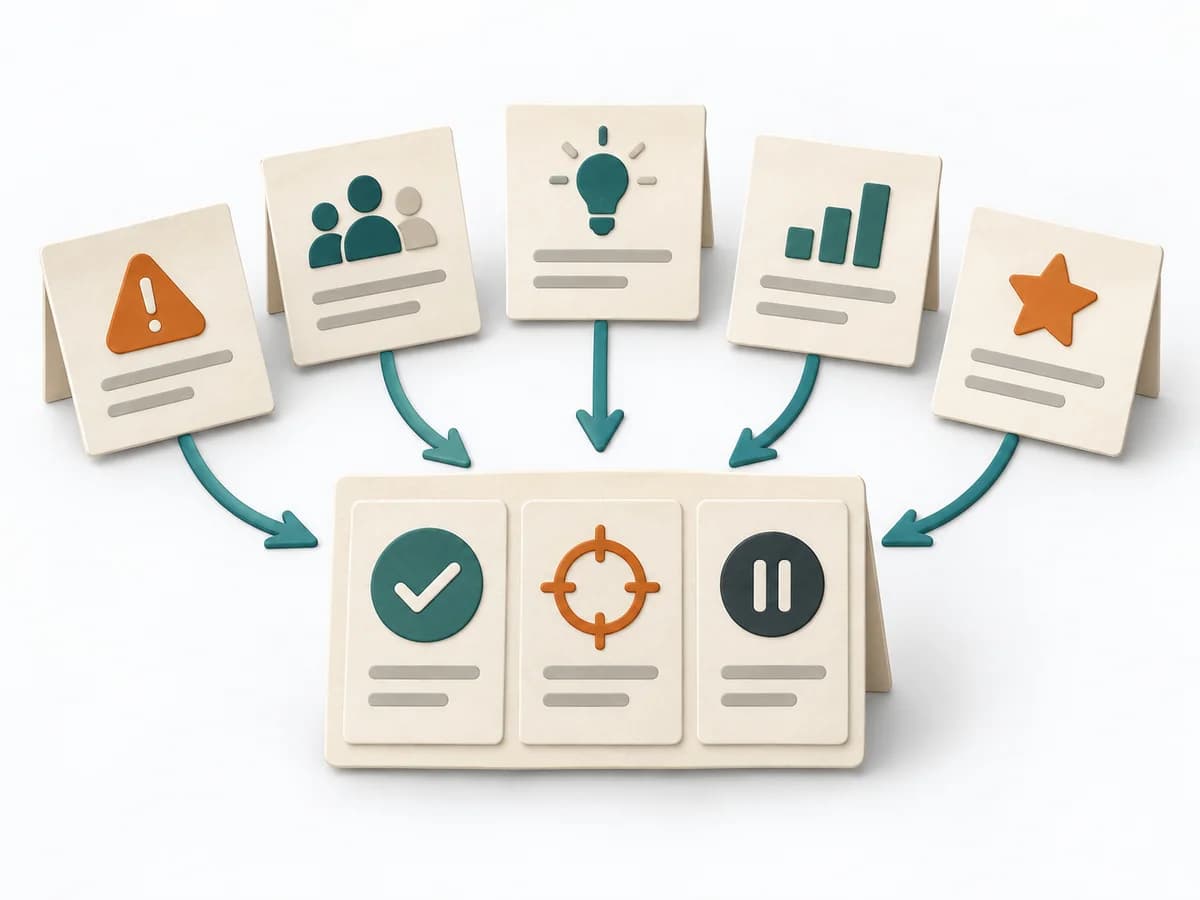 Business Strategy 5-Minuten VC-Check |  Operations Failure Mode and Effects Analysis |  Operations Fishbone Diagram |
|---|---|---|---|---|
Purposedifferent | When systems fail unexpectedly, spontaneous attempts often produce more noise than insight. Hypothesis-driven Troubleshooting translates symptoms into testable assumptions and makes troubleshooting learnable. | The 5-Minute VC Check clarifies opportunities and strategic options at the earliest idea stage. It compares problem quality, customer willingness to pay, alternatives, differentiation, and market potential, and captures the result as a VC-check note, go/sharpen/park decision, and risk list. | For a process, product, or service with noticeable failure risks, the method assesses possible failure modes in advance. It directs attention to combinations of occurrence, effect, and detectability. | When a problem has several possible contributing factors, the method sorts causes by cause areas. It prevents an initial hunch from blocking the view of other plausible drivers. |
Complexitydifferent | Medium | Low | High | Low |
Timedifferent | 30-240 min | 5-15 min | 2-6 h | 30-60 min |
Participantsdifferent | 1-6 | 1-5 | 3-10 | 2-8 |
Formatdifferent | Workshop + async | Workshop + async | Workshop | Workshop |
Outputdifferent | Hypothesis Log, Test Plan, Evidence Notes, Diagnosis Summary | VC-check note, Go/sharpen/park decision, Risk and assumption list, Next validation step | FMEA Table, Risk Priority, Mitigation Actions | Fishbone Diagram, Cause Categories, Investigation Backlog |
Tagsno overlap | TroubleshootingProblem solvingDiagnosis | StartupValidationCompetition | RiskQualityOperationsRoot cause | Root causeQualityOperations |