View methods side by side.
Choose up to four methods. Add them using the search and share the comparison by copying its link.
| Criterion |  Growth Hooked Model |  Decision Making Constraint Analysis | 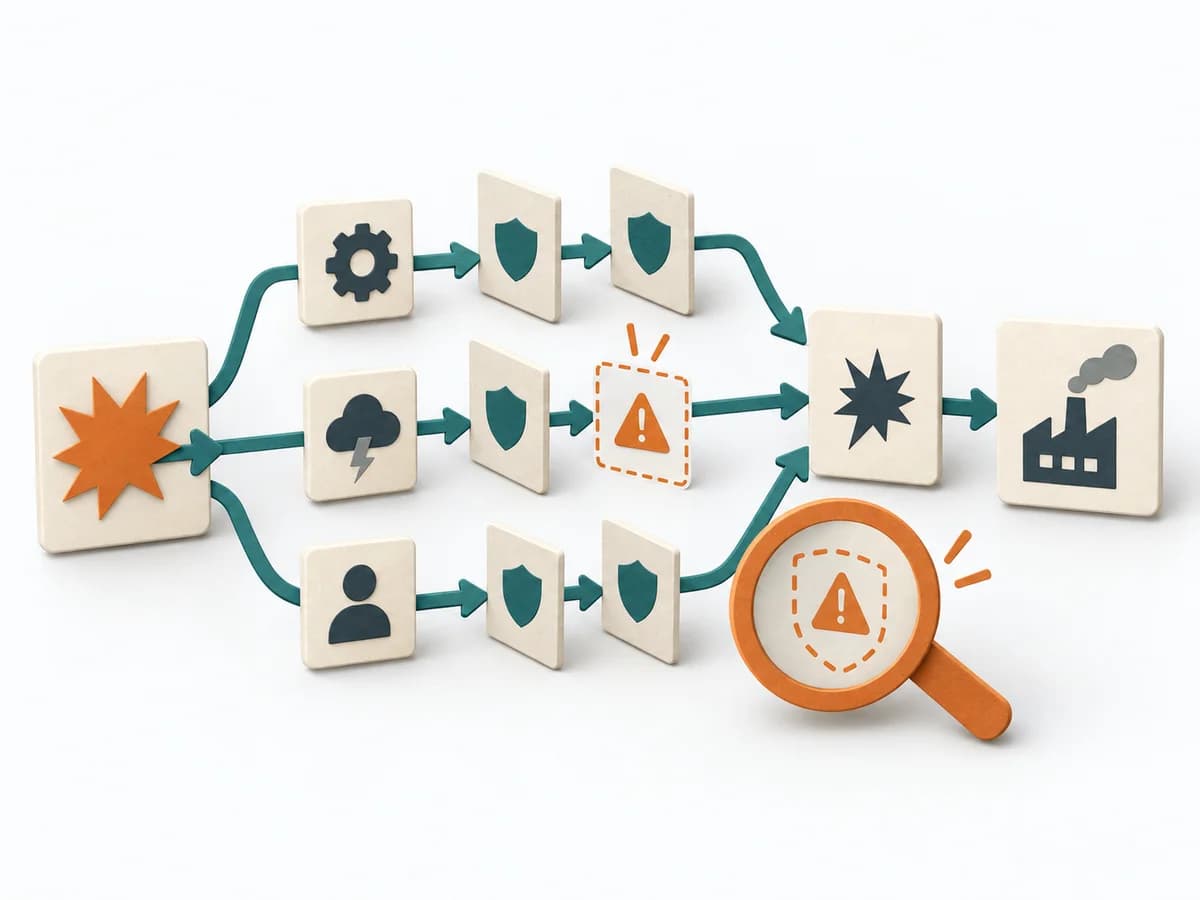 Engineering Failure Scenario Analysis |  Decision Making Decision Tree |
|---|---|---|---|---|
Purposedifferent | The Hooked Model helps clarify engagement loops, user behavior, and experiments. It makes repeat behavior measurable and captures the result as a hooked loop, trigger map, and reward design. | When an initiative stalls, the limit often lies not in the idea but in hard or soft boundary conditions. Constraint Analysis separates these limits and shows which of them can actually be shaped. | In critical processes, it is not enough to plan only for the normal case. Failure Scenario Analysis looks at the path into failure and shows which failures, chains, and control gaps cause the most damage. | For decisions with follow-on paths and dependencies, a linear comparison is often not enough. A Decision Tree shows how options branch under conditions and which consequences hang on each branch. |
Complexitydifferent | Medium | Low | Medium | Medium |
Timedifferent | Multiple workshops over several weeks | 30-90 min | 1-3 h | 30-90 min |
Participantsdifferent | 2-8 | 2-8 | 3-8 | 1-6 |
Formatdifferent | Workshop + async | Workshop + async | Workshop | Workshop + async |
Outputdifferent | Hooked loop, Trigger map, Reward design, Ethics check | Constraint List, Hard/Soft Classification, Option Impact Notes, Decision Boundaries | Failure Scenarios, Risk Notes, Control Gaps, Test and Response Actions | Decision Tree, Option Map, Assumption List |
Tagsno overlap | GrowthBehaviorRetention | ConstraintsDecisionPlanningOptions | FailureResilienceRisk | DecisionTreeOptions |