View methods side by side.
Choose up to four methods. Add them using the search and share the comparison by copying its link.
| Criterion |  UX Research HEART Framework | 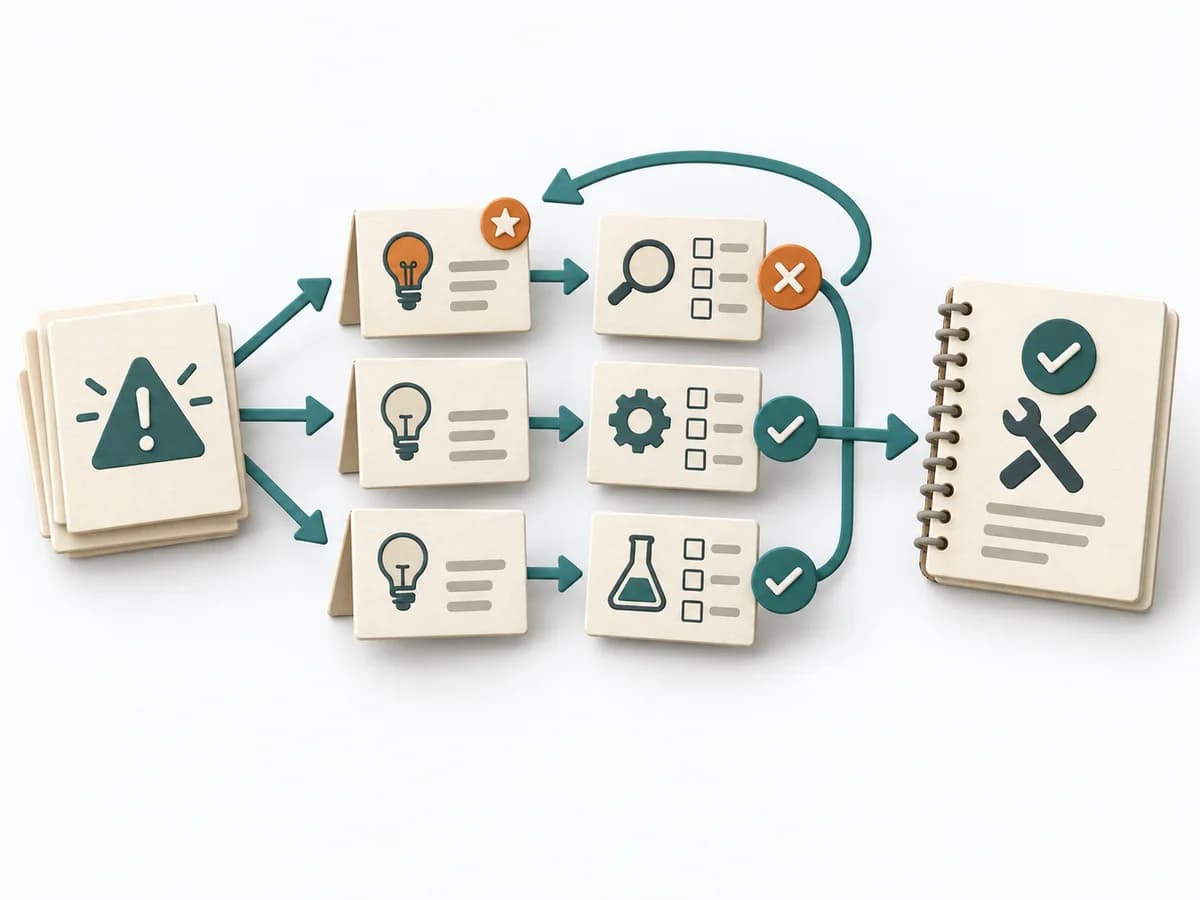 Engineering Hypothesis-Driven Troubleshooting |  Operations 8D Problem Solving |  Operations Change Analysis |
|---|---|---|---|---|
Purposedifferent | Helps clarify observations, needs, and patterns in concrete terms. It groups observations into patterns, questions, and decisions. The result is captured as a HEART-GSM table and dashboard. | When systems fail unexpectedly, spontaneous attempts often produce more noise than insight. Hypothesis-driven Troubleshooting translates symptoms into testable assumptions and makes troubleshooting learnable. | For an acute quality or delivery problem, the method structures immediate protection and root cause work together. It keeps the situation stable while the actual cause is investigated cleanly. | For a deviation after a change, the method isolates the influence of the altered condition. It narrows down which differences are relevant and which are just accompanying noise. |
Complexitydifferent | Medium | Medium | High | Medium |
Timedifferent | 120 min initial, dann laufend | 30-240 min | 1-6 Wochen | 45-120 min |
Participantsdifferent | 3-6 | 1-6 | 4-10 | 2-6 |
Formatsame | Workshop + async | Workshop + async | Workshop + async | Workshop + async |
Outputdifferent | HEART-GSM Table, Dashboard | Hypothesis Log, Test Plan, Evidence Notes, Diagnosis Summary | 8D Report, Containment Plan, Root Cause Evidence, Corrective Action Plan | Change Matrix, Cause Hypotheses, Validation Questions, Action List |
Tagsno overlap | MetricsUX researchMeasurementSatisfaction | TroubleshootingProblem solvingDiagnosis | QualityProblem solvingRoot cause | ChangeRoot causeTroubleshootingComparison |