View methods side by side.
Choose up to four methods. Add them using the search and share the comparison by copying its link.
| Criterion |  Growth Golden Circle | 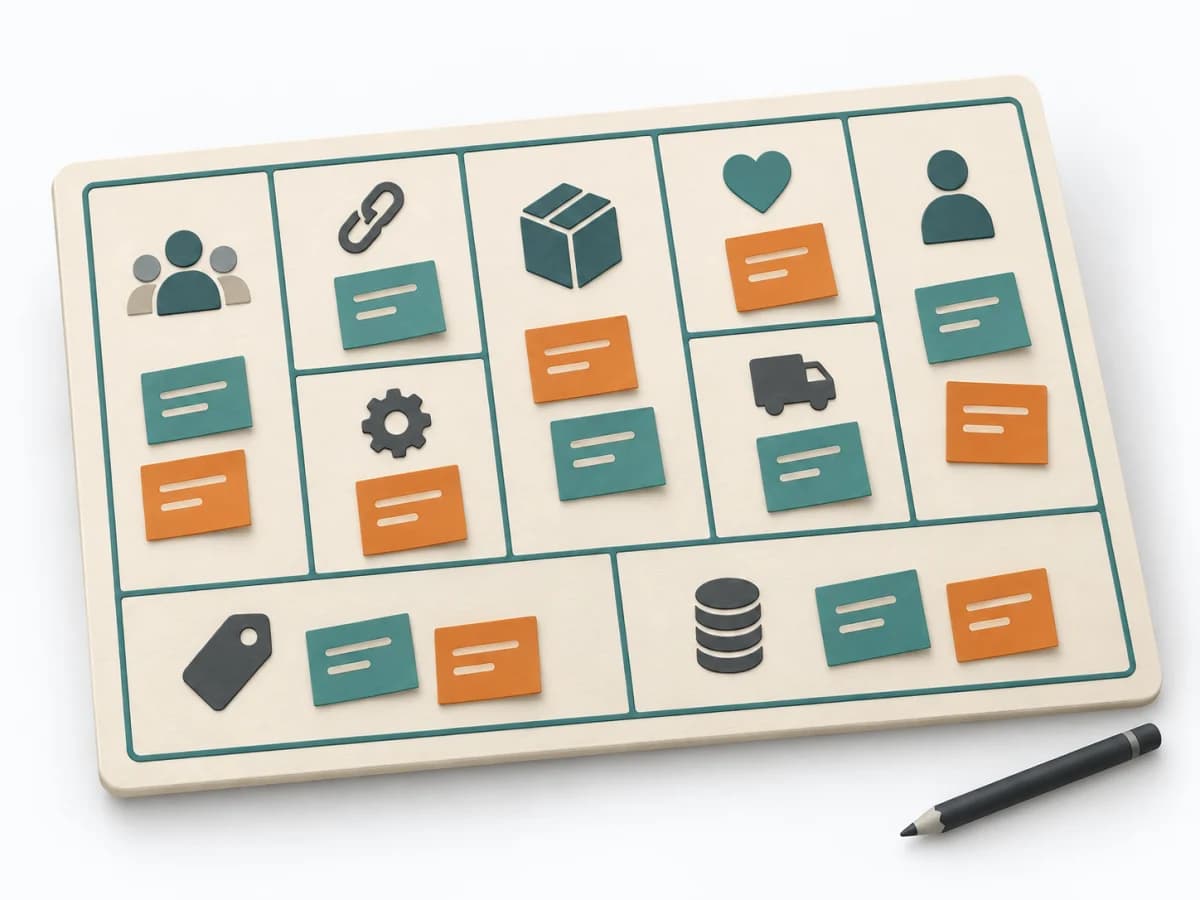 Business Strategy Business Model Canvas |  Facilitation Stakeholder Salience Model |  Facilitation Power Interest Grid |
|---|---|---|---|---|
Purposedifferent | In positioning and communication, what an offering actually stands for often becomes blurred. The Golden Circle sharpens a product's inner rationale and connects purpose, approach, and offering into a clear statement. | The Business Model Canvas condenses a business model to its key building blocks and assumptions. It makes variants quickly comparable and reveals gaps before validation or implementation begins. | When stakeholders appear to matter very differently, the Stakeholder Salience Model rates their actual priority through power, legitimacy, and urgency. It turns individual contributions into a visible selection. The result is captured as a Salience diagram and a class-based strategy. | When many stakeholders compete for attention at once, the Power Interest Grid sorts them by influence and stake. It turns individual contributions into a visible selection. The result is captured as a Power Interest Grid and a stakeholder-specific strategy. |
Complexitydifferent | Low | Medium | Medium | Low |
Timedifferent | 30-60 min | 1-2 h | 60-90 min | 30-60 min |
Participantsdifferent | 1-8 | 2-8 | 3-6 | 2-8 |
Formatdifferent | Workshop + async | Workshop + async | Workshop | Workshop |
Outputdifferent | Why Statement, Messaging Notes, Positioning Draft | Business Model Canvas, Assumption List, Business Hypotheses | Salience Diagram, Strategy per Class | Power Interest Grid, Strategy per Stakeholder |
Tagsno overlap | MarketingPositioningCommunication | Business modelStrategyValueInnovation | StakeholdersFacilitationAlignmentGovernance | StakeholdersFacilitationAlignmentPlanning |