View methods side by side.
Choose up to four methods. Add them using the search and share the comparison by copying its link.
| Criterion |  Growth Golden Circle | 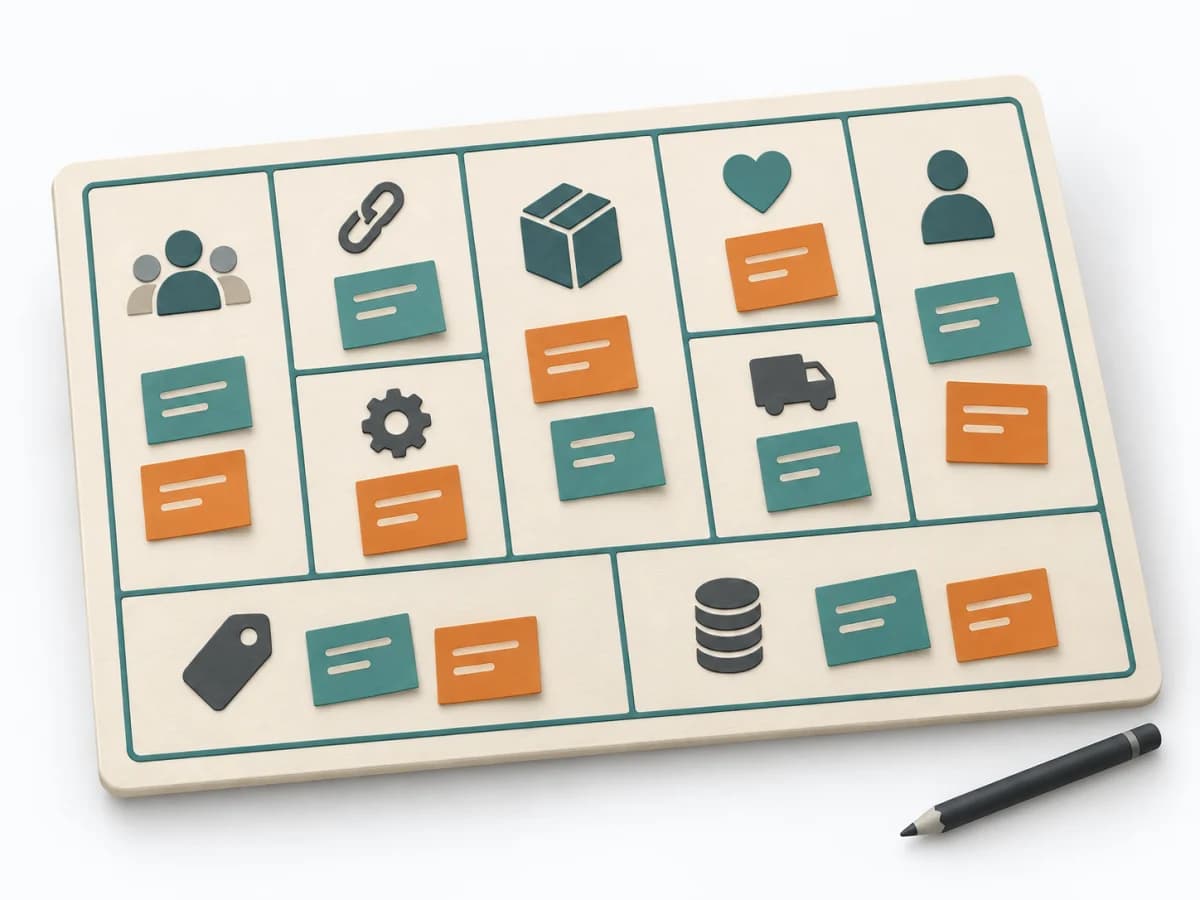 Business Strategy Business Model Canvas |  Growth A/B Testing |  Growth Growth Experiment |
|---|---|---|---|---|
Purposedifferent | In positioning and communication, what an offering actually stands for often becomes blurred. The Golden Circle sharpens a product's inner rationale and connects purpose, approach, and offering into a clear statement. | The Business Model Canvas condenses a business model to its key building blocks and assumptions. It makes variants quickly comparable and reveals gaps before validation or implementation begins. | When two variants compete, discussions quickly decide by taste rather than effect. A/B Testing checks behavior under controlled conditions and separates real improvement from chance or expectation effects. | When growth ideas surface quickly, the temptation to build immediately instead of learning is high. A Growth Experiment frames an assumption so target group, lever, and measurement are clear before the first deployment. |
Complexitydifferent | Low | Medium | High | Medium |
Timedifferent | 30-60 min | 1-2 h | 1-4 Wochen | 1-2 Wochen |
Participantsdifferent | 1-8 | 2-8 | 1-6 | 1-6 |
Formatdifferent | Workshop + async | Workshop + async | Async | Workshop + async |
Outputdifferent | Why Statement, Messaging Notes, Positioning Draft | Business Model Canvas, Assumption List, Business Hypotheses | Experiment results, Decision log, Learning summary | Experiment card, Result summary, Next bet |
Tagsno overlap | MarketingPositioningCommunication | Business modelStrategyValueInnovation | ExperimentsGrowthAnalyticsValidation | MarketingGrowthExperimentsLearning |