View methods side by side.
Choose up to four methods. Add them using the search and share the comparison by copying its link.
| Criterion |  Business Strategy GAP Analysis |  Facilitation Six Thinking Hats |  Decision Making Constraint Analysis | 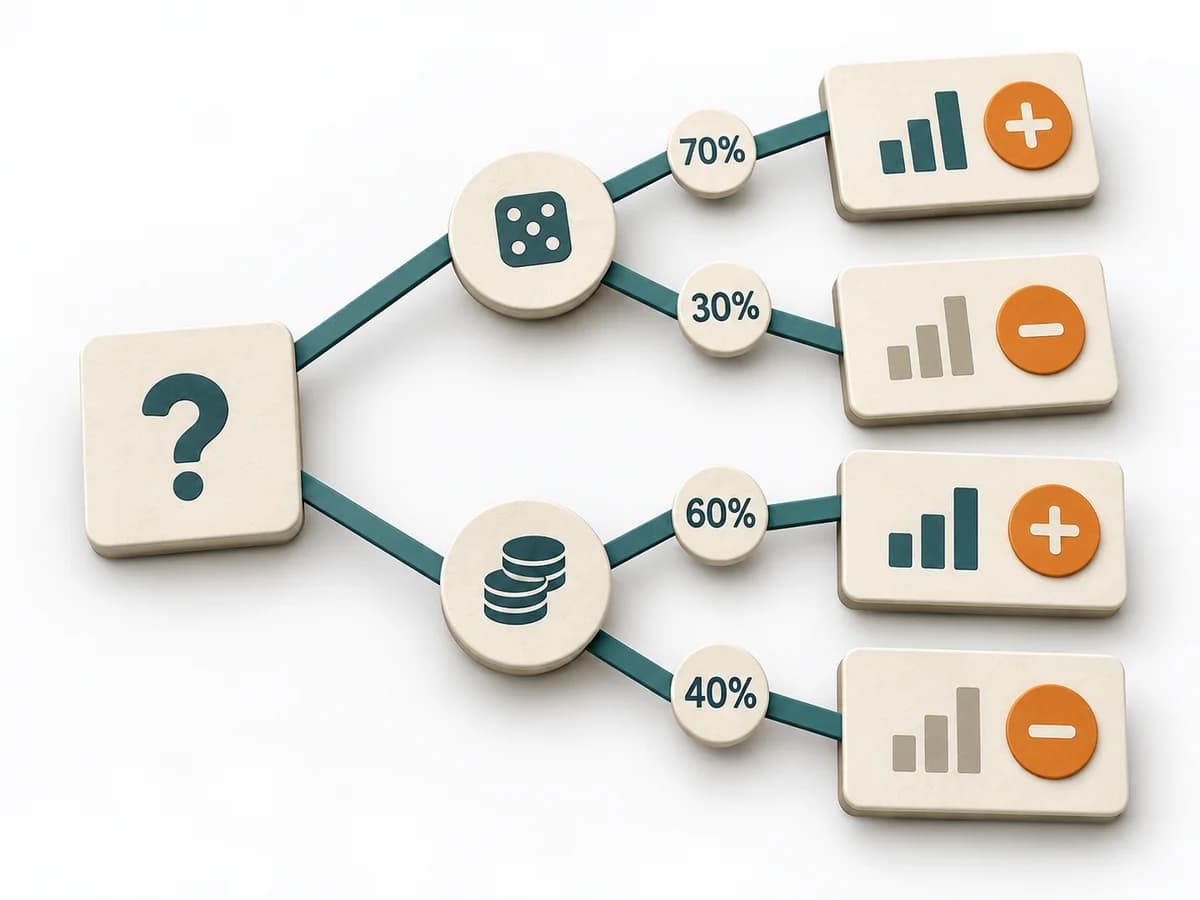 Decision Making Decision Tree |
|---|---|---|---|---|
Purposedifferent | GAP Analysis compares the current state with a target picture and makes the distance manageable. It becomes useful when, ahead of new initiatives, it must become clear which capabilities, processes, or resources are missing. | When a topic gets stuck too quickly in the same thinking mode, Six Thinking Hats deliberately separates the perspectives. This means facts, risks, creativity, and emotional signals get worked through one after another instead of mixed together. | When an initiative stalls, the limit often lies not in the idea but in hard or soft boundary conditions. Constraint Analysis separates these limits and shows which of them can actually be shaped. | For decisions with follow-on paths and dependencies, a linear comparison is often not enough. A Decision Tree shows how options branch under conditions and which consequences hang on each branch. |
Complexitydifferent | Medium | Medium | Low | Medium |
Timedifferent | 1-3 h | 45-90 min | 30-90 min | 30-90 min |
Participantsdifferent | 2-8 | 4-12 | 2-8 | 1-6 |
Formatdifferent | Workshop + async | Workshop | Workshop + async | Workshop + async |
Outputdifferent | Gap Matrix, Action Plan, Risk Notes | Perspective Notes, Decision Inputs, Action Items | Constraint List, Hard/Soft Classification, Option Impact Notes, Decision Boundaries | Decision Tree, Option Map, Assumption List |
Tagsno overlap | StrategyAnalysisPlanning | FacilitationOptionsDecision | ConstraintsDecisionPlanningOptions | DecisionTreeOptions |