View methods side by side.
Choose up to four methods. Add them using the search and share the comparison by copying its link.
| Criterion | 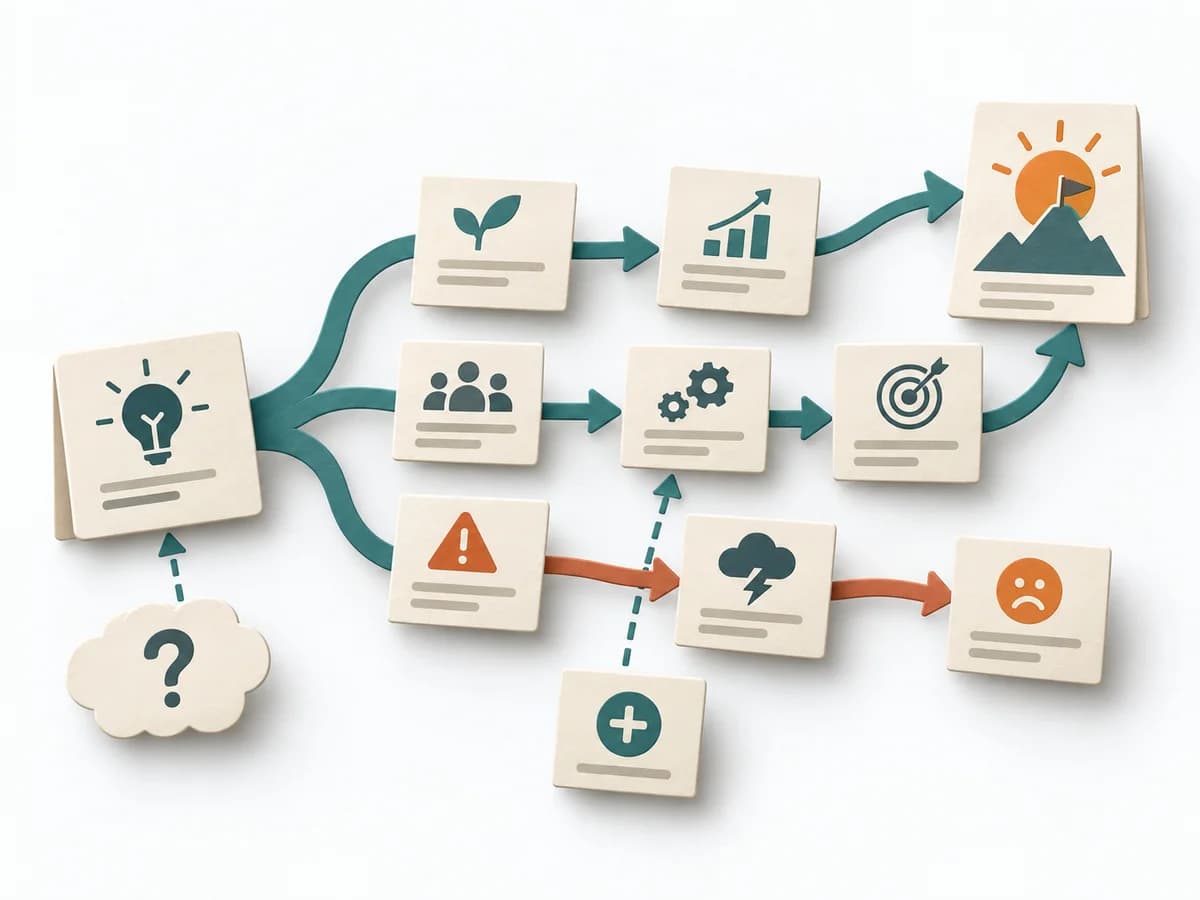 Systems Thinking Future Reality Tree |  Systems Thinking Leverage Points |  Innovation Brainstorming |  Innovation Lotus Blossom |
|---|---|---|---|---|
Purposedifferent | A Future Reality Tree shows how desired actions are meant to lead to a better system state. The method checks whether a path of change holds together logically before time flows into implementation. | Leverage Points show exactly where interventions in a system produce a disproportionate effect. It draws relationships, patterns, and feedback loops. The result is captured as a leverage map and action strategy. | When a team faces an open question with many obvious directions, the method first creates breadth instead of premature commitment. It separates idea flow from evaluation and makes lines of thought visible, creating a pool for selection and further development. | When a central question feels too large, the method breaks it into neighboring topic fields with their own depth of ideation. It holds structure and openness at the same time, so adjacent perspectives don't get lost. This grows an idea space out of a core problem. |
Complexitydifferent | High | High | Low | Low |
Timedifferent | 2-4 h | Half day | 30-60 min | 45-90 min |
Participantsdifferent | 3-8 | 3-12 | 4-12 | 3-10 |
Formatsame | Workshop | Workshop | Workshop | Workshop |
Outputdifferent | Future Reality Tree, Negative Branches, Assumption List, Improved Injections | Leverage Map, Action Strategy | Idea pool, Theme clusters, Shortlist | Lotus Diagram, Idea Themes, Shortlist |
Tagsno overlap | Theory of ConstraintsSystems thinkingChange | Systems thinkingChangeStrategy | BrainstormingIdeationCreativityWorkshopDivergence | BrainstormingIdeationCreativityDivergenceWorkshop |