View methods side by side.
Choose up to four methods. Add them using the search and share the comparison by copying its link.
Selected:Fault IsolationDesign SprintOutcome-Driven InnovationARID (Active Reviews for Intermediate Designs)
| Criterion | 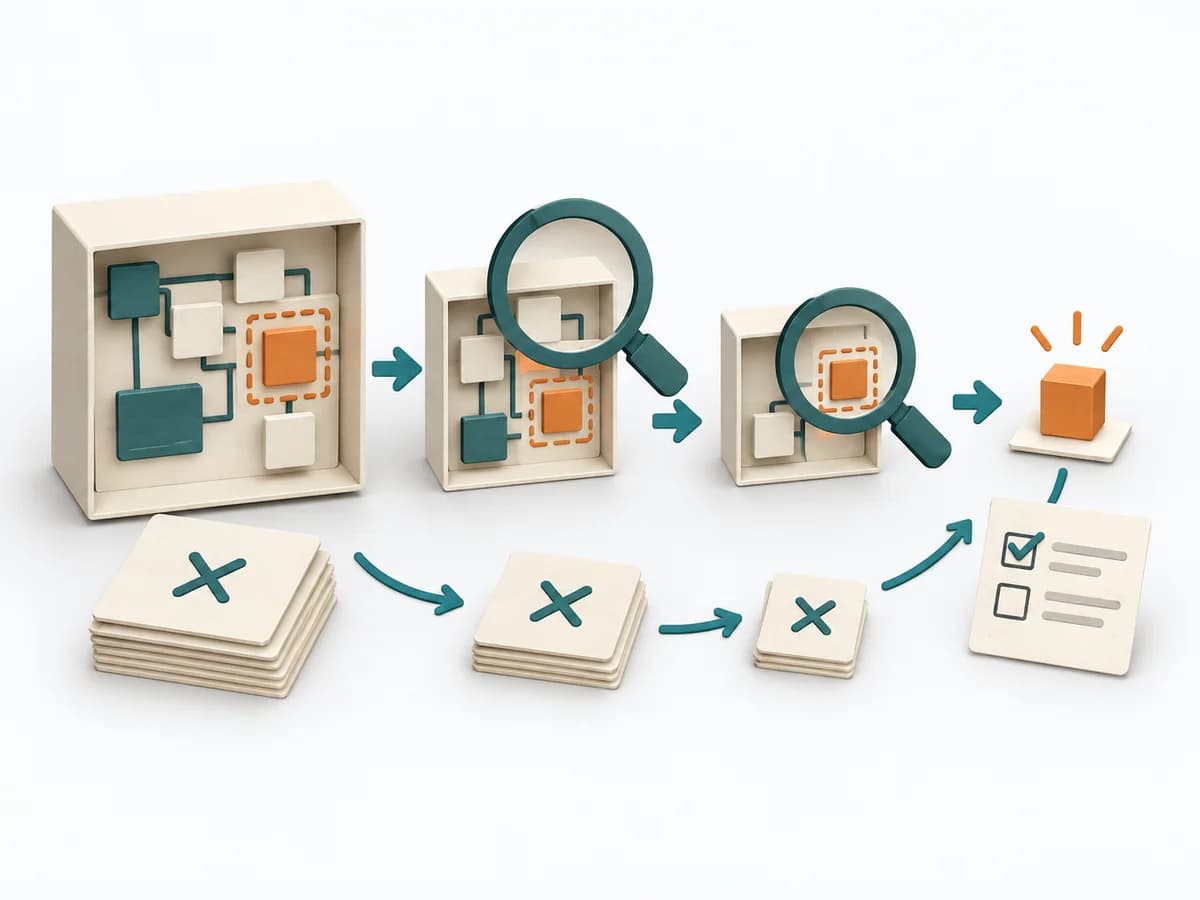 Engineering Fault Isolation |  Innovation Design Sprint |  Product Discovery Outcome-Driven Innovation |  Architecture ARID (Active Reviews for Intermediate Designs) |
|---|---|---|---|---|
Purposedifferent | In technical failures, the visible symptom often gets mixed up with the actual cause. Fault Isolation narrows the fault space and progressively reduces which part of the system is truly affected. | When the product question is unclear and time pressure is high, the method takes a team from an open idea to a testable solution. It connects problem understanding, decision, and learning in one compact format, lowering the risk of spending a lot of energy on a mere guess. | Outcome-Driven Innovation clarifies customer problems, solution opportunities, and evidence. It separates jobs, desired outcomes, importance, satisfaction, and opportunity, and captures results as desired outcome statements, an opportunity landscape, and segments by underserved needs. | ARID examines how well developers can work with a technical design. It focuses on a part of the system that can still be revised, between the architecture overview and the detailed specification. |
Complexitydifferent | Medium | High | High | Medium |
Timedifferent | 30-180 min | 4-5 Tage | Mehrere Wochen | 2–4 h review as a planning range; preparation and evaluation additional |
Participantsdifferent | 1-6 | 5-8 | 2-6 researchers plus sample | Designers, developers as users, and facilitation |
Formatdifferent | Workshop + async | Workshop | Workshop + async | Workshop + async |
Outputdifferent | Fault Isolation Map, Test Log, Excluded Hypotheses, Narrowed Fault Area | Prototype, Test Findings, Decision Rationale | Desired outcome statements, Opportunity landscape, Segmentation by underserved needs, Innovation hypotheses | Prioritized development tasks, Jointly produced code or pseudocode, Observed difficulties and open design questions, Proposed design revisions |
Tagsno overlap | TroubleshootingDiagnosisEngineering | Design sprintPrototypeValidationInnovation | OutcomesInnovationResearchQuantitative | ArchitectureEngineeringFeedbackValidationTasks |