View methods side by side.
Choose up to four methods. Add them using the search and share the comparison by copying its link.
| Criterion | 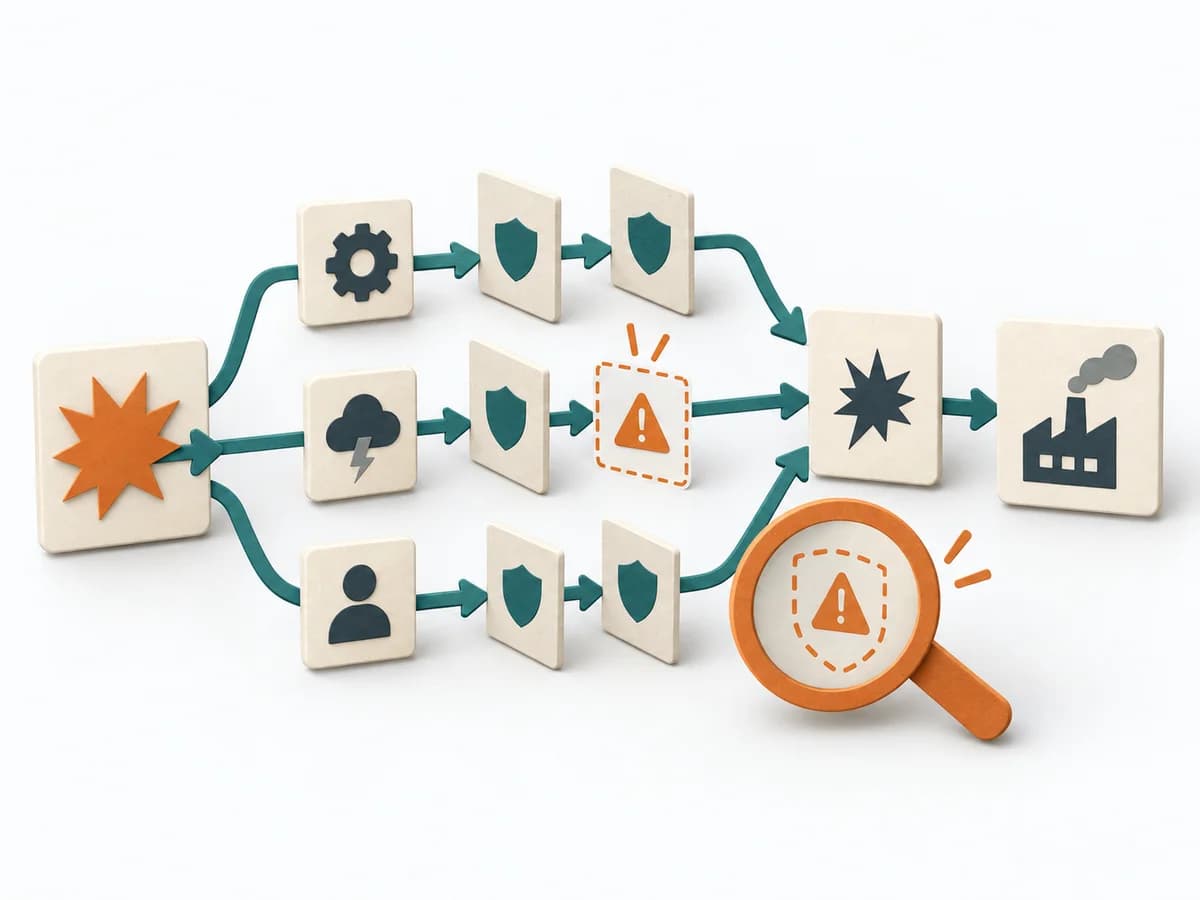 Engineering Failure Scenario Analysis |  Decision Making Pre-Mortem |  Operations Root Cause Analysis |  Operations Kepner-Tregoe |
|---|---|---|---|---|
Purposedifferent | In critical processes, it is not enough to plan only for the normal case. Failure Scenario Analysis looks at the path into failure and shows which failures, chains, and control gaps cause the most damage. | In early initiatives with many uncertainties, planning quickly turns too optimistic. A pre-mortem makes the expected failure visible in advance and sharpens the view of causes, gaps, and countermeasures. | When a problem keeps recurring and the cause stays unclear, the method exposes the underlying mechanism. It separates symptom, guess, and robust explanation from one another. | For a disturbance that's hard to pin down, the method cleanly separates problem, cause, and decision. It reduces mixing when symptoms allow several interpretations. |
Complexitydifferent | Medium | Low | Medium | High |
Timedifferent | 1-3 h | 20–45 min | 1-4 h | 2-8 h |
Participantsdifferent | 3-8 | Small cross-functional group | 3-8 | 2-8 |
Formatdifferent | Workshop | Workshop | Workshop + async | Workshop + async |
Outputdifferent | Failure Scenarios, Risk Notes, Control Gaps, Test and Response Actions | Risk list, Mitigation plan, Assumption log | Problem Statement, Cause Hypotheses, Confirmed Causes, Action Plan | Problem Analysis, Decision Analysis, Risk Plan |
Tagsno overlap | FailureResilienceRisk | RiskDecisionFailurePlanning | Root causeProblem solvingQualityIncident | Problem solvingRoot causeDecisionOperations |