View methods side by side.
Choose up to four methods. Add them using the search and share the comparison by copying its link.
| Criterion |  Engineering Failure Scenario Analysis | 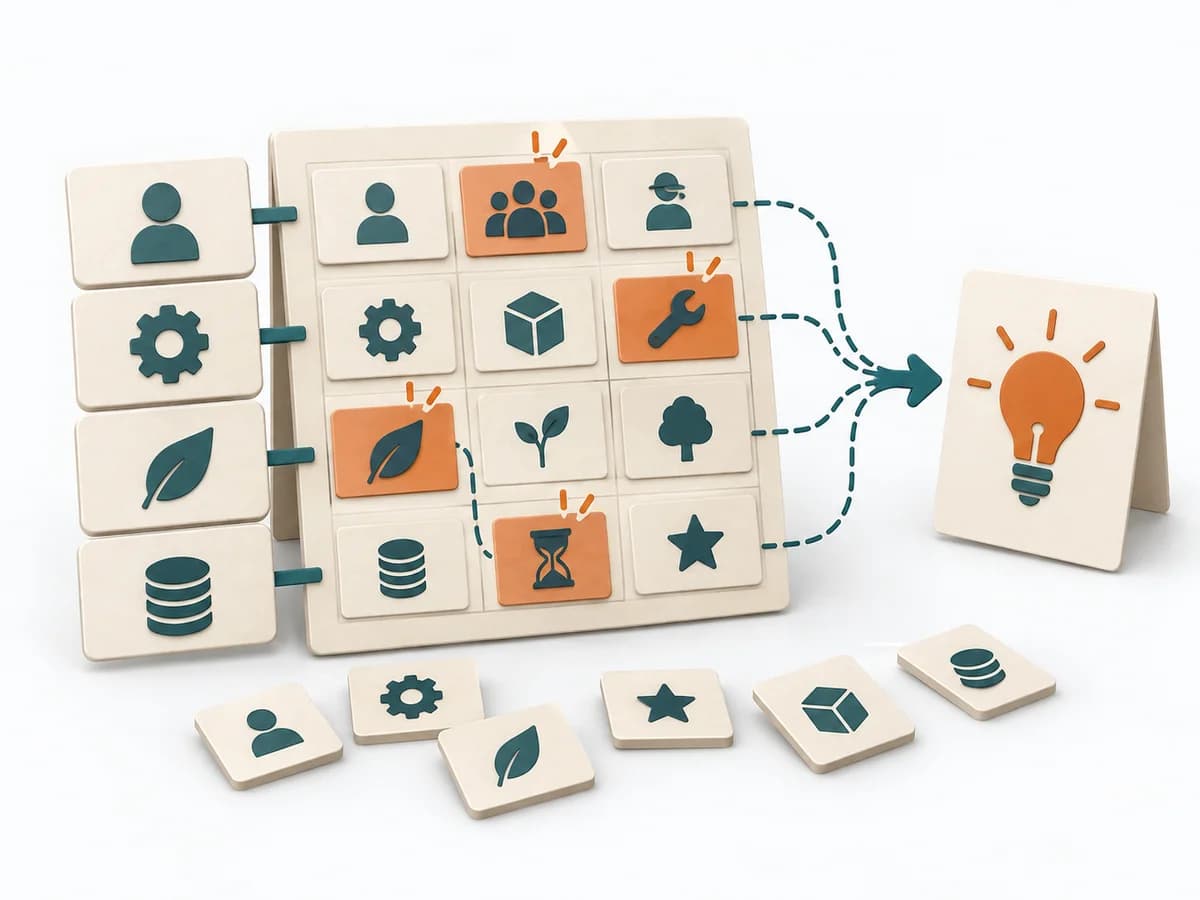 Innovation Morphological Analysis |  Innovation Rolestorming |  Innovation Reverse Brainstorming |
|---|---|---|---|---|
Purposedifferent | In critical processes, it is not enough to plan only for the normal case. Failure Scenario Analysis looks at the path into failure and shows which failures, chains, and control gaps cause the most damage. | For a search for solutions with many degrees of freedom, a grid emerges for systematic combinations. The method separates features, variants, and exclusion criteria, so the space gets explored deliberately. | When a search for ideas stalls, switching roles helps people step outside their own perspective and activate new logics of action. The method reduces habit because contributions arise from a different stance. This brings unfamiliar, often fitting solution approaches into play. | For persistent errors or blockages, the method shifts the view to the opposite of the desired effect. It exposes the mechanics of failure and makes hidden causes easier to grasp. This makes improvement more concrete and the problem clearer. |
Complexitydifferent | Medium | Medium | Low | Low |
Timedifferent | 1-3 h | 1-3 h | 30-60 min | 30-60 min |
Participantsdifferent | 3-8 | 2-8 | 3-12 | 3-12 |
Formatdifferent | Workshop | Workshop + async | Workshop | Workshop |
Outputdifferent | Failure Scenarios, Risk Notes, Control Gaps, Test and Response Actions | Morphological Box, Concept Combinations, Idea Shortlist | Rollenkarten, Ideenpool pro Rolle, Konsolidierte Shortlist | Reverse Ideas, Risk Themes, Solution Ideas |
Tagsno overlap | FailureResilienceRisk | IdeationInnovationCreativity | BrainstormingIdeationCreativity | BrainstormingIdeationCreativityRisk |