View methods side by side.
Choose up to four methods. Add them using the search and share the comparison by copying its link.
| Criterion |  Facilitation Expectation Mapping |  Facilitation Stakeholder Salience Model |  Operations Root Cause Analysis | 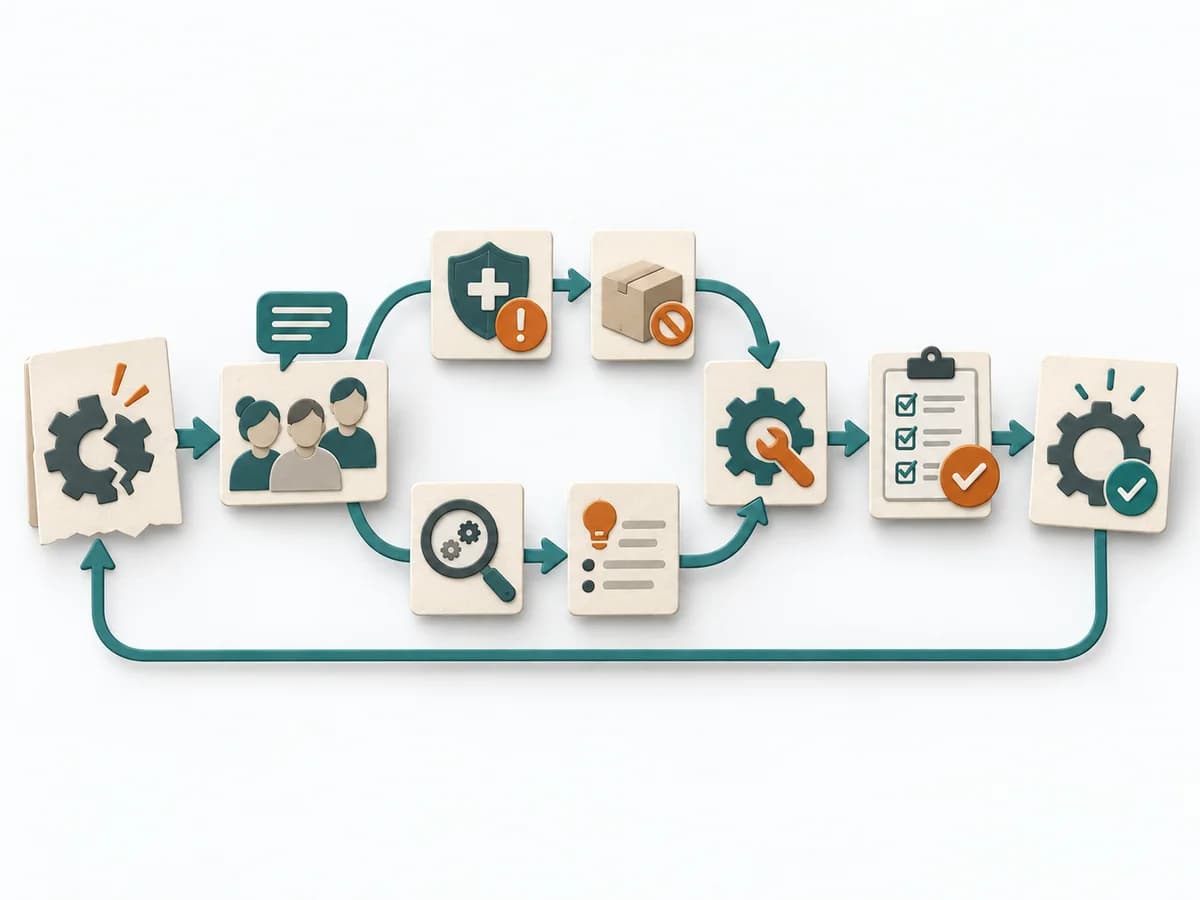 Operations 8D Problem Solving |
|---|---|---|---|---|
Purposedifferent | When roles, interfaces, or projects fail because of differing expectations, Expectation Mapping surfaces these differences. It shows what each side takes for granted and where the pictures diverge. | When stakeholders appear to matter very differently, the Stakeholder Salience Model rates their actual priority through power, legitimacy, and urgency. It turns individual contributions into a visible selection. The result is captured as a Salience diagram and a class-based strategy. | When a problem keeps recurring and the cause stays unclear, the method exposes the underlying mechanism. It separates symptom, guess, and robust explanation from one another. | For an acute quality or delivery problem, the method structures immediate protection and root cause work together. It keeps the situation stable while the actual cause is investigated cleanly. |
Complexitydifferent | Low | Medium | Medium | High |
Timedifferent | 45-90 min | 60-90 min | 1-4 h | 1-6 Wochen |
Participantsdifferent | 3-12 | 3-6 | 3-8 | 4-10 |
Formatdifferent | Workshop | Workshop | Workshop + async | Workshop + async |
Outputdifferent | Expectation Map, Alignment Notes, Agreements | Salience Diagram, Strategy per Class | Problem Statement, Cause Hypotheses, Confirmed Causes, Action Plan | 8D Report, Containment Plan, Root Cause Evidence, Corrective Action Plan |
Tagsno overlap | AlignmentStakeholdersTeam | StakeholdersFacilitationAlignmentGovernance | Root causeProblem solvingQualityIncident | QualityProblem solvingRoot cause |