View methods side by side.
Choose up to four methods. Add them using the search and share the comparison by copying its link.
| Criterion |  Facilitation Dot Estimation |  Decision Making Constraint Analysis |  Product Strategy DIBB | 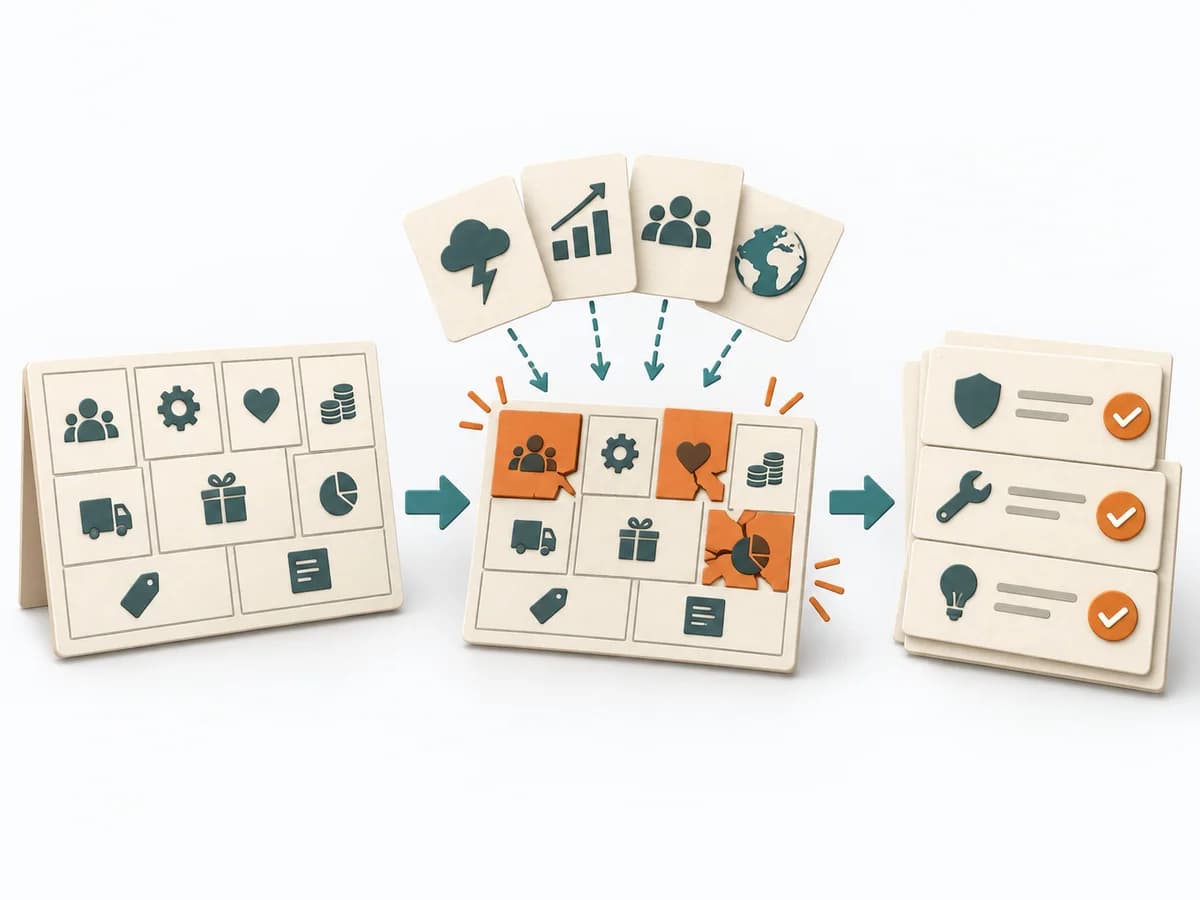 Business Strategy Business Model Stress Test |
|---|---|---|---|---|
Purposedifferent | When size or effort can only be estimated roughly, Dot Estimation condenses the group's experience into a quick range. It turns individual contributions into a visible selection. The result is captured as an Effort Heatmap, Risk Signals, and Discussion Targets. | When an initiative stalls, the limit often lies not in the idea but in hard or soft boundary conditions. Constraint Analysis separates these limits and shows which of them can actually be shaped. | DIBB helps clarify target groups, value, goals, and priorities by making the logic behind a decision explicit. It captures results as a DIBB document, belief list, bet list, and learning report. | A Business Model Stress Test checks how well a business model holds up under pressure and headwinds. It compares strengths, risks, market logic, and courses of action. The result is captured as a stress-test report and action plan per scenario. |
Complexitydifferent | Low | Low | Low | High |
Timedifferent | 5-20 min | 30-90 min | 1-2 h | Half day |
Participantsdifferent | 3-20 | 2-8 | 2-8 | 3-8 |
Formatdifferent | Workshop | Workshop + async | Workshop + async | Workshop |
Outputdifferent | Effort Heatmap, Risk Signals, Discussion Targets | Constraint List, Hard/Soft Classification, Option Impact Notes, Decision Boundaries | DIBB document, Belief list, Bet list, Learning report | Stress Test Report, Action Plan per Scenario |
Tagsno overlap | EstimationEffortRisk | ConstraintsDecisionPlanningOptions | StrategyDecisionAssumptionsHypothesis | StrategyBusiness modelRiskDiagnosis |