View methods side by side.
Choose up to four methods. Add them using the search and share the comparison by copying its link.
| Criterion |  Knowledge Modeling Domain Storytelling | 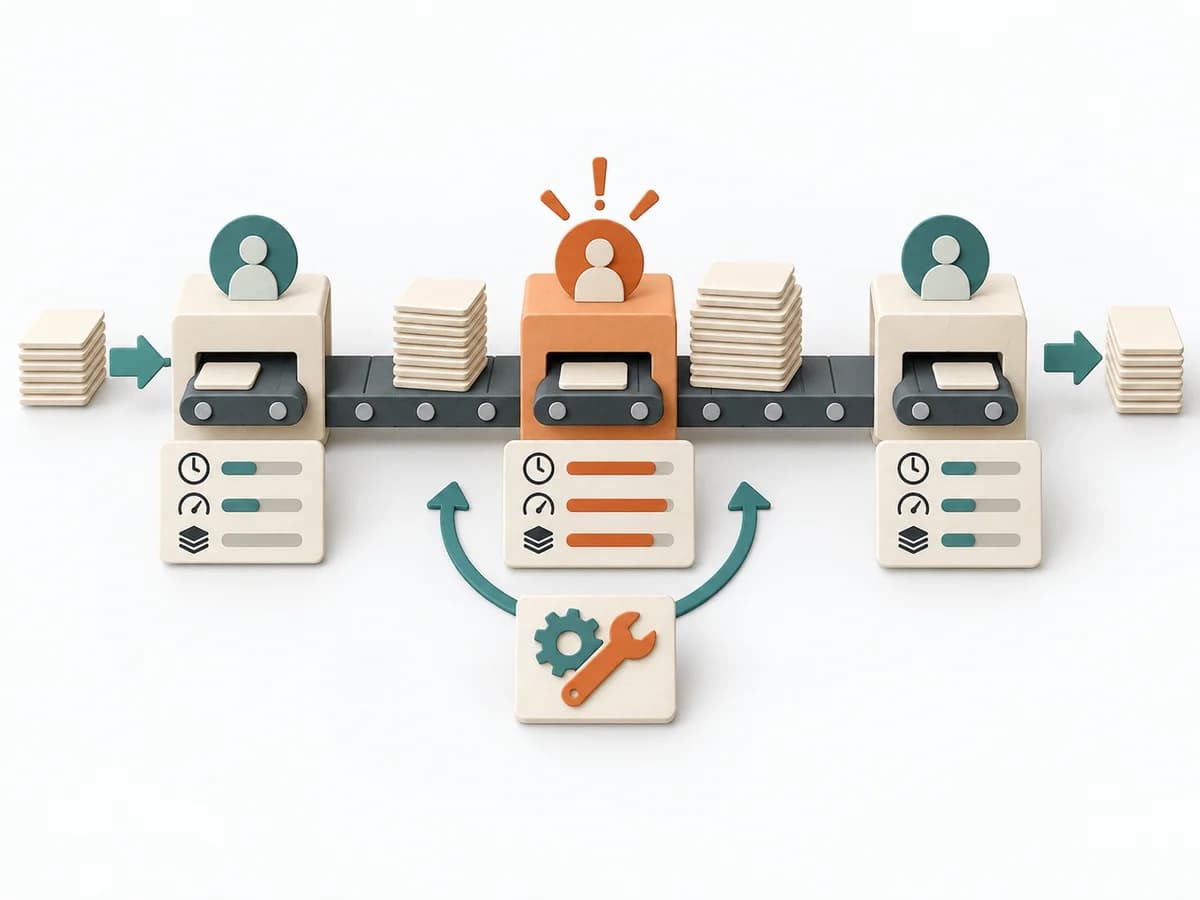 Operations Bottleneck Analysis |  Knowledge Modeling Knowledge Mapping |  Product Discovery Assumption Mapping |
|---|---|---|---|---|
Purposedifferent | Domain Storytelling translates domain knowledge into a shared narrative of actors, objects, and workflows. It is especially useful when language, rules, and process understanding must be tightly connected. | For a flow that backs up at one point, the method looks for the capacity limit with the greatest leverage. It explains why extra effort elsewhere barely improves throughput. | Knowledge Mapping makes knowledge, gaps, and transfer paths visible across a field. It fits when expertise should not just exist but also be findable and transferable. | When assumptions still sit unordered in the room, it weighs uncertainty against leverage. It makes visible which hypotheses should be checked first. |
Complexitydifferent | Low | Medium | Medium | Medium |
Timedifferent | 1-2 h | 1-3 h | 1-3 h | 45-60 min |
Participantsdifferent | 2-8 | 3-8 | 3-12 | 2-8 |
Formatdifferent | Workshop | Workshop + async | Workshop | Workshop + async |
Outputdifferent | Domain Story, Glossary Notes, Process Narrative | Bottleneck Map, Flow Metrics, Improvement Options, Follow-up Measures | Knowledge Map, Critical Knowledge Areas, Transfer Plan | Assumption map, Test backlog, Risk ranking |
Tagsno overlap | KnowledgeDomain-Driven DesignProcess | FlowMeasurementConstraints | KnowledgeMappingRisk | AssumptionsRiskExperimentsValidation |