View methods side by side.
Choose up to four methods. Add them using the search and share the comparison by copying its link.
| Criterion |  Product Strategy DIBB | 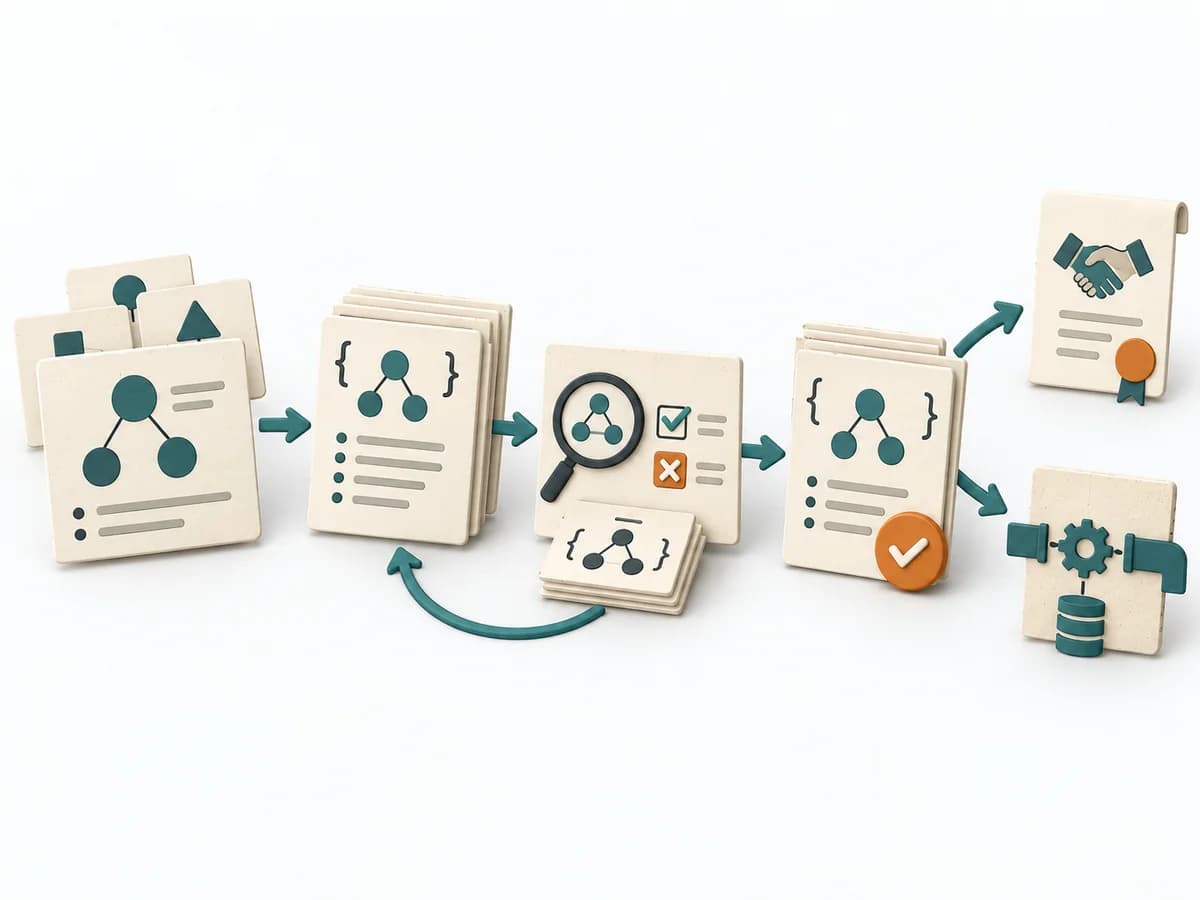 Knowledge Modeling Shape-First Modeling |  Decision Making Assumption Surfacing |  Product Discovery Test Card |
|---|---|---|---|---|
Purposedifferent | DIBB helps clarify target groups, value, goals, and priorities by making the logic behind a decision explicit. It captures results as a DIBB document, belief list, bet list, and learning report. | Shape-First Modeling defines data quality through shapes before implementation or integration frays at the edges. The approach fits when validation and data contracts should be part of the design from the start. | Plans often contain assumptions that were never openly stated and remain dangerous precisely because of that. Assumption Surfacing makes these silent premises visible and prioritizes which of them carry the initiative or could sink it. | The Test Card turns a critical assumption into a testable claim and specifies in advance which result counts as success. |
Complexitydifferent | Low | Medium | Low | Low |
Timedifferent | 1-2 h | Halber Tag pro Domain Slice | 45-90 min | 20-35 min |
Participantsdifferent | 2-8 | 1-4 | 2-8 | 1-5 |
Formatsame | Workshop + async | Workshop + async | Workshop + async | Workshop + async |
Outputdifferent | DIBB document, Belief list, Bet list, Learning report | SHACL or ShEx Shapes, Validation Reports, Data Contracts, Shape Documentation | Assumption List, Critical Assumptions, Learning Plan | Test Card with a pre-set threshold |
Tagsno overlap | StrategyDecisionAssumptionsHypothesis | Knowledge graphValidationSemantic | AssumptionsRiskDecisionDiscovery | ExperimentsValidationDiscoveryHypothesis |