View methods side by side.
Choose up to four methods. Add them using the search and share the comparison by copying its link.
| Criterion |  UX Research Diary Study | 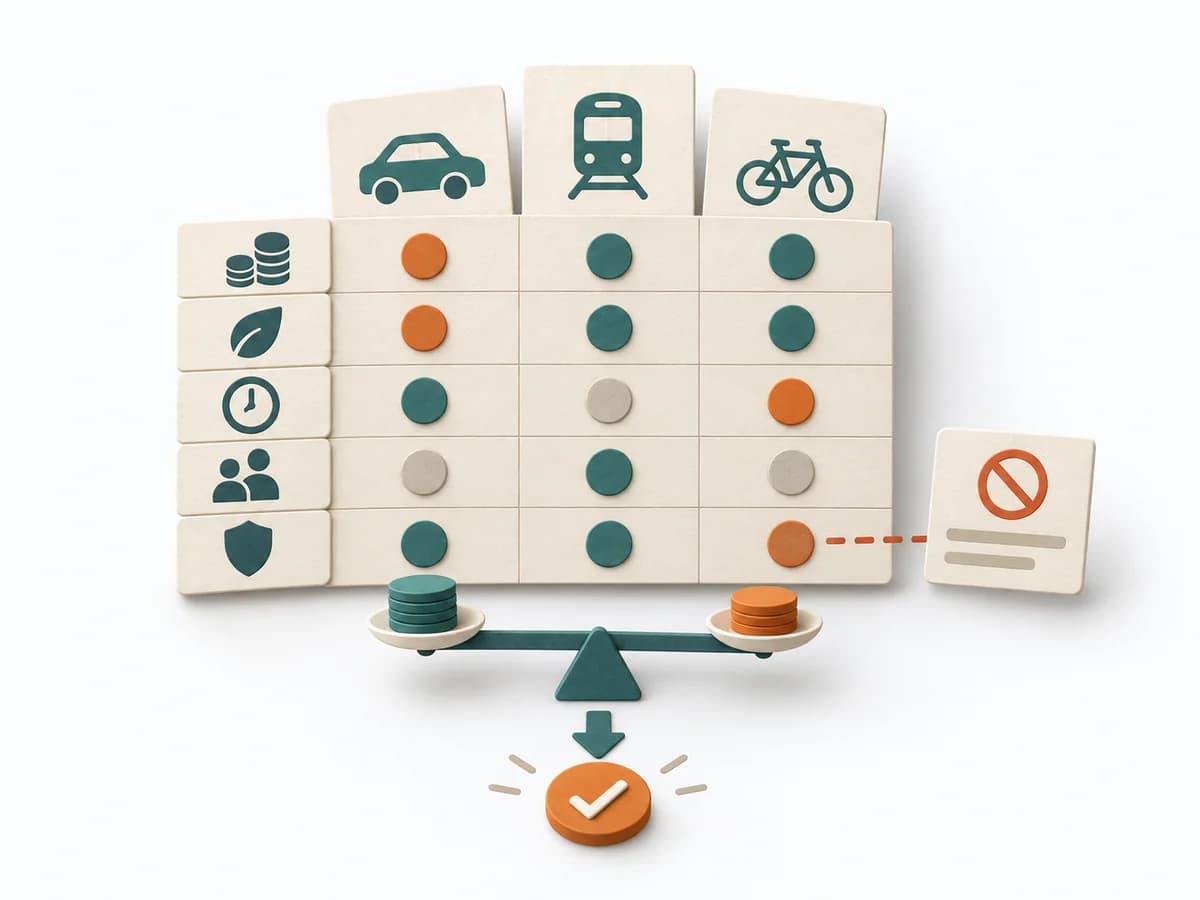 Decision Making Trade-off Analysis |  Decision Making Decision Tree |  Facilitation Six Thinking Hats |
|---|---|---|---|---|
Purposedifferent | When experiences build up over days or weeks and a single session cannot capture them, Diary Study records the course of everyday life. Recurring triggers, moods, and habits become visible this way, beyond the sharpness of memory. | With limited resources, quality, speed, cost, and risk almost always compete with each other. Trade-off Analysis makes these tensions explicit and prevents decisions from producing hidden side effects. | For decisions with follow-on paths and dependencies, a linear comparison is often not enough. A Decision Tree shows how options branch under conditions and which consequences hang on each branch. | When a topic gets stuck too quickly in the same thinking mode, Six Thinking Hats deliberately separates the perspectives. This means facts, risks, creativity, and emotional signals get worked through one after another instead of mixed together. |
Complexitysame | Medium | Medium | Medium | Medium |
Timedifferent | 1-4 Wochen | 45-120 min | 30-90 min | 45-90 min |
Participantsdifferent | 5-20 | 2-8 | 1-6 | 4-12 |
Formatdifferent | Async | Workshop + async | Workshop + async | Workshop |
Outputdifferent | Diary Entries, Longitudinal Patterns, Experience Timeline | Trade-off Matrix, Criteria List, Decision Rationale, Accepted Downsides | Decision Tree, Option Map, Assumption List | Perspective Notes, Decision Inputs, Action Items |
Tagsno overlap | UX researchTrackingBehavior | TradeoffsDecisionCriteriaOptions | DecisionTreeOptions | FacilitationOptionsDecision |